
The Saudi US AI partnership has emerged as a central focus in Riyadh’s strategic approach to its relations with Washington. According to Gulf analyst Gregory Gause, while recent talks between Saudi Arabia and the United States have largely emphasized financial and commercial deals, the kingdom views collaboration on artificial intelligence as the most reliable pathway to securing long-term US protection.
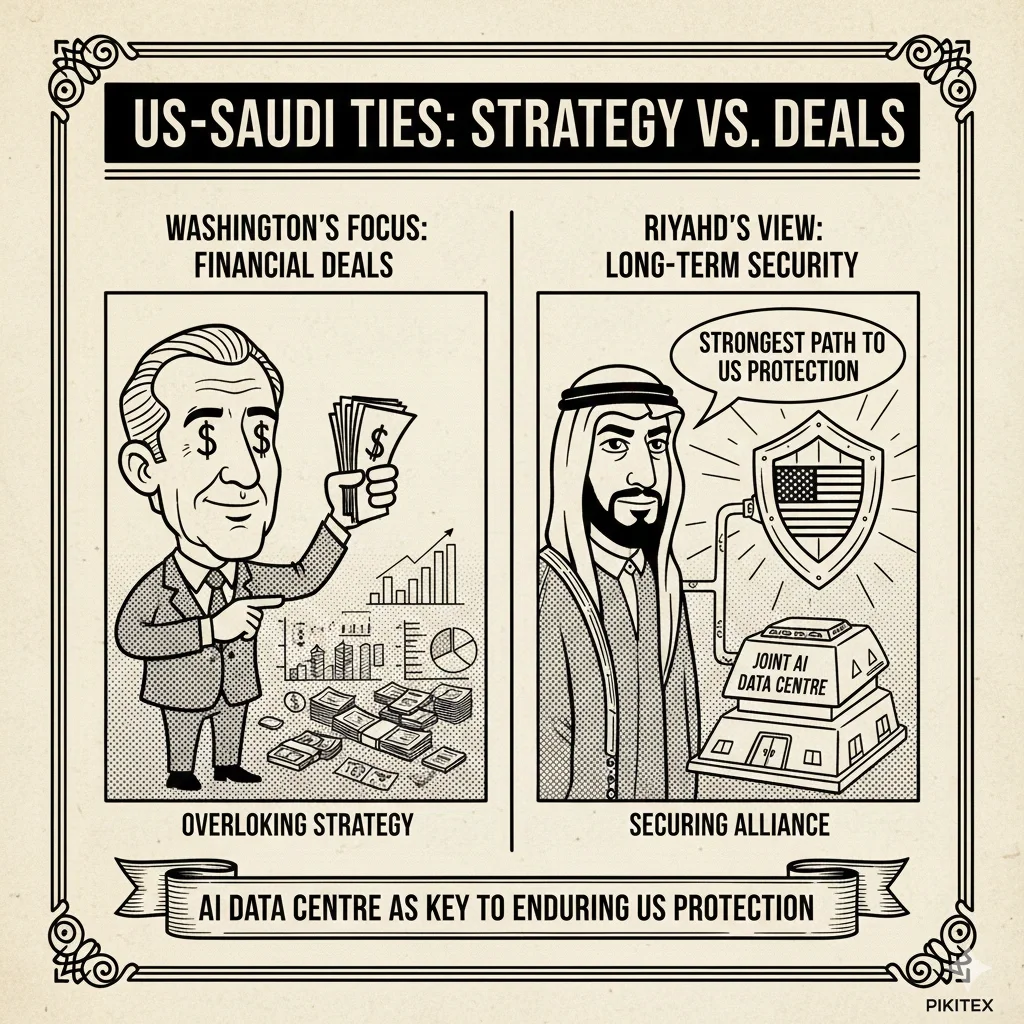
Gause, a political scientist and professor emeritus at Texas A&M University, criticized the US approach under President Donald Trump as treating Saudi Arabia like a “piggy bank”, prioritizing immediate financial agreements over broader strategic concerns. He notes that key regional issues—including conflicts in Sudan, Palestine, Iran, and Syria—are often overshadowed in these discussions.
AI Collaboration as a Security Lever
Saudi Arabia is pursuing a joint AI data centre with the United States, a move Gause describes as a strategic safeguard for future American security commitments. The centre would enable Saudi Arabia to leverage cutting-edge AI technology for defense, cybersecurity, and intelligence purposes, reinforcing the kingdom’s regional security posture.
While China remains Saudi Arabia’s largest oil buyer, the kingdom continues to see the US as its preferred strategic partner, particularly in areas of defense, advanced technology, economic collaboration, and regional security coordination. This underscores the growing importance of Saudi US AI partnership as a bridge for broader strategic alignment between the two nations.
Commercial Deals vs. Strategic Priorities
Recent negotiations have largely focused on commercial agreements, including arms sales, energy investments, and infrastructure projects. Gause argues that these deals, while financially beneficial, fail to address long-term strategic challenges in the Middle East. By prioritizing a joint AI initiative, Saudi Arabia aims to secure technology and security guarantees that extend beyond immediate economic interests.
The AI partnership represents a forward-looking approach, enabling both nations to share expertise in artificial intelligence, data analytics, and cybersecurity while simultaneously reinforcing defense collaboration. For Washington, this presents an opportunity to maintain influence in the Gulf region, even as Riyadh explores diversified international partnerships, including its growing engagement with China.
Broader Implications for US–Saudi Relations
The emphasis on AI and technology highlights a shift in Saudi Arabia’s foreign policy strategy. By tying security guarantees to advanced technological collaboration, Riyadh signals that modern defense capabilities and innovation are increasingly central to its security calculus.
Gause notes that the AI initiative also strengthens economic and defense linkages, creating high-value opportunities for US companies and enhancing bilateral cooperation across multiple sectors. The Saudi US AI partnership could thus become a cornerstone of future relations, balancing commercial interests with deeper strategic objectives.
Looking Ahead
As discussions continue, the Saudi US AI partnership is expected to gain further attention, both within governmental circles and the private sector. Analysts suggest that successful collaboration on AI could redefine regional security dynamics, providing the kingdom with robust technology-based defenses while reinforcing US influence in the Gulf.
By prioritizing AI alongside traditional defense agreements, Saudi Arabia demonstrates a forward-thinking approach to international partnerships, ensuring that security, technology, and economic growth are integrated into a single strategic vision.