
Summary
Russia’s war-fueled industrial boom is losing momentum as new data reveal declines in key defense-linked sectors, raising concerns about an economic slowdown amid tightening budgets and Western sanctions.
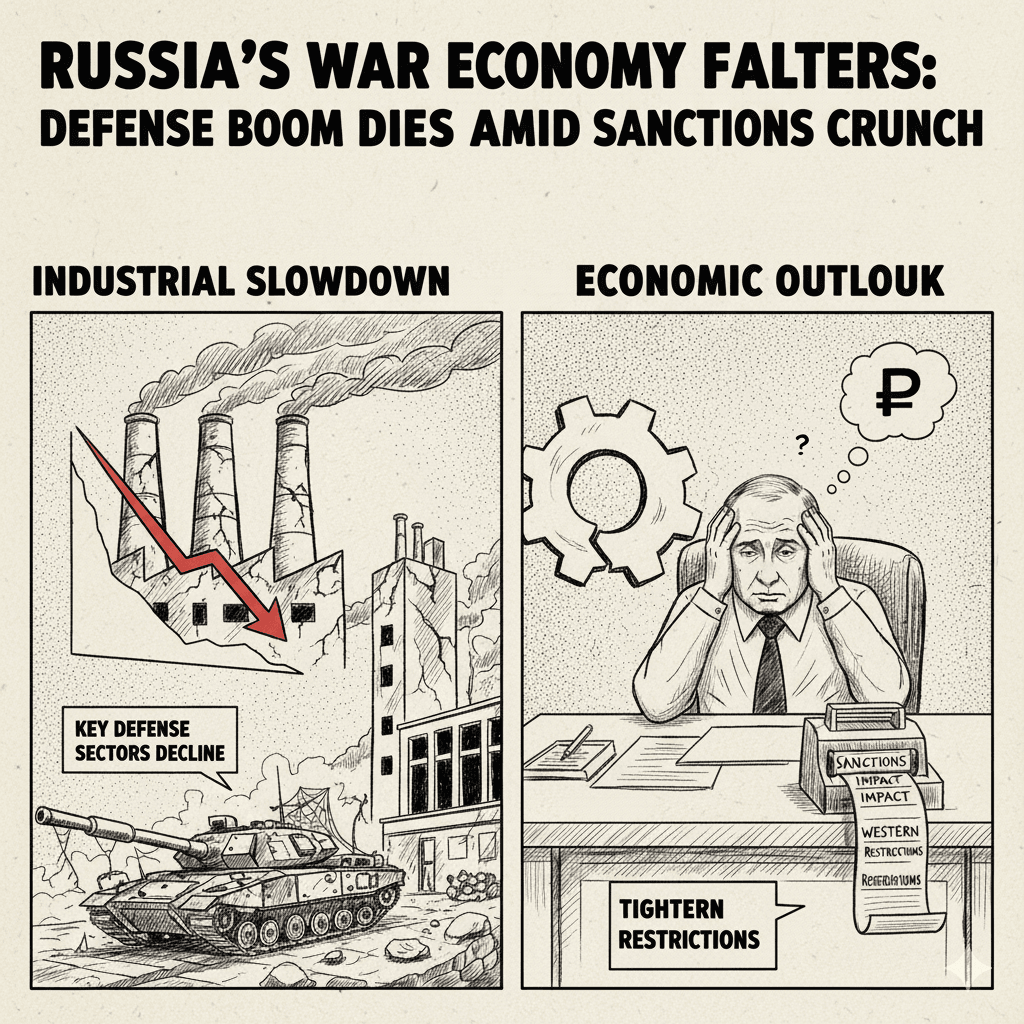
Moscow, October 25 — Russia’s defense-industrial complex, the main engine of its wartime economy, has begun to stall after nearly three years of double-digit expansion, according to the latest figures from Rosstat.
Industries tied to the military sector—long buoyed by massive state contracts—recorded stagnation or outright decline in September for the first time since Russia’s full-scale invasion of Ukraine.
Production of fabricated metal products dropped 1.6% year-on-year after surging 31.6% in 2024, while output of other transport equipment, including tanks and armored vehicles, slowed sharply to 6% from 61.2% a month earlier. Month-to-month, metal production fell 6% and military vehicle output plunged 20%, according to Raiffeisenbank.
Analysts from MMI described the data as “shocking,” noting that defense manufacturing—previously driving growth—has now dragged the broader industrial index lower. Overall manufacturing rose just 0.4% in September, eight times slower than in August, marking its weakest performance since early 2023.
Economists link the downturn to shrinking fiscal space. Machine-building output, heavily reliant on defense orders, fell 0.1% after a 15.7% surge in August. Alfa Bank’s chief economist Natalia Orlova warned that fiscal tightening could further weigh on industry in coming months.
With oil and gas revenues down 21% and a budget deficit five times higher than projected, the Finance Ministry is expected to cut spending in the final quarter, risking a broader economic “cooldown.”
The Russian Academy of Sciences reported that 18 of 24 manufacturing subsectors are now in recession. GDP shrank 0.6% between January and August, while new U.S. sanctions on Rosneft and Lukoil may further strain the economy.
“The risks of a hard landing for the Russian economy are increasing,” said Petr Matys of Touch Capital Markets.