
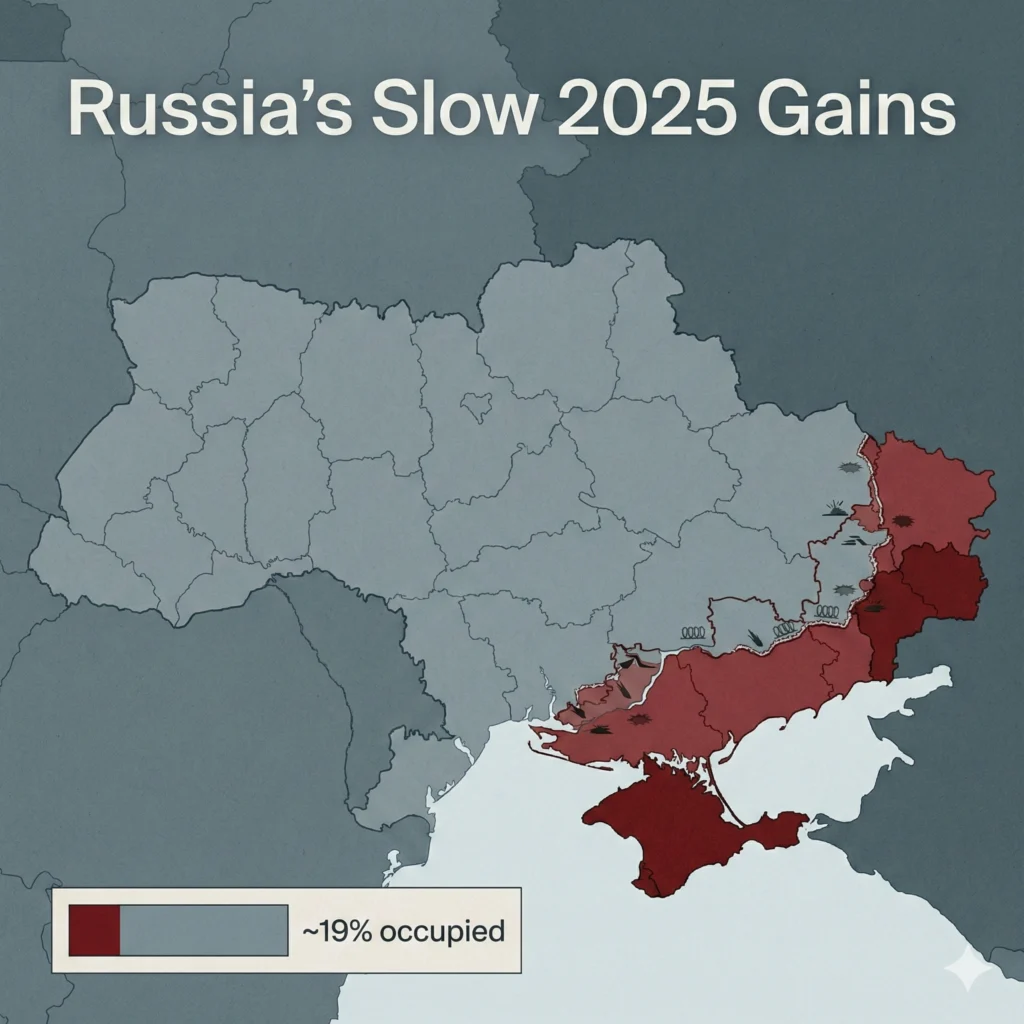
Russia Ukraine territorial gains in 2025 were limited, with Moscow seizing just over 4,300 square kilometers, equivalent to around 0.7% of the country, according to DeepState’s year-end assessment. Most territorial advances occurred in the heavily contested Donetsk region, while gains in other occupied areas were minimal. Moscow now controls roughly 19% of Ukraine overall, reinforcing its hold on Donetsk, Luhansk, and parts of Zaporizhzhia and Kherson. Analysts describe the situation as a slow, grinding campaign with neither side able to achieve rapid shifts on the frontlines.
The latest figures reflect a stark contrast to the early months of the full-scale invasion, when territorial changes were more dramatic. In 2025, Ukraine successfully blunted larger Russian offensives, but the country struggled to reclaim lost ground amid dwindling Western aid and sustained pressure across multiple fronts. This stalemate underlines a persistent, attritional war as 2026 begins, with both sides entrenched and limited signs of immediate breakthroughs.
Donetsk Sees Largest Russian Advances
The Donetsk region remains the focal point of Russia Ukraine territorial gains. Occupation of Donetsk has increased to approximately 78% of the oblast, making it the most heavily seized area in 2025. Military analysts note that Russia’s advances here reflect a targeted strategy to consolidate control over the industrially and strategically important eastern territories.
Meanwhile, Luhansk is now almost entirely under Moscow’s control, and the region serves as a crucial logistics hub for operations across the Donbas. These developments highlight how Russia Ukraine territorial gains are concentrated in the east, with Ukrainian forces facing severe challenges in mounting counteroffensives under continuous artillery and air pressure.
Limited Movement in Zaporizhzhia and Kherson
In Zaporizhzhia, Russian control edged up from around 73% at the end of 2024 to roughly 75% in 2025, showing only marginal territorial gains. Kherson remained largely static, with approximately 72% of the oblast under occupation, suggesting that intense fighting has not translated into significant shifts.
This slow pace indicates that the war has evolved into a war of attrition, with both sides fortifying positions and preparing for long-term engagements. Analysts emphasize that such minimal movement underscores the effectiveness of Ukraine’s defensive operations, even as it struggles with equipment shortages and the ongoing humanitarian crisis.
Overall Occupation and Stalemate
Across all regions, Russia Ukraine territorial gains now total just over 116,000 square kilometers of Ukrainian territory, about 19–19.25% of the country, a footprint accumulated since Crimea’s annexation in 2014 and the initial Donbas occupation. While gains in 2025 were modest, the data reveal a strategic focus on consolidating existing territories rather than pursuing rapid expansion.
Military experts describe the current situation as a stubborn stalemate, with entrenched positions, fortified lines, and little expectation of rapid territorial shifts in the near future. Ukraine continues to hold key urban centers and crucial supply routes, making any large-scale offensive both costly and risky for Moscow, further emphasizing the slow pace of Russia Ukraine territorial gains.
Implications for the Ukraine Conflict
The slowing of Russia Ukraine territorial gains signals broader challenges for Moscow, including logistical constraints, mounting international pressure, and the difficulty of sustaining a multi-front campaign. For Ukraine, these figures suggest that defensive operations are successfully preventing sweeping losses but that full-scale counteroffensives remain complicated by limited resources.
Analysts warn that the ongoing stalemate may prolong the war and increase civilian suffering, emphasizing the need for continued international support, strategic planning, and humanitarian assistance. The data from 2025 underline that the conflict is likely to remain a protracted struggle, with incremental changes rather than dramatic territorial shifts dominating the immediate future.
Final Thoughts
Russia’s modest territorial gains in 2025 highlight the protracted nature of the Ukraine conflict. While Moscow strengthened control over Donetsk, Luhansk, and parts of Zaporizhzhia and Kherson, overall progress was slow, reflecting Ukraine’s effective defensive measures and persistent stalemate.
As 2026 begins, the Russia Ukraine territorial gains narrative underscores the ongoing challenges for both sides. Analysts expect a continuation of attritional warfare, with incremental changes shaping the conflict rather than sudden breakthroughs. Monitoring these developments is crucial for understanding the strategic trajectory of the war and its broader geopolitical implications.
For more details & sources visit: TVP World
For more regional updates and industry insights, visit our Brazil News Page.