
The Port of Rotterdam has officially accelerated its Rotterdam Greening Strategy 2026 following a massive €160 million influx of specialized EU financing aimed at decarbonizing Europe’s largest maritime hub. As the primary gateway for energy and goods into the continent, Rotterdam is under intense pressure to transition from fossil fuel reliance to a sustainable, electrified economy. This new round of funding ensures that the port can remain competitive while meeting the stringent climate targets set by the European Green Deal and national Dutch mandates.
The implementation of the Rotterdam Greening Strategy 2026 focuses heavily on the integration of shore power and the expansion of zero-emission infrastructure across its massive industrial complexes. By providing ships with renewable electricity while docked, the port aims to drastically reduce nitrogen, CO2, and particulate emissions in the surrounding residential areas. This move is not just an environmental necessity but a core part of the port’s long-term business model to attract the next generation of eco-conscious shipping lines.
Financial Foundations of Rotterdam Greening Strategy 2026
The economic engine behind the Rotterdam Greening Strategy 2026 is fueled by a combination of a €90 million loan from the European Investment Bank and a €70 million EU grant. These funds are specifically earmarked for high-risk, high-reward innovations that individual companies might struggle to finance alone in a volatile market. By de-risking these green projects, the EU is ensuring that Rotterdam remains the premier testing ground for maritime sustainability technologies that will eventually be exported to other global ports.
Market analysts suggest that the Rotterdam Greening Strategy 2026 will serve as a blueprint for other global hubs looking to modernize their aging infrastructure. The funding allows for the construction of specialized connection points and the retrofitting of existing terminals to handle high-voltage shore power. This strategic investment is expected to create hundreds of high-tech jobs in the Netherlands while securing the port’s status as a central pillar of the European energy transition and maritime autonomy.
Rotterdam Greening Strategy 2026
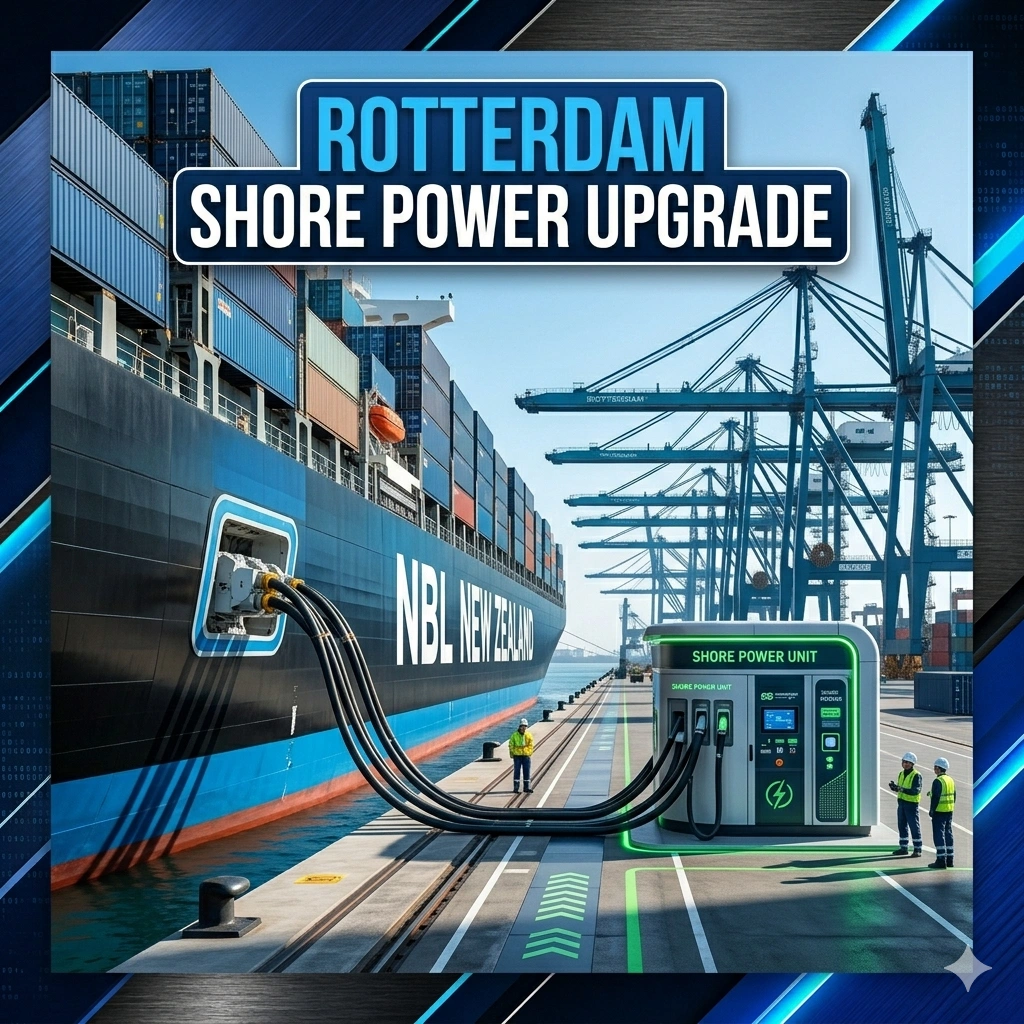
The core pillar of the Rotterdam Greening Strategy 2026 is the rapid development of a large-scale shore power ecosystem that covers eight kilometers of quay. This “Rotterdam Shore Power” project is a joint venture between the Port Authority and the energy firm Eneco, designed to replace diesel generators on massive container vessels. By positioning itself as the primary leader in shore-side electricity, Rotterdam is essentially future-proofing its operations against the inevitable global carbon taxes and environmental shipping regulations.
Under the Rotterdam Greening Strategy 2026, the port authority is also prioritizing the installation of 35 distinct connection points across three major deep-sea terminals. This massive logistical undertaking involves laying extensive cabling and building new grid infrastructure to support the high power demands of modern mega-ships. This holistic approach ensures that every aspect of the port’s operations—from docking to cargo handling—is aligned with the zero-emission goals of the 2050 climate-neutral roadmap.
Shore Power Expansion and Emission Reduction
A critical technical component of the Rotterdam Greening Strategy 2026 involves the massive rollout of shore power installations across all major container terminals. Currently, many large vessels keep their engines running while in port to power onboard systems, leading to significant local noise and air pollution. The new EU-financed project will allow even the largest container ships to “plug in” to the Dutch national grid, which is increasingly powered by massive offshore wind farms in the North Sea.
- Significant reduction in local particulate matter and nitrogen oxide levels for nearby residents.
- Incentives for shipping companies that invest in dual-fuel or fully electric vessels.
- Enhanced cooperation between the port and the City of Rotterdam on urban air quality.
- Integration of smart grid technology to manage the peak electricity demand of docked ships.
Rotterdam Greening Strategy 2026
The successful execution of the Rotterdam Greening Strategy 2026 requires a sophisticated digital management system to optimize energy flows in real-time between the grid and the ships. By using advanced algorithms, the port can predict when renewable energy production will be at its peak and adjust the charging schedules of docked vessels accordingly. This digital layer is what makes the Rotterdam Greening Strategy 2026 the most advanced maritime decarbonization plan in the world today.
Furthermore, the Rotterdam Greening Strategy 2026 emphasizes the importance of public health by eliminating the low-frequency noise and vibrations caused by idling ship engines. This improvement in the “port-city relationship” is vital for maintaining local support for the port’s continued physical expansion. These health-based solutions prove that industrial growth and community well-being are not mutually exclusive, provided there is sufficient strategic planning and financial backing from international partners like the EIB.
Global Competitiveness and the Energy Transition
The Rotterdam Greening Strategy 2026 is a defensive move against emerging green ports in Asia and the Middle East that are also vying for the title of the world’s cleanest shipping hub. If Rotterdam fails to provide the infrastructure for zero-emission operations, it risks losing its dominant market share to more agile competitors in the Mediterranean. The EU financing acts as a catalyst, allowing the port to move significantly faster than standard market forces would typically permit for such large projects.
- Strengthening the “Green Shipping Corridors” between Rotterdam and major global ports.
- Standardizing electrical connection procedures for various classes of container vessels.
- Developing new safety protocols for the handling of high-voltage maritime power cables.
Impact on the Dutch National Economy
The benefits of the Rotterdam Greening Strategy 2026 extend far beyond the quayside, providing a significant boost to the Dutch GDP through innovation and construction. As the port transitions toward green energy, it attracts new engineering firms that require expertise in clean power and sustainable maritime logistics. This “cluster effect” is a major part of the Rotterdam Greening Strategy 2026, ensuring that the Netherlands remains at the forefront of the global maritime tech industry.
The implementation of the Rotterdam Greening Strategy 2026 also reinforces Europe’s energy autonomy by reducing the maritime sector’s reliance on imported fossil fuels. By utilizing domestic wind and solar power to fuel international trade, the port reduces its vulnerability to geopolitical instability in oil-producing regions. This shift toward self-sufficiency is a key driver for the European Investment Bank’s involvement in the project, as they look to secure the continent’s critical supply chains.
Rotterdam Greening Strategy 2026
Under the Rotterdam Greening Strategy 2026, the Port of Rotterdam is effectively acting as a “living lab” for the transition to a 100% sustainable logistics network. The ability to test shore power at such a massive scale provides an unbiased look at the technical challenges of grid integration for large-scale industrial sites. While small-scale shore power has existed for years, the Rotterdam Greening Strategy 2026 proves that it is feasible for the largest deep-sea terminals in the world.
The project also explores the role of energy storage systems in smoothing out the power spikes caused by multiple ships connecting to the grid simultaneously. By integrating battery buffers, the Rotterdam Greening Strategy 2026 aims to protect the stability of the Dutch national grid while ensuring that every ship gets the power it needs. This intelligent infrastructure is what transforms a simple port into a sophisticated energy node capable of supporting the entire regional network during energy transitions.
Future Scaling and European Integration
The data produced by the Rotterdam Greening Strategy 2026 will be instrumental in the drafting of new European maritime regulations and emission standards. As the EU looks to set mandatory shore power targets for all major ports by 2030, the results from the Rotterdam Shore Power project will provide the empirical evidence needed to justify these mandates. Rotterdam is essentially performing the “heavy lifting” for the rest of the continent, ensuring that future projects are built on a foundation of proven engineering.
- Testing the durability of shore power components in harsh saline maritime environments.
- Evaluating the cost-benefit analysis of shore power for different types of cargo vessels.
- Collaborating with Eneco to ensure a 100% renewable mix for the shore power supply.
Shore Power as a Public Health Necessity
As urban populations around major ports grow, the Rotterdam Greening Strategy 2026 fills the critical gap in environmental protection for port cities. Without shore power, the particulate matter from ship exhausts remains a major contributor to respiratory issues in the local population. The phased delivery of the Rotterdam Greening Strategy 2026, with the first facilities operational by 2028, is a direct investment in the long-term health of the Dutch people.
The commitment to the Rotterdam Greening Strategy 2026 signals to the global market that the Port of Rotterdam is ready for the “post-combustion” era of maritime logistics. While the total transition will take decades, the current €160 million project is a definitive step in the right direction. This environmental foresight is what will keep Rotterdam’s air clean while maintaining its status as Europe’s premier gateway for international trade and commerce.
Advancing Sustainable Logistics Solutions
The synergy between the Rotterdam Greening Strategy 2026 and the port’s broader digitalization efforts cannot be overstated. By using the Internet of Things (IoT) to monitor energy consumption at each shore power point, the facility creates a transparent data trail for shipping companies. This allows these companies to accurately report their carbon reductions to their shareholders and customers, adding further value to the Rotterdam Greening Strategy 2026 infrastructure.
The Rotterdam Greening Strategy 2026 therefore supports not just the physical grid, but also the emerging “green data” economy. This multi-dimensional approach is the hallmark of modern port planning, where physical goods and digital information are treated as part of a single, interconnected system. The Rotterdam project is currently the only one in Europe where this level of large-scale electrification is being integrated with such a sophisticated commercial environment.
Safety Standards and Operational Excellence
Operational safety is a top priority within the Rotterdam Greening Strategy 2026 framework, especially given the high voltages involved in shore power connections. The testing protocols developed by the joint venture include rigorous safety checks for every ship connection to prevent electrical surges or fires. Because the system is designed to be user-friendly for ship crews, the risk of human error—a common concern with new maritime technologies—is virtually eliminated.
The Rotterdam Greening Strategy 2026 also includes a dedicated training program for port workers and ship engineers, ensuring that the workforce is prepared for the shift to electric operations. This focus on human capital ensures that the transition to green energy also brings sustainable employment opportunities to the Rotterdam region. By investing in its people as much as its cables, the port is creating a resilient ecosystem that can support the Rotterdam Greening Strategy 2026 for the next thirty years.
Conclusion: A New Era for European Maritime Trade
The finalization of the Rotterdam Greening Strategy 2026 financing marks the beginning of a more mature phase in the global shipping transition. No longer are we merely looking at how to reduce emissions at sea; we are now perfecting the art of eliminating them while ships are in our backyard. Rotterdam’s leadership in this field, supported by the EIB and Eneco, provides a clear roadmap for a decarbonized and energy-independent European maritime sector.
As the Rotterdam Greening Strategy 2026 moves from the financing phase to full construction, the lessons learned in the Netherlands will echo across the global shipping market. The modularity, safety, and longevity of the shore power system make it the ideal partner for the zero-emission fleets of the future. With the injection of €160 million, the world has one less excuse to delay the move away from fossil fuels in our ports, proving that the technology for a sustainable maritime future is already here and funded.
For more details & sources visit: The European Sting
Read more on Netherland news: 360 News Orbit – Netherland.