
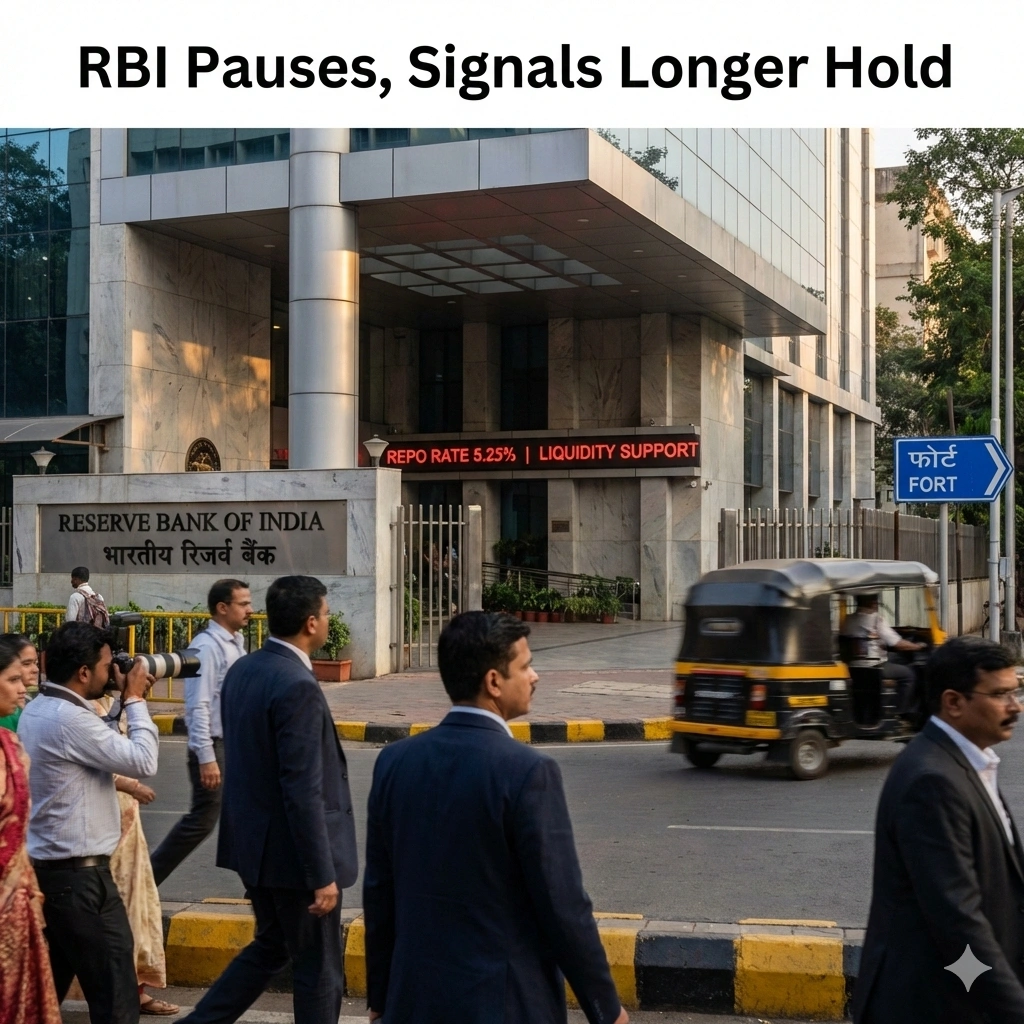
The RBI holds rates 5.25% decision marked a pause in India’s monetary easing cycle, as policymakers signaled growing confidence that external headwinds are easing following progress on the US-India trade deal and an emerging EU trade agreement. The move, announced on February 7, 2026, was widely expected by markets and reflected a wait-and-watch approach as earlier rate cuts continue to filter through the economy.
The Reserve Bank of India’s Monetary Policy Committee (MPC) voted unanimously to keep the benchmark repo rate unchanged at 5.25%, in line with forecasts from a Reuters poll. The decision suggests that policymakers are comfortable holding rates steady while assessing the impact of last year’s cumulative easing.
Trade Deals Ease Key External Headwinds
RBI Governor Sanjay Malhotra acknowledged that global conditions remain uncertain, noting that external headwinds had intensified in recent quarters. However, in explaining why the RBI holds rates 5.25%, he emphasized that progress on major trade negotiations has improved the outlook for India’s economy.
According to Malhotra, the successful conclusion of trade arrangements with the United States and the European Union “augurs well” for India’s medium-term growth prospects. These developments were cited as a key reason for pausing further rate cuts, as they help reduce pressure on exports, capital flows, and investor sentiment.
Reuters reported that expectations around tariff-related steps with Washington and trade arrangements with Europe were seen as easing a major pressure point for India’s economy and financial markets, reinforcing the central bank’s decision to hold rates at 5.25%.
Focus Shifts to Transmission of Past Rate Cuts
With the RBI holding rates at 5.25%, attention is now shifting toward how effectively previous policy easing is transmitting into the real economy. The central bank cut rates by a cumulative 125 basis points during the last easing cycle, and policymakers appear keen to evaluate its impact on borrowing costs and credit growth.
Economists quoted in the coverage described the RBI’s tone as signaling “lower for longer,” suggesting that rates are likely to remain unchanged for an extended period unless inflation or growth conditions shift sharply.
RBI Holds Rates 5.25% While Reaffirming Active Liquidity Support
While the RBI holds rates at 5.25%, it reaffirmed its commitment to an active liquidity management stance to ensure monetary policy remains supportive of growth. The central bank said it would maintain adequate system liquidity to back productive credit demand and strengthen monetary policy transmission across the banking system.
Officials emphasized that sufficient liquidity is critical for encouraging lending to both businesses and households, particularly as banks continue to adjust to the lagged effects of earlier rate cuts. By focusing on liquidity tools rather than additional rate reductions, the RBI aims to support economic momentum without altering the policy rate.
This approach allows policymakers to balance growth support with financial stability while closely monitoring inflation and global conditions.
Market Reaction and Economic Implications
Financial markets interpreted the RBI’s decision to keep policy unchanged as a signal of stability and policy continuity. The combination of steady interest rates, supportive liquidity conditions, and easing trade-related risks has helped anchor expectations for India’s economic outlook in 2026.
Analysts noted that improving clarity around trade relations with major partners could bolster investor confidence, support exports, and reduce volatility in capital flows. Together, these factors ease pressure on the central bank to pursue aggressive monetary intervention, reinforcing expectations of a prolonged policy pause.
Outlook: Cautious Optimism for 2026
The RBI holds rates 5.25% decision reflects cautious optimism. While global risks persist, including geopolitical tensions and uneven global growth, policymakers appear encouraged by reduced trade uncertainty and moderating inflation pressures.
Going forward, the central bank is expected to remain data-dependent, closely monitoring inflation trends, credit conditions, and global developments before making its next move.
For more details & sources visit: Reuters
For the latest updates from India, visit our India news page.