
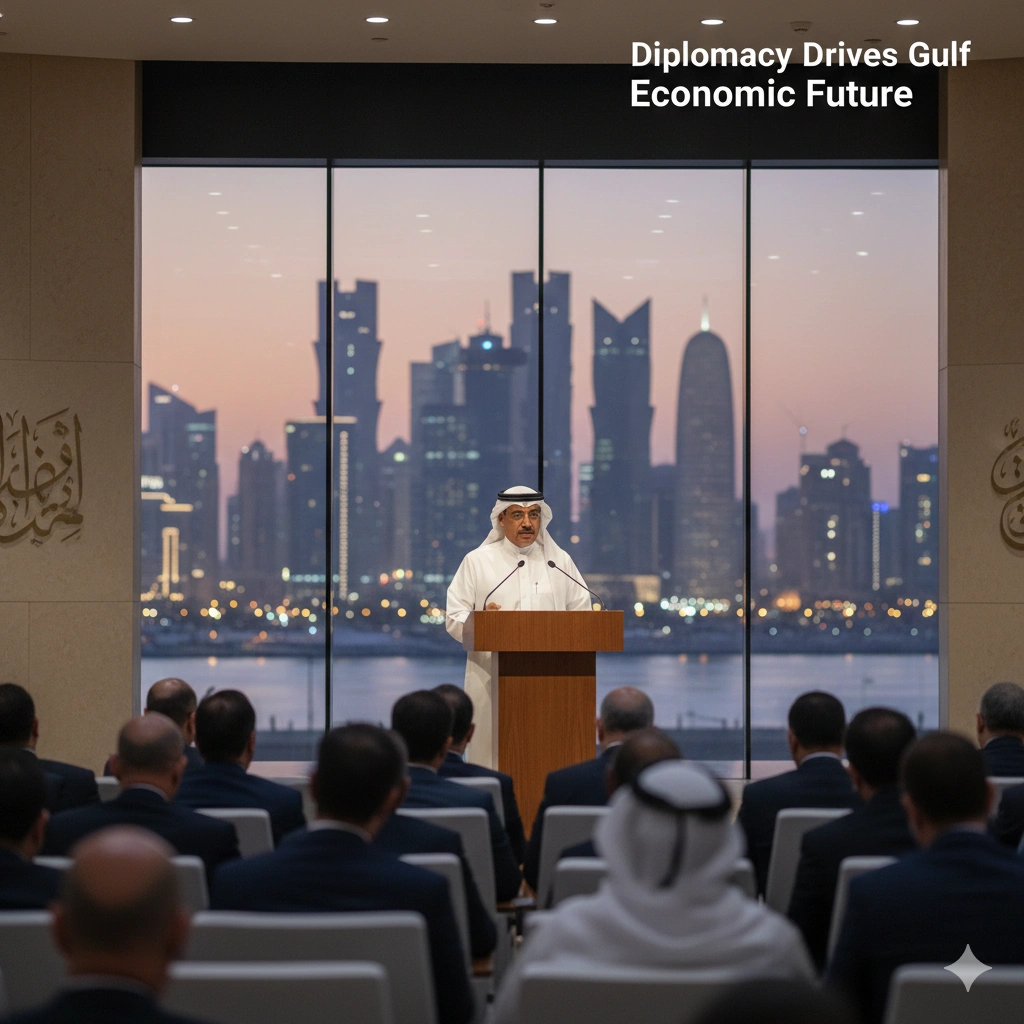
Qatar diplomacy Vision 2030 took center stage as Prime Minister Sheikh Mohammed bin Abdulrahman bin Jassim Al Thani discussed the country’s strategic global role during a Goldman Sachs “Talks at GS” session. He emphasized that active mediation and international diplomacy are key pillars of national security, regional stability, and long-term economic growth.
Global Diplomacy and Mediation as Pillars of Security (H2)
During the session, Sheikh Mohammed highlighted Qatar diplomacy Vision 2030 as encompassing not just domestic policy but also a proactive international approach. Mediation—both regionally and globally—was described as essential to:
- Supporting political stability in the Gulf and broader Middle East
- Reducing risks of conflict spillover
- Protecting Qatar’s national interests while fostering constructive international engagement
The Prime Minister cited Qatar’s longstanding track record in facilitating dialogues and agreements across conflict zones as a testament to its credibility as a neutral yet influential mediator.
Economic Growth and National Champions (H2)
A major component of Qatar diplomacy Vision 2030 is translating influence into economic development. Sheikh Mohammed outlined an agenda to strengthen Qatar’s national champion companies, enhancing their competitiveness on a global scale.
Key priorities include:
- Expanding sectors aligned with Qatar’s long-term Vision 2030 goals
- Fostering public-private partnerships to spur innovation and investment
- Supporting entrepreneurship and large-scale projects that reinforce economic resilience
The PM underscored that economic growth is inseparable from diplomatic influence, as global partnerships often create avenues for investment, trade, and strategic cooperation.
Education and Long-Term Development (H3)
Education investment is another central pillar of Qatar diplomacy Vision 2030. Sheikh Mohammed stressed that developing human capital through high-quality education is crucial for sustainable growth and for equipping Qataris to thrive in a knowledge-based global economy.
Programs focusing on innovation, STEM education, and global skill development are positioned as catalysts for both national growth and Qatar’s ability to contribute to international diplomacy effectively.
Strategic International Engagement (H3)
The Goldman Sachs session highlighted Qatar’s proactive approach to international engagement. Sheikh Mohammed discussed how diplomatic influence is translated into long-term security and global leadership, emphasizing measured interventions that support regional stability without overextension.
He pointed to Qatar’s experience mediating sensitive negotiations in the Middle East, including high-profile prisoner exchanges and conflict resolution initiatives, as examples of how Qatar diplomacy Vision 2030 integrates political strategy with national security.
Qatar National Vision 2030 as a Roadmap (H2)
Sheikh Mohammed framed Qatar diplomacy Vision 2030 around the Qatar National Vision 2030 roadmap, which prioritizes:
- Economic diversification
- Strengthening national champions
- Education and workforce development
- Global diplomatic engagement
This comprehensive vision aligns domestic policy with international positioning, reinforcing Qatar’s role as a regional hub for diplomacy, investment, and sustainable growth.
Conclusion: Qatar Diplomacy Vision 2030 Bridges Security and Growth (H2)
The Qatar diplomacy Vision 2030 framework, as articulated by PM Al Thani, positions the country at the intersection of international mediation, national security, and economic expansion. By leveraging diplomacy, strengthening education, and supporting national champions, Qatar aims to secure long-term stability while enhancing its global influence.
The session, moderated by Jared Cohen of Goldman Sachs Global Institute, underscored Qatar’s commitment to aligning Vision 2030 goals with both domestic prosperity and international leadership.
For more details, see the Goldman Sachs “Talks at GS” session.
For more news, visit 360 news orbit.