
Qatar Airways has sent ripples through the aviation industry by confirming it will prolong its current operational restrictions. The Qatar Airways Iran Suspension has been officially extended until June 30, 2026, as the carrier navigates a complex geopolitical landscape. This decision, communicated via a formal trade advisory, means the majority of routes connecting Doha to various Iranian cities will remain inactive for the foreseeable future. Only a single daily flight between Doha and Tehran will remain to provide essential connectivity, while all other regional services remain grounded.
The extension of the Qatar Airways Iran Suspension reflects a deeply cautious stance taken by the Gulf giant regarding aviation safety and regional stability. By limiting its presence to just one flight per day into Tehran’s Imam Khomeini International Airport, the airline is balancing diplomatic necessity with operational security. This move is not an isolated incident but part of a broader trend among international carriers who are re-evaluating their risk profiles in the Middle East. Passengers and travel agents must now prepare for a prolonged period of limited capacity and potential itinerary disruptions.
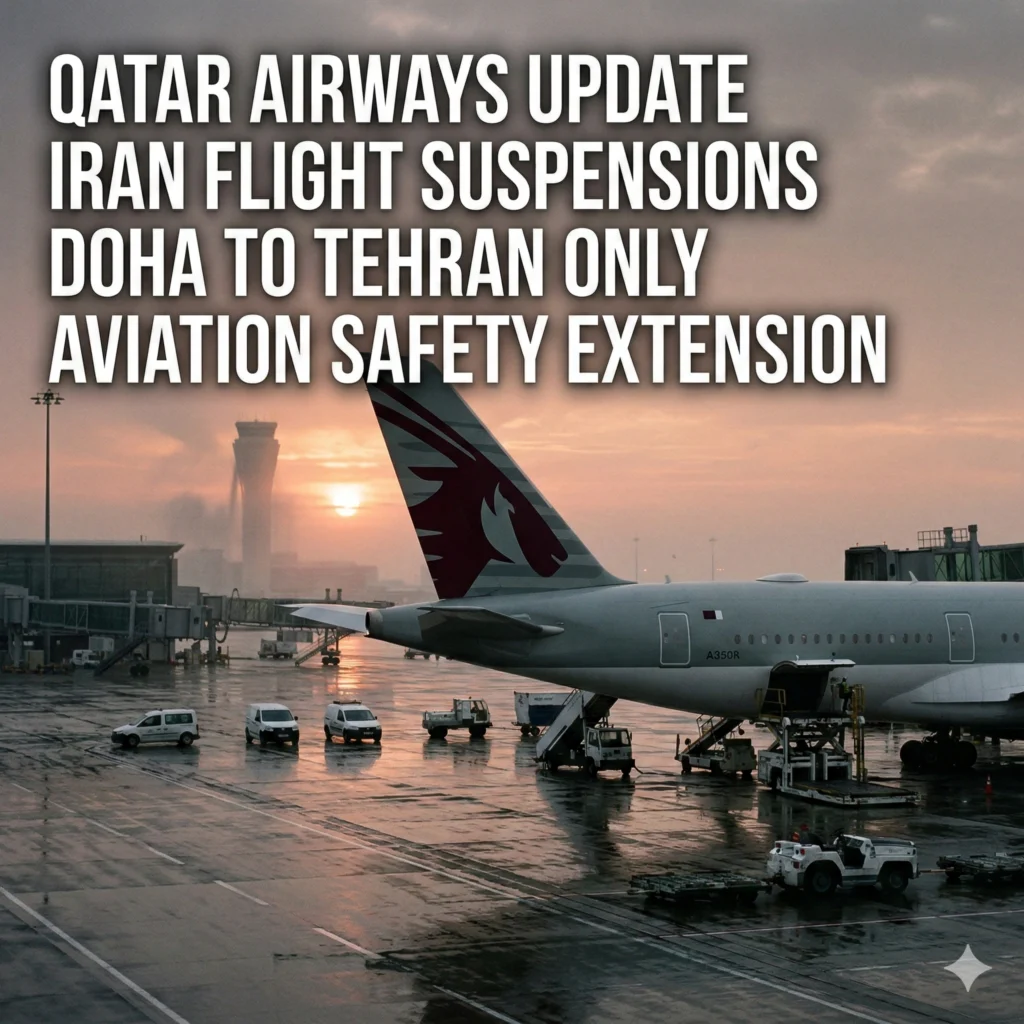
Aviation Safety and Regional Tensions
The primary driver behind the Qatar Airways Iran Suspension remains the volatile security environment that has plagued regional corridors over the last several months. International aviation monitors have frequently highlighted the risks associated with commercial overflights in contested zones, leading many airlines to divert or cancel services. Qatar Airways, which prides itself on safety excellence, has determined that a full resumption of services is not yet viable under current conditions. The decision to maintain only a minimal “lifeline” flight to the capital suggests a wait-and-see approach.
Furthermore, the Qatar Airways Iran Suspension is influenced by the logistical hurdles of maintaining ground operations in multiple Iranian cities simultaneously. With fluctuating insurance premiums for aircraft flying into certain zones, concentrated operations in Tehran allow the airline to manage costs more effectively. This strategic retreat from secondary cities like Mashhad and Shiraz ensures that the airline can maintain its high service standards on the remaining daily route without overextending its resources in a high-risk environment.
The geopolitical weight of the Qatar Airways Iran Suspension cannot be ignored, as Doha often serves as a critical intermediary in regional affairs. Aviation analysts suggest that the reduction in flights is a pragmatic response to the current lack of de-escalation in the broader Middle East. While the airline is a commercial entity, its operations are frequently seen as a bellwether for the region’s overall stability. The extension until mid-2026 signals that a return to “normalcy” is likely further away than many had initially hoped.
Impact on Global Travel Connectivity
The continuation of the Qatar Airways Iran Suspension has significant implications for travelers using Doha as a transit hub between the West and Iran. Historically, Qatar Airways provided one of the most reliable bridges for the Iranian diaspora in North America and Europe. With most flights suspended, these travelers are now facing limited options, higher ticket prices, and longer layovers with alternative carriers. The “single daily flight” limit creates a bottleneck that will likely keep load factors high and availability low throughout the 2026 spring season.
Businesses that rely on air cargo between the Gulf and Iran are also feeling the pressure of the Qatar Airways Iran Suspension. While belly-hold capacity on the daily Tehran flight exists, the loss of multiple frequencies to other commercial centers hampers the efficient movement of perishable goods and urgent spare parts. This reduction in cargo capacity forces logistics companies to seek more expensive or time-consuming overland routes, adding another layer of cost to an already strained regional trade environment.
The Qatar Airways Iran Suspension also affects the airline’s competitive positioning against other regional rivals. While some carriers have chosen to maintain higher frequencies, Qatar Airways’ choice to prioritize safety and risk mitigation may influence the policies of its codeshare partners. Frequent flyers who typically earn miles on these routes are being redirected to other parts of the network, which could lead to a temporary shift in passenger loyalty. The airline is working hard to minimize the fallout by offering robust refund and rebooking policies.
Qatar Airways Iran Suspension
The technical implementation of the Qatar Airways Iran Suspension involves a massive logistical recalibration for the airline’s scheduling department. Managing a network that spans hundreds of destinations requires precise timing, and the sudden removal of a dozen weekly flights to Iran creates gaps in the Doha hub schedule. The airline is currently optimizing its fleet usage, shifting the wide-body aircraft originally intended for Iranian routes to more stable markets in Southeast Asia and Europe to maximize revenue.
Internally, the Qatar Airways Iran Suspension has led to a reshuffling of crew assignments and ground staff resources. Maintaining a skeleton crew in Tehran while suspending operations in other cities requires a delicate balance of local labor laws and international safety protocols. The airline has stated that its staff’s safety is paramount, and the 2026 extension ensures that personnel are not exposed to unnecessary risks. This human element is a critical component of the carrier’s long-term operational strategy.
Moreover, the Qatar Airways Iran Suspension serves as a signal to the insurance markets that the risks of operating in certain airspaces remain elevated. When a major carrier like Qatar Airways pulls back, it often sets a precedent that affects premium rates for the entire industry. This creates a feedback loop where higher costs lead to further service reductions across different airlines. The suspension extension is a clear indicator that the insurance and risk assessment community does not anticipate a significant improvement in the regional security outlook before the summer of 2026.
Strategic Realignment of Gulf Carriers
The Qatar Airways Iran Suspension highlights a growing divergence in how Gulf airlines handle regional crises. While some carriers have adopted an aggressive “business as usual” stance, Qatar Airways’ cautious pivot reflects a more conservative management style focused on long-term brand protection. This strategy is designed to ensure that the airline’s global reputation for safety remains untarnished, even if it means sacrificing short-term market share in a neighborly market.
The Qatar Airways Iran Suspension is also a reflection of the evolving diplomatic ties within the region. As Qatar navigates its relationships with both Western allies and regional neighbors, the airline’s flight map often mirrors the state of these delicate balances. By maintaining one flight to Tehran, the airline keeps a vital communication channel open while simultaneously signaling its concerns through the broader suspension. This “middle path” is a classic example of how aviation and diplomacy are inextricably linked in the modern era.
Affected Routes and Alternatives
- Tehran (IKA): Reduced to one daily flight (QR490/491).
- Mashhad (MHD): Services remain fully suspended until June 30, 2026.
- Shiraz (SYZ): Services remain fully suspended until June 30, 2026.
- Isfahan (IFN): Services remain fully suspended until June 30, 2026.
Travelers impacted by the Qatar Airways Iran Suspension are encouraged to look into alternative hubs such as Istanbul or Dubai, though these routes are also seeing increased demand. The airline’s trade advisory provides a clear framework for those seeking refunds, but the lack of direct options will undoubtedly complicate travel plans for thousands. The aviation sector is watching closely to see if other carriers will follow suit and further tighten the skies over the region.
Economic Fallout for the Aviation Sector
The financial impact of the Qatar Airways Iran Suspension is multifaceted, affecting airport revenues, fuel suppliers, and catering services. In Iran, the reduced frequency of a major international carrier like Qatar Airways leads to a significant loss in landing fees and ground handling revenue at regional airports. This economic drain complicates the maintenance and upgrading of aviation infrastructure within the country, potentially leading to longer-term issues with airport safety and service quality.
For Qatar Airways, the Qatar Airways Iran Suspension means a loss of high-yield passenger traffic that previously utilized the airline’s premium lounges and duty-free facilities in Doha. However, the airline is mitigating these losses by aggressively expanding its footprint in other growing markets. The redirection of aircraft to destinations with higher stability and demand allows the carrier to maintain its overall profitability despite the regional setback. This agility is a hallmark of the airline’s 2026 fiscal strategy.
The Qatar Airways Iran Suspension also impacts the global supply of aviation parts and maintenance services. With fewer planes flying these routes, the demand for specialized technical support in the region has dipped. This has forced some maintenance providers to consolidate their operations, leading to a smaller but more specialized footprint. The ripple effects of a single airline’s suspension can be felt across the entire aerospace value chain, from engine manufacturers to specialized cleaning crews.
Future Outlook and Reopening Criteria
The roadmap for ending the Qatar Airways Iran Suspension depends on a set of transparent safety benchmarks that the airline has yet to fully disclose. Industry insiders believe that a sustained period of regional de-escalation and the implementation of enhanced air traffic control protocols would be necessary precursors to a full resumption of flights. The June 2026 date is not set in stone; it serves as a planning horizon that can be adjusted based on real-time intelligence and safety audits.
Should the security situation improve, the reversal of the Qatar Airways Iran Suspension would likely occur in phases. The airline would likely restore frequencies to Tehran first, followed by a gradual reintroduction of flights to major cities like Mashhad and Shiraz. This phased approach allows the airline to test the operational environment and ensure that all safety protocols are functioning as intended before committing to a full-scale return.
Strategic Priorities for 2026
- Constant monitoring of regional airspace safety in collaboration with international bodies.
- Maximizing the efficiency of the single daily Doha-Tehran route to meet essential demand.
- Providing flexible rebooking options to maintain customer trust during the suspension.
- Reallocating fleet resources to high-growth markets to offset regional revenue losses.
In the interim, the Qatar Airways Iran Suspension will remain a defining feature of the Middle Eastern aviation landscape. The airline’s commitment to safety, even at the cost of operational scale, reinforces its position as a global leader in responsible aviation. As June 2026 approaches, the world will be watching for signs of a thaw in regional tensions that could finally lead to the reopening of these critical air corridors.
The Qatar Airways Iran Suspension is more than just a schedule change; it is a profound statement on the current state of global connectivity. It serves as a reminder that the aviation industry is deeply susceptible to the winds of politics and security. For the passengers, the airline, and the region, the next few months will be a period of adaptation and resilience. Qatar Airways continues to navigate these turbulent skies with a steady hand, prioritizing the long-term safety of its passengers above all else.
Ultimately, the resolution of the Qatar Airways Iran Suspension will be a signal of a broader regional healing process. Until that day comes, the single daily flight to Tehran stands as a lone bridge in a fractured sky. The airline remains ready to scale its operations back up the moment it is safe to do so, but for now, caution is the order of the day. The aviation world remains hopeful that by the time June 2026 arrives, the conditions will finally be right for a full and safe return to the skies of Iran.
For more details & sources visit: The Caspian Post
Read more about Qatar news on 360 News Orbit – Qatar.