
Poland Migrant Crisis records 14,754 pushbacks as the government introduces a series of aggressive border security measures and social reforms. A recent coalition report from the European Council on Refugees and Exiles (ECRE) highlights Poland as the leading EU member state for migrant rejections during the 2025 calendar year. These findings surface just as Warsaw moves to withdraw from international landmine treaties to bolster its national defense. The confluence of these events signals a significant shift in Poland’s humanitarian and security landscape as of March 2026. Understanding the Poland Migrant Crisis requires looking at both the physical border barriers and the changing legal status of those seeking refuge within the country.
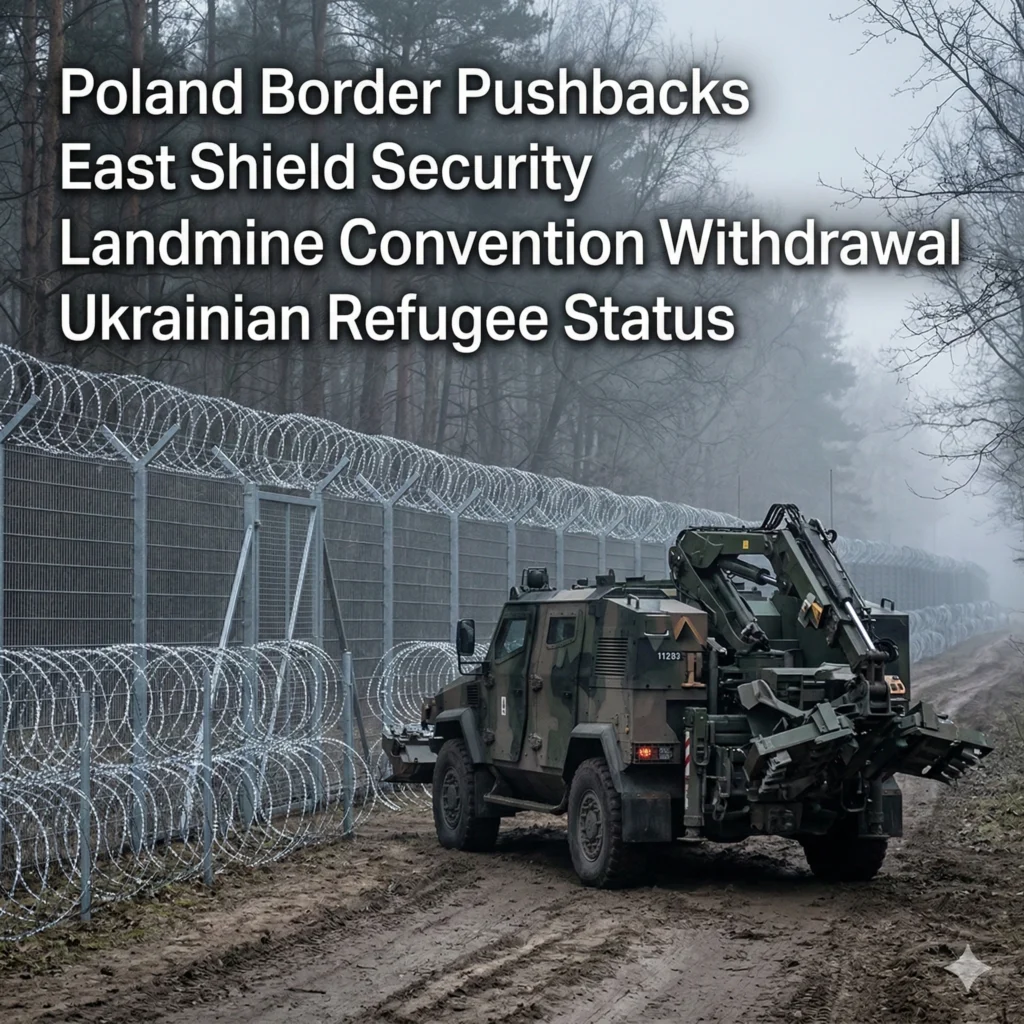
Poland Migrant Crisis
The Poland Migrant Crisis has reached a critical juncture with the release of data showing 80,865 total pushbacks across the European Union. Poland alone accounted for nearly 15,000 of these incidents, marking it as the most active state in preventing unauthorized entry. The majority of these cases occurred along the porous and dangerous border with Belarus, a zone often hidden from public view. Human rights advocates argue that these figures represent a systemic failure to uphold international protection standards for vulnerable individuals.
Prime Minister Donald Tusk has defended these actions as necessary for national sovereignty and the protection of EU external borders. The government maintains that the Poland Migrant Crisis is exacerbated by hybrid warfare tactics employed by neighboring hostile regimes. Consequently, the border zones have become highly militarized environments where security takes precedence over traditional asylum processing protocols. Local NGOs continue to document instances of violence and deprivation in these restricted areas, despite limited access.
The 2025 data suggests that the Poland Migrant Crisis is not a temporary surge but a sustained geopolitical reality. Along the borders of Latvia, Lithuania, and Poland, over 28,500 pushbacks were recorded, illustrating a coordinated regional effort to seal the Eastern corridor. As the numbers climb, international pressure on Warsaw to balance security with human rights is mounting from various European institutions. However, the Polish administration remains firm in its stance that border integrity is the foundation of national safety.
The East Shield and Landmine Deployment
A controversial development in the Poland Migrant Crisis involves the finalization of the East Shield project, a massive defense infrastructure initiative. Prime Minister Tusk recently announced that Poland now possesses the capability to mine its eastern borders within forty-eight hours of a perceived threat. This announcement follows Poland’s strategic withdrawal from the Anti-Personnel Landmines Convention, a move mirrored by several Baltic nations. The deployment of hybrid mine layers is intended to serve as a high-tech deterrent against potential ground incursions.
Human rights organizations have reacted with alarm, stating that landmines transform the Poland Migrant Crisis into a life-threatening gauntlet for refugees. These groups warn that such barriers do not distinguish between military threats and civilians seeking international protection. The physical danger of the border zone is now compounded by the presence of explosive hazards that may remain for decades. Government officials, however, argue that these measures are essential components of a modern defense strategy in an era of heightened European tension.
The decision to remilitarize the border with mines marks a departure from decades of European disarmament efforts. While the government views this as a proactive step toward national security, it fundamentally changes the nature of the Poland Migrant Crisis. Critics suggest that such extreme measures may inadvertently fuel the very instability they are designed to prevent. The international community is closely watching how these defensive structures will interact with the daily flow of migrants at the border.
Ending Special Status for Ukrainians
While the border remains a flashpoint, the Poland Migrant Crisis is also evolving internally through significant legislative changes. President Karol Nawrocki recently signed a law that officially ends the special legal and social status for nearly one million Ukrainian refugees. This legislation abolishes the unconditional privileges that were first established in 2022 following the outbreak of the regional conflict. The move reflects a broader trend toward long-term integration rather than temporary emergency assistance.
The new legal framework ties future benefits directly to employment status and mandatory social insurance contributions from the refugees. This shift is intended to reduce the fiscal burden on the Polish state while encouraging economic self-sufficiency among the displaced. For many, this marks the end of a period of state-funded stability and the beginning of a more competitive existence. These changes are a core component of the evolving Poland Migrant Crisis as the country transitions from an emergency host to a permanent residence.
Experts in social policy warn that these reforms will hit vulnerable groups the hardest, particularly single mothers and the elderly. Without the safety net of unconditional support, many families may find themselves in precarious financial positions within Polish society. The government argues that these measures are necessary to ensure the sustainability of the national social welfare system. Balancing economic reality with humanitarian duty remains a central challenge in managing the domestic side of the Poland Migrant Crisis.
Vulnerable Groups and Economic Barriers
The impact of the new legislation is expected to be felt most acutely by those who cannot easily enter the labor market. The Poland Migrant Crisis has created a large population of displaced persons with varied levels of professional training and language proficiency. Single mothers, who make up a significant portion of the Ukrainian refugee population, face unique hurdles in balancing work with childcare. The disabled and elderly also face high risks of poverty as their previous social protections are phased out.
Advocacy groups are calling for targeted interventions to prevent a surge in homelessness and destitution among these populations. They argue that while economic integration is a valid goal, it must be accompanied by robust support systems for the marginalized. The Poland Migrant Crisis now involves a complex task of managing the needs of a diverse refugee group within a tightening fiscal environment. Success will depend on the government’s ability to create inclusive policies that do not leave the most vulnerable behind.
Furthermore, the requirement for mandatory insurance contributions adds another layer of administrative complexity for both refugees and employers. Small businesses may find it difficult to navigate the new regulations, potentially leading to a rise in informal or “under-the-table” employment. This secondary effect of the Poland Migrant Crisis could undermine the government’s goal of formal economic integration. Policymakers are being urged to simplify the transition process to avoid creating a shadow economy of displaced workers.
Poland Migrant Crisis
The Poland Migrant Crisis continues to dominate the political discourse in Warsaw as the 2026 election cycle approaches. The recorded 14,754 pushbacks are frequently cited by both supporters of border security and proponents of human rights to justify their positions. This focus keyword represents the intersection of national defense, European law, and basic human dignity in a changing world. As the government rolls out more advanced surveillance and barrier technologies, the visibility of the crisis is likely to decrease, even as the intensity remains.
Public opinion remains divided, with a significant portion of the population supporting the government’s “security-first” approach. Many citizens view the Poland Migrant Crisis as a direct threat to their way of life and national identity. Conversely, a vocal minority and various international bodies remind the state of its obligations under the Geneva Convention. This internal friction is a defining feature of the current sociopolitical climate in Poland as it navigates these difficult waters.
The ongoing presence of the East Shield and the threat of landmines have made the border one of the most fortified in the world. This physical reality serves as a constant reminder of the high stakes involved in the Poland Migrant Crisis. Whether through pushbacks at the fence or the withdrawal of benefits in the city, the state’s message is one of deterrence and discipline. The coming months will reveal whether these harsh measures succeed in stabilizing the region or if they lead to further humanitarian complications.
International Repercussions and EU Relations
Poland’s handling of the Poland Migrant Crisis has significant implications for its standing within the European Union. The high number of pushbacks has already drawn criticism from EU human rights commissioners who demand more transparency at the border. There is a concern that Poland’s actions might set a precedent for other member states to bypass collective asylum rules. This tension highlights the broader struggle within the EU to define a unified migration and border policy.
The withdrawal from the landmine convention also puts Poland at odds with several of its Western European allies. While Baltic nations share Poland’s security concerns, the move is seen by others as a step backward for international humanitarian law. The Poland Migrant Crisis is thus not just a local issue but a catalyst for a larger debate about the future of European values. Negotiating these diplomatic hurdles will require skilled statesmanship and a willingness to find common ground with Brussels.
Despite the friction, Poland remains a crucial partner for the EU in managing the eastern frontier. The union often provides funding for border infrastructure, even as it criticizes the methods used to secure it. This complex relationship ensures that the Poland Migrant Crisis will remain a top priority for European leadership for years to come. The resolution of this crisis will likely involve a mix of high-tech security and updated legal frameworks that reflect the realities of the 2026 geopolitical landscape.
Managing the Border and Human Rights
Efforts to monitor the Poland Migrant Crisis are hampered by the “no-go” zones established by the military along the border. These restricted areas prevent journalists and aid workers from documenting the actual conditions faced by those attempting to cross. Human rights organizations argue that this lack of transparency is a deliberate attempt to hide the reality of the Poland Migrant Crisis from the public. They continue to lobby for independent oversight and access to the border regions to ensure that basic rights are being respected.
The use of hybrid mine layers and other advanced weaponry further complicates the humanitarian response. Medical teams working in the area must now account for the risk of explosives when attempting to reach injured or stranded migrants. The Poland Migrant Crisis has evolved into a high-stakes tactical environment where the margin for error is increasingly slim. Protecting human life in such a zone requires extraordinary coordination between security forces and humanitarian agencies, which is currently lacking.
- Recorded 14,754 pushbacks in Poland during 2025.
- Strategic withdrawal from the Anti-Personnel Landmines Convention.
- Implementation of the East Shield defense project.
- Transition of Ukrainian refugees to employment-based benefits.
As the government continues to prioritize defense, the human cost of the Poland Migrant Crisis remains a subject of intense debate. The challenge lies in creating a security apparatus that can protect the nation without sacrificing its moral and legal commitments. The evolution of the Poland Migrant Crisis will ultimately serve as a litmus test for the country’s ability to lead in a time of regional instability.
Future Outlook and Policy Shifts
The long-term resolution of the Poland Migrant Crisis will likely require a shift in both domestic and international policy. Current strategies focused on deterrence and benefit reduction may provide short-term political gains but do not address the root causes of displacement. Developing a comprehensive framework that includes legal pathways for migration could help alleviate some of the pressure on the eastern border. This would transform the Poland Migrant Crisis from an emergency to a managed administrative process.
Furthermore, regional cooperation with neighbors like Ukraine and the Baltic states is essential for a stable security environment. Shared intelligence and resources can help mitigate the Poland Migrant Crisis more effectively than unilateral actions. The Polish government has already begun some of this work through the East Shield project, but more needs to be done on the humanitarian side. Building a resilient society that can absorb and integrate newcomers is as important as building fences.
The coming year will be pivotal as the new laws regarding Ukrainian refugees take full effect. Observers will be watching to see if the focus on employment leads to successful integration or increased social inequality. The Poland Migrant Crisis is a multifaceted problem that touches on every aspect of national life, from the economy to national security. Finding a sustainable path forward will require courage, innovation, and a commitment to the fundamental rights of all individuals.
For more details & sources visit: ECRE (European Council on Refugees and Exiles)
Read more on Poland news: 360 News Orbit – Poland.