
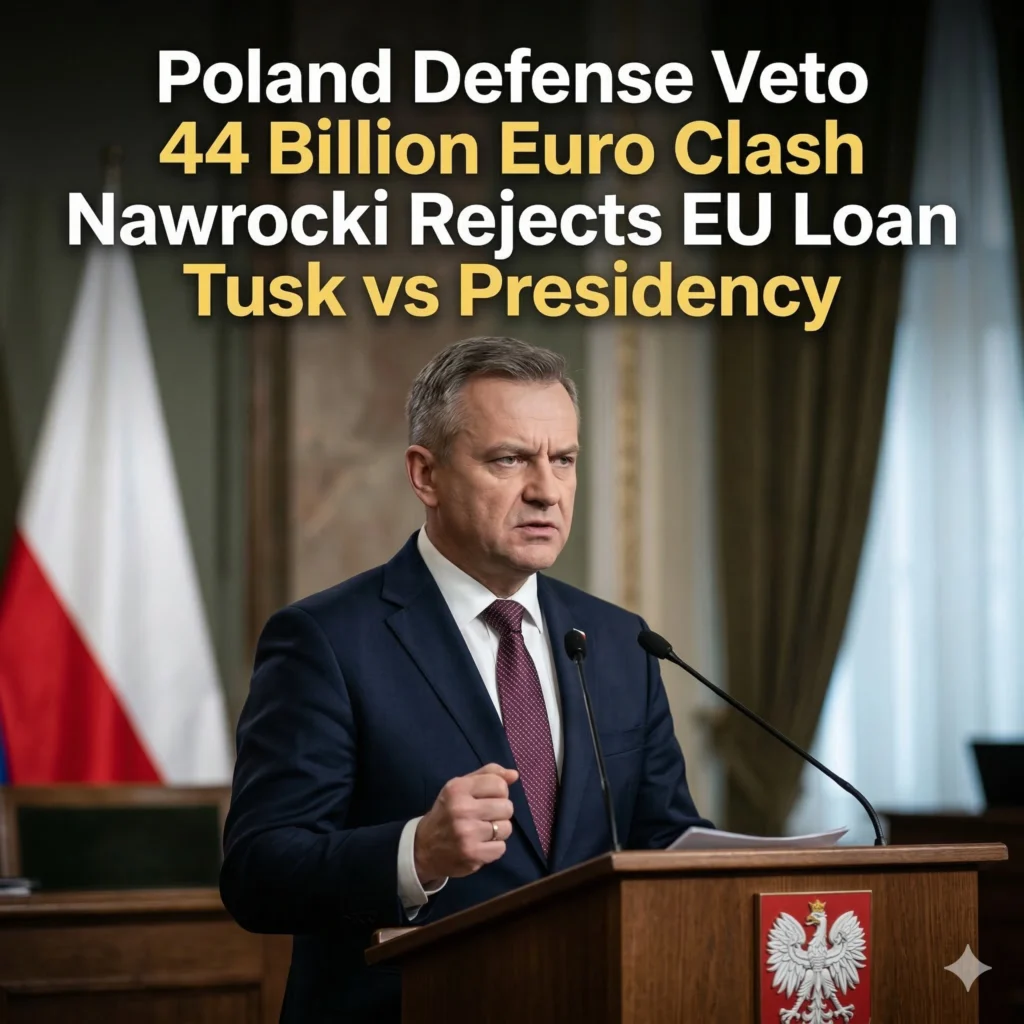
The Poland Defense Funding Crisis reached a boiling point this week when President Karol Nawrocki officially blocked a critical piece of legislation. This controversial move prevents the nation from accessing approximately 44 billion euros specifically allocated through the European Union’s SAFE defense initiative. Consequently, the decision has ignited a fierce institutional conflict between the nationalist-leaning presidency and Prime Minister Donald Tusk’s pro-EU coalition government. Many experts believe this standoff represents the most significant political deadlock in Warsaw since the current administration took office.
While the government argues the funds are vital for national security, the president maintains that the long-term economic risks outweigh the immediate military benefits. This legislative veto effectively halts a massive 43.7 billion euro injection intended to modernize the Polish Armed Forces and expand domestic industrial capabilities. Furthermore, the decision comes at a time when regional security threats are at an all-time high across Eastern Europe. As a result, the Poland Defense Funding Crisis has moved from a domestic policy debate to a major international concern regarding the stability of NATO’s eastern flank.
The Origins of the Poland Defense Funding Crisis
The current Poland Defense Funding Crisis stems from a fundamental disagreement over how to finance one of the most ambitious military build-ups in modern European history. Originally, the SAFE defense scheme was designed by the European Union to provide member states with low-interest loans to bolster their defensive posture. However, President Nawrocki argues that accepting these funds would bind the Polish economy to foreign-currency debt for nearly half a century. This long-term financial commitment is viewed by the presidency as a threat to the country’s sovereign fiscal policy and future economic independence.
Prime Minister Donald Tusk’s administration had initially viewed the 44 billion euro package as a cornerstone of their strategic defense roadmap. They argued that the favorable interest rates provided by the EU were far superior to any terms available on the private commercial market. Despite these assurances, the presidency remained unconvinced, citing the potential for 45 years of debt repayment as an unacceptable burden for future generations. This divergence in economic philosophy has now paralyzed the procurement process for essential military hardware and infrastructure projects.
Poland Defense Funding Crisis
The escalation of the Poland Defense Funding Crisis reflects a deep-seated rivalry between the different branches of the Polish government. President Karol Nawrocki utilized his televised address to frame the veto as a necessary act of patriotic resistance against foreign financial influence. By blocking the SAFE initiative, he effectively challenged the military leadership and the cabinet’s authority on national security matters. This bold maneuver has forced the Tusk government to scramble for alternative solutions while the nation’s defense contracts hang in the balance.
In response to the veto, Prime Minister Tusk publicly criticized the president, labeling the decision a missed opportunity for the nation’s safety and growth. He emphasized that the government is already exploring “Plan B” options to bypass the presidential block through various legal and administrative channels. Nevertheless, the legal hurdles for such a bypass are significant, and the delay could cost the country years in its modernization timeline. The Poland Defense Funding Crisis continues to evolve as constitutional experts debate the limits of presidential power in matters of national defense and international finance.
Economic Sovereignty vs. Military Modernization
Central to the Poland Defense Funding Crisis is the debate over whether military strength should ever be sacrificed for fiscal conservatism. President Nawrocki has proposed an alternative domestic funding approach labeled “SAFE 0 percent,” which aims to avoid EU-dependent loans entirely. This proposal suggests that Poland should rely on its own internal revenues and domestic bonds to fund the military expansion. While this sounds appealing to nationalists, many economists warn that domestic markets may not have the depth to support such a massive capital requirement without causing inflation.
Conversely, the Tusk government maintains that the scale of the required defense spending—totaling billions of euros—requires the backing of a large international entity like the EU. They argue that the Poland Defense Funding Crisis is being artificially manufactured by the presidency to score political points with a specific voter base. Without the 44 billion euros from the SAFE scheme, Poland may be forced to scale back its orders for advanced fighter jets, tanks, and missile defense systems. This reduction in procurement could leave the country vulnerable during a period of intense regional instability.
Military Leadership and Public Reaction
The Poland Defense Funding Crisis has also created a visible rift between the civilian presidency and the professional military establishment. High-ranking officers, including General Wieslaw Kukula and General Artur Kuptel, had publicly voiced their support for the EU financing plan before the veto occurred. Their endorsement was based on the urgent technical need for modernized equipment and improved logistics. The president’s decision to ignore the advice of his top generals is being interpreted by many analysts as a personal vote of no confidence in the current military brass.
Public opinion on the matter appears to be largely in favor of securing the EU funds, despite the president’s objections. A recent poll conducted by IBRiS revealed that 58.4 percent of the Polish public believed the president should have signed the defense financing bill into law. This indicates that a majority of citizens prioritize immediate national security over long-term debt concerns. As the Poland Defense Funding Crisis dominates the headlines, the pressure on the presidency from both the military and the electorate continues to mount daily.
Strategic Consequences for European Security
Beyond the borders of Warsaw, the Poland Defense Funding Crisis has major implications for the broader security of the European Union. Poland has recently positioned itself as the leading military power on the continent, with plans to spend a record percentage of its GDP on defense. If the financing for these plans is disrupted, the collective defense of the EU’s eastern border could be significantly weakened. Allied nations in NATO are watching the situation closely, as any delay in Poland’s modernization affects the alliance’s overall readiness and deterrence capabilities.
The European Union’s 150-billion-euro SAFE initiative was intended to be a flagship program for continental cooperation in the face of rising threats. Poland’s inability to access nearly 30 percent of that fund due to internal political strife sends a troubling signal to Brussels and other member states. The Poland Defense Funding Crisis suggests that even when there is a clear external threat, internal partisan politics can still derail vital security infrastructure. This situation serves as a cautionary tale for other nations attempting to balance domestic sovereignty with integrated European defense strategies.
Analyzing the Alternative Funding Proposals
In an effort to resolve the Poland Defense Funding Crisis, the presidency has touted the “SAFE 0 percent” model as a superior path forward. This plan involves utilizing the national central bank and domestic commercial banks to provide interest-free or low-interest capital for defense projects. Proponents of this idea argue it keeps the control of Polish debt entirely within the country, preventing external actors from exerting leverage. However, critics point out that this could lead to a massive crowding-out effect in the domestic credit markets, making it harder for private businesses to secure loans.
- Domestic bonds might require higher interest rates than EU loans to attract enough local investors.
- Central bank intervention could potentially violate constitutional rules regarding the independence of the monetary authority.
- The total amount of 44 billion euros is likely too large for the domestic banking sector to absorb in a short period.
- Redirecting domestic funds toward defense could lead to austerity measures in education, healthcare, and infrastructure.
The Role of Prime Minister Donald Tusk’s Plan B
As the Poland Defense Funding Crisis persists, the Tusk administration is looking for ways to circumvent the presidential veto. One potential strategy involves restructuring the defense contracts so they are funded through existing ministerial budgets rather than a single massive loan. This would require a series of smaller, piecemeal legislative changes that might be harder for the president to block individually. Another option being discussed is the use of state-owned development banks to act as intermediaries for the EU funds, potentially bypassing the need for a direct presidential signature on the loan agreement.
However, each of these “Plan B” options comes with its own set of legal and political risks. Any attempt to bypass the presidency could be challenged in the Constitutional Tribunal, leading to a prolonged legal battle that would still delay the funding. Furthermore, the Poland Defense Funding Crisis has made international lenders more cautious about the stability of Polish defense contracts. If the government and the presidency cannot present a united front, the cost of borrowing—regardless of the source—is likely to increase due to the perceived political risk.
Long-Term Impact on the Polish Industrial Base
The Poland Defense Funding Crisis does not just affect the purchase of foreign equipment; it also threatens the growth of the domestic arms industry. A significant portion of the 44 billion euros was earmarked for investing in Polish factories that produce ammunition, armored vehicles, and electronics. Without this capital, local manufacturers may struggle to meet the increased demand from the army, forcing the government to buy more equipment from abroad. This irony is not lost on critics who point out that the president’s “sovereignty” argument might actually lead to more reliance on foreign suppliers.
- Local manufacturing jobs in the defense sector could be at risk if funding is delayed past the current fiscal year.
- Research and development projects for next-generation drone technology may lose their necessary initial investment.
- Collaborative projects with other European nations could be canceled if Poland cannot meet its financial obligations.
The Constitutional Deadlock and Future Elections
The ongoing Poland Defense Funding Crisis is widely seen as a preview of the upcoming electoral battles in the country. By taking a hardline stance against the EU loan, President Nawrocki is appealing to a base that is skeptical of European integration and concerned about national debt. Meanwhile, Prime Minister Tusk is positioning his coalition as the only force capable of modernizing the country and ensuring security through international cooperation. This polarized environment makes a compromise on the defense budget highly unlikely in the near future.
The stalemate highlights a potential flaw in the Polish constitution regarding the division of power over national security and finance. If the president can block the funding for the military during a period of crisis, the government’s ability to govern effectively is put into question. As the Poland Defense Funding Crisis drags on, there are growing calls for a constitutional reform to clarify these roles, though such a reform would require a supermajority that neither side currently possesses.
International Reaction to the Veto
NATO officials have expressed quiet concern regarding the Poland Defense Funding Crisis, though they officially maintain that it is an internal Polish matter. Behind the scenes, there is worry that a delay in Poland’s military expansion could leave a gap in the alliance’s defense-in-depth strategy. European Union officials in Brussels have also reacted with disappointment, noting that the SAFE initiative was tailored to help countries like Poland face specific regional threats. The veto is seen by some in the EU as an ungrateful gesture after months of negotiation to secure the favorable loan terms.
- U.S. defense contractors are monitoring the situation to see if their existing orders will be affected by the lack of funding.
- Neighboring Baltic states are concerned that a slower Polish buildup reduces their own security buffer.
- International credit rating agencies may downgrade Poland’s outlook if the political deadlock continues to affect fiscal planning.
Conclusion of the Current Standoff
The resolution of the Poland Defense Funding Crisis remains uncertain as both sides refuse to back down from their entrenched positions. President Nawrocki continues to insist on his domestic funding model, while the Tusk government maintains that the EU loan is the only viable path for a massive military buildup. This impasse leaves billions of euros in limbo and creates a sense of instability within the Polish military and the broader defense industry. The coming weeks will be crucial as the government attempts to implement its “Plan B” and the public pressure on the presidency continues to intensify.
Ultimately, the Poland Defense Funding Crisis serves as a stark reminder of the challenges inherent in balancing national sovereignty with the realities of modern geopolitical defense. Whether the funds are eventually secured through the EU or a domestic alternative, the political scars from this battle are likely to influence Polish policy for years to come. For now, the nation’s ambitious plans to become a military superpower remain on hold, awaiting a breakthrough in this high-stakes institutional game of chicken.
For more details & sources visit: Balkan Insight
Read more on Poland news: 360 News Orbit – Poland.