
President Claudia Sheinbaum has officially signaled a transformative shift in North American energy policy by considering a strategic Petrobras partnership for Pemex to revitalize Mexico’s stagnant oil production. During her morning press conference, the President confirmed that Mexico is actively evaluating a high-level technical offer from Brazilian President Lula da Silva. This state-to-state alliance is designed to bridge the significant technological gap in Mexico’s deepwater capabilities, specifically targeting ultra-deepwater fields like Trion and Lakach.
As production in traditional shallow-water areas continues to dwindle, the integration of Brazilian expertise is seen as a vital lifeline for Mexico’s energy sovereignty. This collaboration could redefine the operational standards for state-owned enterprises in the Global South, moving away from reliance on Western private majors toward a more integrated regional model.
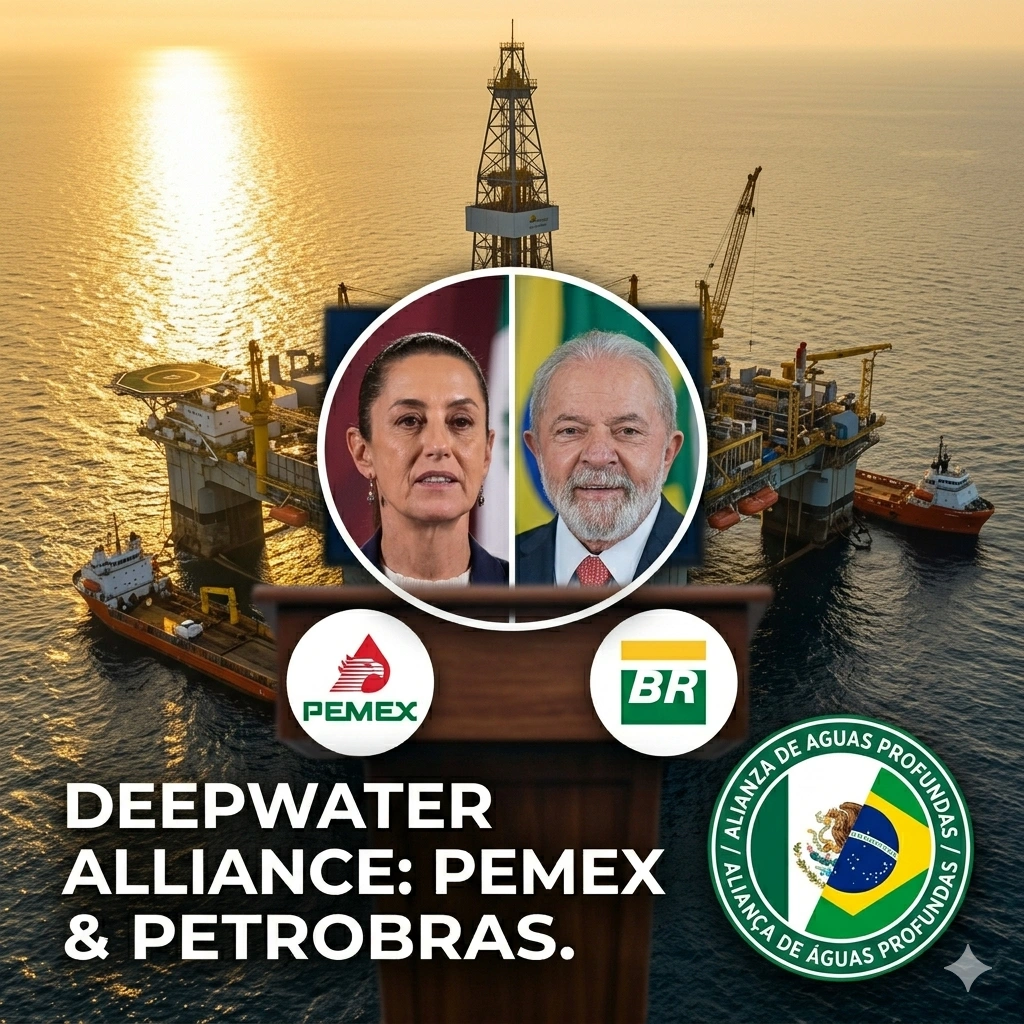
Petrobras partnership for Pemex and deepwater expertise
The core motivation behind the Petrobras partnership for Pemex lies in Brazil’s undisputed global leadership in deepwater and ultra-deepwater extraction. While Petróleos Mexicanos (Pemex) has historically excelled in shallow-water production, it lacks the specialized subsea technology and experience required to exploit fields thousands of meters below the sea level. Petrobras, under the leadership of Magda Chambriard, has developed proprietary technologies that allow for efficient extraction in high-pressure, pre-salt environments. By forming this alliance, President Sheinbaum aims to transfer this critical knowledge to the Mexican workforce, ensuring that the nation’s natural resources are managed by state-led entities rather than solely by foreign private corporations.
A Petrobras partnership for Pemex would focus primarily on the technical challenges associated with the Trion ultra-deepwater field. Trion is estimated to hold hundreds of millions of barrels of oil equivalent, but the complexity of its geological structure has delayed full-scale production for years. Petrobras’s entry into the project would provide the engineering precision needed to navigate these depths safely and profitably. Furthermore, the Lakach natural gas field, which has faced multiple cancellations and restarts, could finally see consistent development under a shared technical framework. This partnership is not merely a commercial deal; it is a strategic alignment of two of the world’s most significant state-owned oil companies.
The diplomatic weight of the Petrobras partnership for Pemex cannot be overstated, as it reflects a personal commitment between Presidents Sheinbaum and Lula da Silva to strengthen Latin American resource independence. Magda Chambriard is expected to lead a high-level delegation to Mexico City in the coming weeks to finalize the technical parameters of the cooperation. This meeting will likely cover everything from subsea robotics to advanced seismic imaging, providing Pemex with a roadmap for the next decade of offshore exploration. For Sheinbaum, the Petrobras partnership for Pemex represents a pragmatic middle ground between total state isolation and the neoliberal energy reforms of her predecessors.
Addressing the decline of shallow-water production
The urgency of the Petrobras partnership for Pemex is driven by the alarming rate of production decline in Mexico’s legacy offshore fields. For decades, the Cantarell and Ku-Maloob-Zaap complexes provided the bulk of Mexico’s daily output, but these shallow-water giants are now in a terminal phase of depletion. Without a significant pivot to deepwater exploration, Mexico faces the risk of becoming a net importer of crude oil within the next decade. The Petrobras partnership for Pemex is the centerpiece of a broader strategy to replace lost barrels with high-value, deepwater production that can sustain the nation’s refineries and export commitments.
President Sheinbaum has emphasized that the Petrobras partnership for Pemex is essential for maintaining the country’s energy self-sufficiency goals. The transition from shallow to deep water is both expensive and risky, requiring capital investments that Pemex, currently burdened by high debt levels, cannot easily shoulder alone. Partnering with a fellow state-owned giant like Petrobras allows for a cost-sharing model that keeps the majority of the profits within the public sector of both nations. This “state-to-state” logic is a hallmark of Sheinbaum’s energy philosophy, which prioritizes national control over raw resources while acknowledging the need for external technical support.
- Shallow-water fields are currently losing 5% to 8% of their output annually.
- Deepwater fields like Trion represent the only viable path for large-scale replacement.
- The Petrobras partnership for Pemex reduces the “learning curve” costs by years.
- Enhanced recovery techniques from Brazil could also extend the life of older Mexican wells.
By leveraging the Petrobras partnership for Pemex, the Mexican government hopes to stabilize production at around 1.8 to 1.9 million barrels per day. This stability is crucial for funding social programs and infrastructure projects that are central to the “Second Stage” of the Fourth Transformation. The integration of Brazilian technology into the Mexican energy grid is seen as a long-term investment in the nation’s industrial capacity. It is a calculated move to ensure that the decline of the old fields does not lead to a broader economic contraction.
Technical focus on Trion and Lakach fields
The specific targets of the Petrobras partnership for Pemex are the Trion and Lakach fields, both of which are cornerstone projects for Mexico’s energy future. Trion, located in the Perdido Fold Belt near the maritime border with the United States, requires Floating Production Storage and Offloading (FPSO) vessels that Petrobras has operated with high success in the Atlantic. The Petrobras partnership for Pemex will likely see Brazilian engineers advising on the deployment and maintenance of these massive floating refineries. Ensuring the environmental safety of these deepwater operations is also a top priority, given the ecological sensitivity of the Gulf of Mexico.
The Lakach field presents a different set of challenges, as it is primarily a natural gas play in deep water. Mexico currently relies heavily on imported gas from the United States for its power generation, making the development of Lakach a matter of national security. Through the Petrobras partnership for Pemex, Brazil’s experience in subsea gas gathering systems could be applied to bring Lakach’s reserves to the Mexican mainland more efficiently. This would reduce the country’s vulnerability to price fluctuations in the American market and provide a cleaner energy source for Mexican industry.
[Image showing a deepwater drilling platform in the Gulf of Mexico] The visual representation of a Petrobras partnership for Pemex would be the sight of dual-flagged vessels working in tandem to tap into these ultra-deep reserves. President Sheinbaum has made it clear that while Pemex holds the titles to these fields, the operational intelligence will be a collaborative effort. The Petrobras partnership for Pemex is also expected to include training programs for Mexican petroleum engineers at Petrobras’s world-renowned research center, CENPES, in Rio de Janeiro. This academic exchange will ensure that the benefits of the partnership last long after the initial drilling contracts are completed.
Petrobras partnership for Pemex
The Petrobras partnership for Pemex is the most ambitious energy collaboration in Latin American history, uniting the two largest economies in the region under a shared vision of resource management. President Claudia Sheinbaum’s evaluation of this offer signifies a departure from the traditional reliance on North American oil majors for deepwater technology. This “South-South” cooperation model is intended to protect Mexico’s energy sovereignty while ensuring that its state-owned oil giant remains a competitive force on the global stage. The upcoming visit of Magda Chambriard to Mexico will be the first step in turning this political vision into a reality of steel and oil.
- Focus on the Trion ultra-deepwater field.
- Development of the Lakach natural gas reserves.
- Technology transfer for subsea engineering.
- Potential for joint ethanol production ventures.
As the Petrobras partnership for Pemex moves from discussion to implementation, the international energy community is watching closely. The success of this alliance could serve as a blueprint for other resource-rich nations looking to develop their assets without surrendering control to private equity. For the Mexican people, the Petrobras partnership for Pemex offers the promise of a more secure energy future and the continued growth of their national oil company. Sheinbaum’s pragmatic approach to international relations is clearly bearing fruit in the energy sector, balancing the need for technical innovation with the requirements of national pride.
Energy sovereignty and the state-to-state model
A central pillar of the Petrobras partnership for Pemex is the concept of energy sovereignty. President Sheinbaum has frequently stated that Mexico must own the means of its energy production to truly be a free nation. Unlike private partnerships with companies like Shell or BP, the Petrobras partnership for Pemex is viewed through a lens of diplomatic brotherhood. Because both companies are controlled by their respective governments, their interests are aligned with public welfare rather than purely with quarterly dividends for private shareholders. This alignment makes the Petrobras partnership for Pemex a more “robust political framework” for Mexico’s long-term planning.
This state-to-state model also simplifies the regulatory and legal hurdles that often plague international oil projects. By dealing directly with the Brazilian government, Mexico can negotiate terms that prioritize job creation for locals and environmental protections that meet national standards. The Petrobras partnership for Pemex is expected to include clauses on “local content,” ensuring that Mexican suppliers and workers are integrated into the deepwater supply chain. This is a critical component of Sheinbaum’s economic plan, which seeks to use the energy sector as a motor for broader industrial development across the country.
The Petrobras partnership for Pemex also provides a defensive shield against external economic pressures. In an era of volatile oil prices and shifting geopolitical alliances, having a strong regional partner like Brazil offers Mexico more leverage in international forums. The Petrobras partnership for Pemex could eventually lead to a coordinated Latin American energy policy, where nations share reserves and technology to ensure regional stability. This vision of a unified energy front is one that Presidents Sheinbaum and Lula da Silva have both championed in their recent diplomatic exchanges.
Broadening the scope: Ethanol and renewables
While the primary focus of the Petrobras partnership for Pemex is deepwater oil, President Sheinbaum has indicated that the collaboration could extend into renewable energy sources. Specifically, Mexico is exploring partnerships for sugarcane-based ethanol production, a field where Brazil is the undisputed world champion. This move would help Mexico diversify its fuel mix and reduce its carbon footprint, aligning the Petrobras partnership for Pemex with the global energy transition. It shows that Sheinbaum’s vision for Pemex is not limited to fossil fuels but includes a transformation into a broader energy company.
The ethanol component of the Petrobras partnership for Pemex would also benefit the Mexican agricultural sector. By creating a new market for sugarcane, the government can support rural communities while simultaneously producing a cleaner-burning additive for gasoline. This holistic approach is a signature of Sheinbaum’s administration, which seeks to connect industrial policy with social justice. The Petrobras partnership for Pemex thus becomes a vehicle for both energy innovation and rural development, proving that state-led oil companies can be versatile and forward-thinking in the 21st century.
- Brazil’s ethanol technology is highly efficient and scalable.
- Mexico has a vast agricultural base capable of producing the raw materials.
- Joint ventures could lead to new bio-fuel refineries in southern Mexico.
- The Petrobras partnership for Pemex serves as a bridge to a greener future.
Integrating bio-fuels into the Petrobras partnership for Pemex allows the Mexican government to meet its international climate commitments without sacrificing economic growth. It also reduces the need for expensive chemical additives in gasoline, further lowering the cost of fuel for the Mexican public. This diversification strategy ensures that the Petrobras partnership for Pemex remains relevant even as the world moves toward a lower-carbon economy. Sheinbaum is clearly positioning Pemex to be more than just an oil driller; she wants it to be a sustainable energy powerhouse.
Overcoming Pemex’s financial and operational hurdles
One of the greatest challenges for the Petrobras partnership for Pemex will be the precarious financial situation of the Mexican oil giant. Pemex currently carries a debt load of over 100 billion dollars, making it one of the most indebted oil companies in the world. The Petrobras partnership for Pemex must be structured in a way that allows for growth without adding significantly to this debt. Brazilian investment and expertise can act as a force multiplier, allowing Pemex to achieve more with less capital expenditure. The Petrobras partnership for Pemex is a strategic “work-around” for the company’s financial limitations.
Operational efficiency is another area where the Petrobras partnership for Pemex will be scrutinized. Petrobras has undergone a significant internal transformation over the last decade, becoming more transparent and efficient in its project management. By adopting some of these best practices, Pemex can improve its own internal processes and reduce the waste that has plagued the company for years. The Petrobras partnership for Pemex is an opportunity for a “cultural transfer” as much as a technological one. Learning how to manage massive deepwater projects on time and under budget is a skill that Pemex desperately needs to acquire.
- Shared procurement of drilling rigs can lower costs for both companies.
- Joint research and development in carbon capture technology.
- Streamlined project management frameworks based on the Petrobras model.
- The Petrobras partnership for Pemex offers a path to financial stabilization.
The skepticism of international ratings agencies toward Pemex could be mitigated by a successful Petrobras partnership for Pemex. If investors see that Pemex is working with a world-class operator like Petrobras, it could lead to improved credit ratings and lower borrowing costs for the Mexican government. This financial benefit is a secondary but vital goal of the Petrobras partnership for Pemex. It demonstrates that the Mexican government is serious about modernizing its state-led energy sector while keeping it within the public domain.
Future outlook for Mexico-Brazil energy relations
The Petrobras partnership for Pemex is likely only the beginning of a much deeper energy relationship between the two Latin American giants. As they successfully navigate the challenges of Trion and Lakach, the scope of their cooperation is expected to expand. Future phases of the Petrobras partnership for Pemex could include joint exploration of the “Pre-Salt” fields in the southern Gulf of Mexico, which are thought to have similar characteristics to Brazil’s prolific basins. This long-term outlook is what makes the Petrobras partnership for Pemex so significant for the regional economy.
President Sheinbaum’s willingness to engage in such a massive project so early in her term shows her confidence in the state-led model. The Petrobras partnership for Pemex will be a defining feature of her presidency, either as a triumphant success or a cautionary tale. However, given the track record of Petrobras and the strategic necessity for Mexico, the odds of success are high. The Petrobras partnership for Pemex represents a new era of regional cooperation, where shared history and common goals lead to concrete industrial progress.
In the coming months, the results of the initial meetings between energy officials will be made public, providing more detail on the Petrobras partnership for Pemex. For the residents of oil-producing states like Tabasco and Veracruz, the partnership offers the hope of new jobs and revitalized infrastructure. For the global energy market, it signals that the era of state-to-state dominance in oil production is far from over. The Petrobras partnership for Pemex is a bold step into the deep waters of the future, guided by the steady hand of regional diplomacy.
Conclusion and the path to implementation
The Petrobras partnership for Pemex is more than just a business arrangement; it is a manifestation of the “Third Way” in energy policy—one that is state-led but technologically advanced. President Claudia Sheinbaum’s move to partner with Brazil is a masterstroke of energy diplomacy, addressing Mexico’s most pressing technical needs while preserving its national dignity. The Petrobras partnership for Pemex is the key that could unlock billions of barrels of oil and trillions of cubic feet of gas that have been out of reach for too long. As Magda Chambriard arrives in Mexico, the world will see the birth of a new energy superpower alliance.
Implementation will require careful coordination between the Ministries of Energy in both countries and the management teams of both oil companies. The Petrobras partnership for Pemex must move past the political rhetoric and into the engineering offices where the real work happens. However, with the full backing of both Presidents, the momentum behind the Petrobras partnership for Pemex is undeniable. The future of Mexican oil lies in the deep blue waters of the Gulf, and with Brazil’s help, Pemex is finally ready to dive in.
The legacy of the Petrobras partnership for Pemex will be measured by the barrels produced and the stability of the Mexican energy grid for decades to come. By choosing a partner that understands the social and political weight of a national oil company, Sheinbaum has chosen the path most likely to succeed. The Petrobras partnership for Pemex is a beacon of hope for a region that is reclaiming its resources for the benefit of its people. The deepwater ambitions of Mexico are no longer a dream; they are a shared project of the Americas.
For more details & sources visit: Business Recorder
Read more about Brazil news on 360 News Orbit – Brazil.