
The Panama Canal port ruling has sparked renewed debate about foreign ownership of strategic assets, with analysts warning that the decision could carry lessons for countries reviewing Chinese investment in critical infrastructure. A recent policy analysis argues that Panama’s move to void contracts tied to a Chinese-linked operator may influence how governments assess security risks, legal stability, and investor confidence.
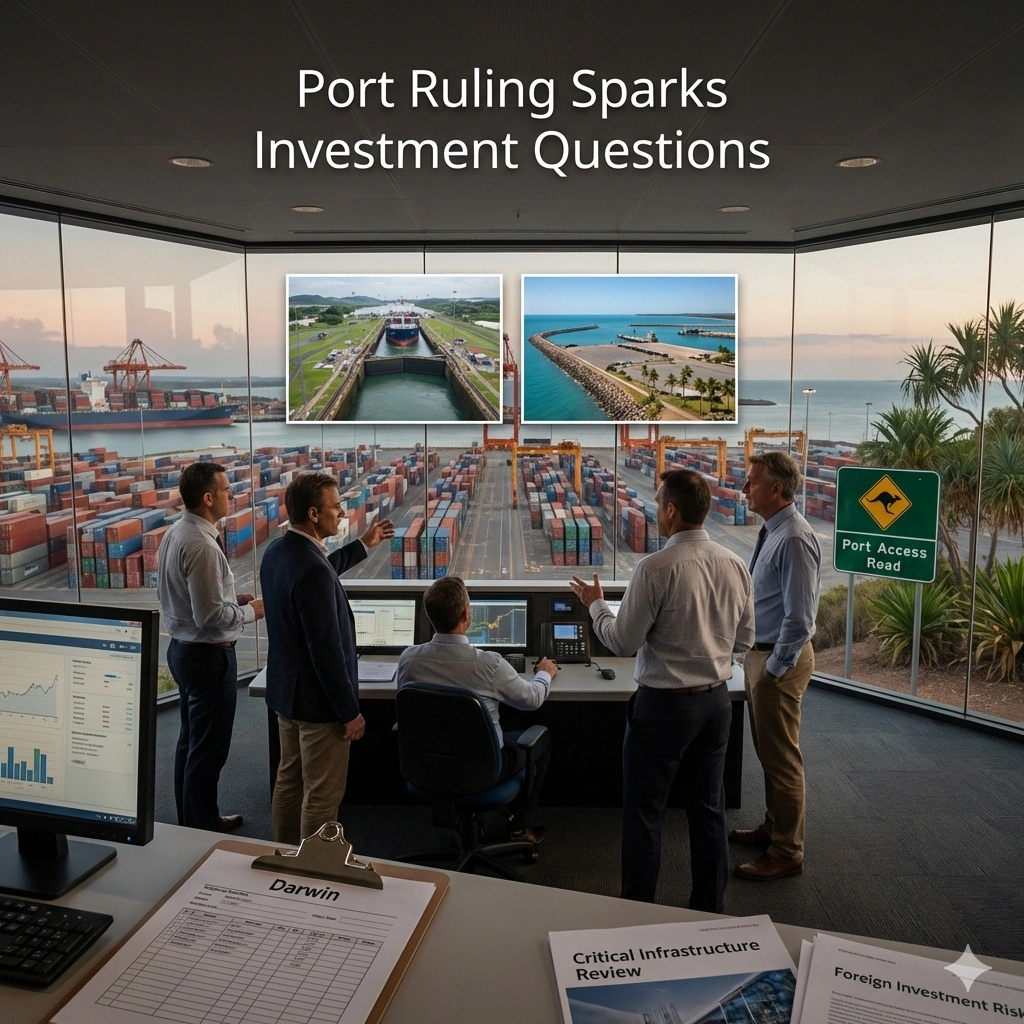
What the Panama Canal Port Ruling Means
The Panama Canal port ruling refers to Panama’s Supreme Court decision to invalidate key port contracts connected to a subsidiary of CK Hutchison, a Hong Kong-based conglomerate. The agreements covered management of container terminals located at both the Pacific and Atlantic entrances of the canal.
According to international reporting, the contracts were declared unconstitutional, creating uncertainty over future operations, ownership arrangements, and continuity of services at these strategically important sites.
Because the Panama Canal is one of the world’s most critical shipping routes, any disruption or legal uncertainty around port management can quickly draw global attention from governments, investors, and logistics operators.
Why Analysts Say Australia Should Pay Attention
Policy experts note that while the canal itself is not central to most Australian supply chains, the broader implications of the Panama Canal port ruling could still affect Australia’s domestic debates on foreign investment.
The case is being discussed as a practical example of how political, legal, and geopolitical factors can reshape major infrastructure agreements after they have already been approved. Analysts argue that sudden reversals or legal challenges can create market volatility and complicate long-term planning for both governments and private investors.
In Australia’s context, the episode is often compared with ongoing sensitivities surrounding foreign involvement in assets such as the Port of Darwin, which has previously been the subject of national security and investment scrutiny.
Investment Credibility and Market Confidence
One of the central concerns highlighted in commentary is the impact of the Panama Canal port ruling on perceptions of “investment credibility.” When major contracts are overturned, investors may begin to question whether regulatory frameworks are predictable and durable.
Such uncertainty can have several consequences:
- Reduced appetite for large infrastructure investments
- Higher financing costs due to perceived political risk
- Delays in future projects
- Increased due diligence requirements
Analysts warn that even when rulings are framed as legitimate legal enforcement, they can still be interpreted through a geopolitical lens, especially when strategic infrastructure and foreign state-linked companies are involved.
Risk of Political and Commercial Retaliation
Another issue raised in the debate is the possibility of retaliatory economic or political responses. Commentary linked to Chinese state-affiliated voices has suggested companies should reassess exposure in markets where contracts could be reversed after approval.
This type of reaction can affect bilateral trade relations, investment flows, and long-term partnership planning. Governments therefore face the challenge of balancing national security concerns with the need to maintain a stable and attractive investment environment.
Lessons for Managing Foreign Investment in Strategic Assets
The Panama Canal port ruling is increasingly being framed as a case study in how countries should handle both the approval and potential unwinding of foreign investments in critical infrastructure.
Policy analysts argue that clearer, risk-informed frameworks could help governments:
- Define which assets qualify as strategic or sensitive
- Establish transparent review mechanisms before approvals
- Provide legal certainty for investors
- Reduce the likelihood of costly reversals
In Australia’s case, experts suggest that consistent rules would help avoid cycles in which projects are first approved and later reconsidered due to shifting political or security concerns.
Broader Implications for Global Infrastructure Investment
Beyond Panama and Australia, the situation highlights a wider trend in which infrastructure projects are increasingly viewed through a geopolitical and national security lens. Ports, energy systems, telecommunications networks, and logistics hubs are now considered critical nodes in economic resilience.
As competition between major powers intensifies, governments are tightening screening processes for foreign investment while investors are becoming more cautious about political risk. The Panama Canal port ruling illustrates how legal decisions in one jurisdiction can influence global perceptions of stability and partnership reliability.
For policymakers, the key challenge is finding a balance between safeguarding strategic assets and maintaining open investment channels that support economic growth. For investors, the episode underscores the importance of understanding regulatory environments, political sensitivities, and long-term contractual protections before committing capital.
For more details & sources visit: Lowy Institute (The Interpreter)
For more Australia-related updates, visit our Australia News page.