
Pakistan Türkiye agriculture deals have taken a significant step forward as Islamabad formalized two major technology-focused Memorandums of Understanding (MoUs) with Turkish partners on February 14, 2026. The agreements aim to modernize farming systems, improve livestock productivity, and accelerate export-led economic growth following Pakistan’s recent macroeconomic stabilization.
Facilitated under the Special Investment Facilitation Council (SIFC), the agreements are designed to fast-track foreign investment and eliminate bureaucratic hurdles in strategic sectors including agriculture, livestock, tourism, and minerals.
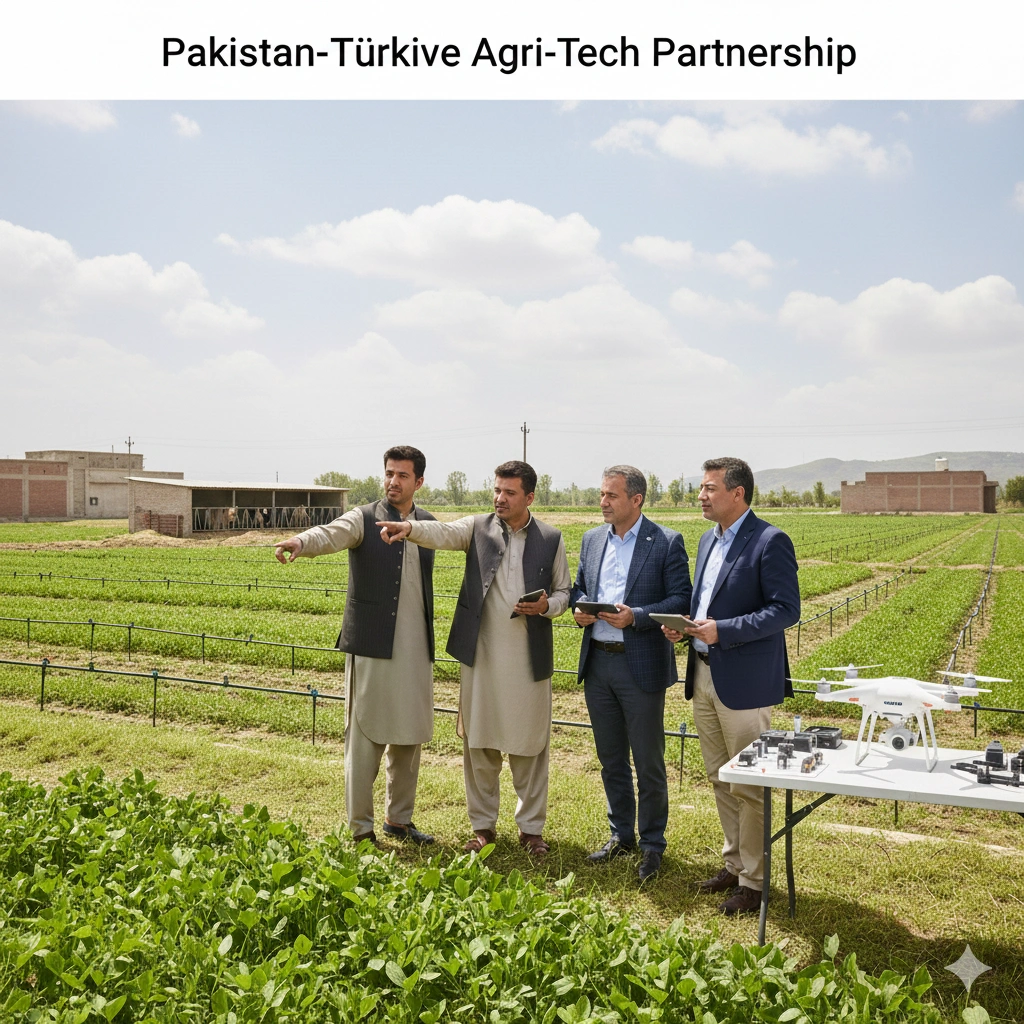
Strategic Partnerships Under SIFC Framework
The new agreements connect the Pakistan Agricultural Research Council with Türkiye’s Agricultural Technologies Cluster (TÜME), while Pakistan’s Green Corporate Livestock Initiative (Pvt.) Ltd. partners with Turkish firm Dost Agriculture Enterprises.
These collaborations will focus on:
- Advanced crop science and research
- Precision farming technologies
- Climate-resilient agricultural practices
- Modern corporate livestock management
- Sustainable and export-oriented value chains
Officials say the partnerships are structured to ensure that agreements move beyond paperwork and deliver measurable economic outcomes, including increased rural employment, higher farm incomes, and improved export competitiveness.
Technology Transfer and Capacity Building
Under the broader framework of the Pakistan Türkiye agriculture deals, one MoU emphasizes research collaboration and structured technology transfer between the Pakistan Agricultural Research Council and Türkiye’s Agricultural Technologies Cluster (TÜME). The initiative is designed to significantly strengthen Pakistan’s agricultural research ecosystem by introducing modern innovations in seed development, irrigation efficiency, precision farming, and smart agriculture tools.
Capacity building is a central pillar of the agreement. Through joint research initiatives and knowledge exchange programs, Pakistani scientists and agricultural professionals are expected to gain exposure to Türkiye’s cutting-edge agri-tech systems. This will enable local adaptation of advanced solutions tailored to Pakistan’s diverse agro-climatic zones.
Corporate Livestock Farming for Export Markets
The second MoU focuses on transforming Pakistan’s livestock sector through corporate farming models. The collaboration between GCLI and Dost Agriculture Enterprises will promote:
- Improved animal health systems
- Sustainable production techniques
- Efficient feed management
- Modern meat and dairy processing
- Export-focused value chain development
Livestock is already a major contributor to Pakistan’s agricultural GDP. By introducing structured corporate models and technology-driven management practices, policymakers aim to increase productivity while ensuring compliance with international sanitary and phytosanitary standards.
SIFC’s Role in Fast-Tracking Investment
Established in 2023, the Special Investment Facilitation Council serves as a civil-military coordination platform to streamline foreign investment in priority sectors. By functioning as a one-window operation, the SIFC reduces regulatory delays and improves coordination between ministries, investors, and provincial authorities.
Federal Secretary SIFC Jamil Qureshi highlighted that Pakistan’s fertile land, strategic location, and young workforce, when combined with Türkiye’s technological expertise, could unlock “new pathways for productivity, value addition, and global market access.”
The government views these Pakistan Türkiye agriculture deals as part of a broader export-led recovery strategy following its IMF-supported economic stabilization program.
Export-Led Recovery and Rural Prosperity
Pakistan’s economic recovery plan increasingly relies on strengthening productive sectors capable of generating foreign exchange. Agriculture and livestock account for a significant share of employment and exports, making modernization essential for sustainable growth.
By improving yields, reducing post-harvest losses, and upgrading processing facilities, the agreements aim to position Pakistan as a competitive supplier in regional and global food markets.
Officials stress that the real success of these deals will depend on implementation speed and measurable outcomes. Islamabad has pledged to maintain a business-friendly environment to ensure that signed agreements translate into:
- Higher export volumes
- Increased rural incomes
- Greater foreign investment inflows
- Job creation in agribusiness sectors
Strengthening Pakistan-Türkiye Economic Relations
Türkiye and Pakistan share longstanding diplomatic and economic ties. These new agriculture-focused agreements add strategic depth to bilateral cooperation by moving beyond trade into technology-driven industrial collaboration.
As both countries look to diversify export markets and strengthen food security, this partnership signals a forward-looking approach centered on innovation, sustainability, and global competitiveness.
With structured institutional support from the SIFC, the Pakistan Türkiye agriculture deals are positioned to play a pivotal role in reshaping Pakistan’s agri-economy and reinforcing its long-term export ambitions.
For more details & sources visit: Arab News
Read more on Turkey news: 360 News Orbit – Turkey