
The recent Pakistan Constitutional Amendment approved on November 12 has ignited intense national debate, as lawmakers passed sweeping changes that grant unprecedented powers and lifelong immunity to Army Chief Field Marshal Asim Munir. The amendment, formally known as the 27th Constitutional Amendment, also restructures the judicial hierarchy, reducing the authority of the Supreme Court and further entrenching military influence in Pakistan’s political system.
A Transformational Shift in Civil-Military Power Dynamics
Under the new amendment, Asim Munir is appointed Chief of Defence Forces, a role that consolidates oversight of all military branches under his permanent authority. The amendment also ensures he receives lifelong legal immunity, shielding him from any form of prosecution regardless of future political developments.
In addition to expanding the military leadership’s authority, the Pakistan Constitutional Amendment introduces a new Federal Constitutional Court. This body, appointed by the executive branch, will sit above the Supreme Court—a move widely criticized as weakening judicial independence and granting the government increased control over constitutional interpretation.
Legal Experts Warn of Deepening Military Dominance
Prominent political observers and scholars have raised alarms about the long-term implications of the amendment. Georgetown University professor Aqil Shah described the change as a continuation of military dominance over civilian institutions, warning that it may permanently tilt Pakistan’s already delicate civil-military balance.
Constitutional lawyer Salahuddin Ahmed was even more direct, characterizing the amendment as a step toward a “lifelong dictatorship.” He noted that granting immunity and consolidated authority to a single military leader sets a precedent that undermines democratic norms and accountability.
Opposition Boycotts Vote, Calling It a Democratic “Funeral”
The legislation passed quickly through both the National Assembly and Senate, backed strongly by the ruling coalition led by Prime Minister Shehbaz Sharif. However, opposition parties—including the Pakistan Tehreek-e-Insaf (PTI)—boycotted the vote entirely.
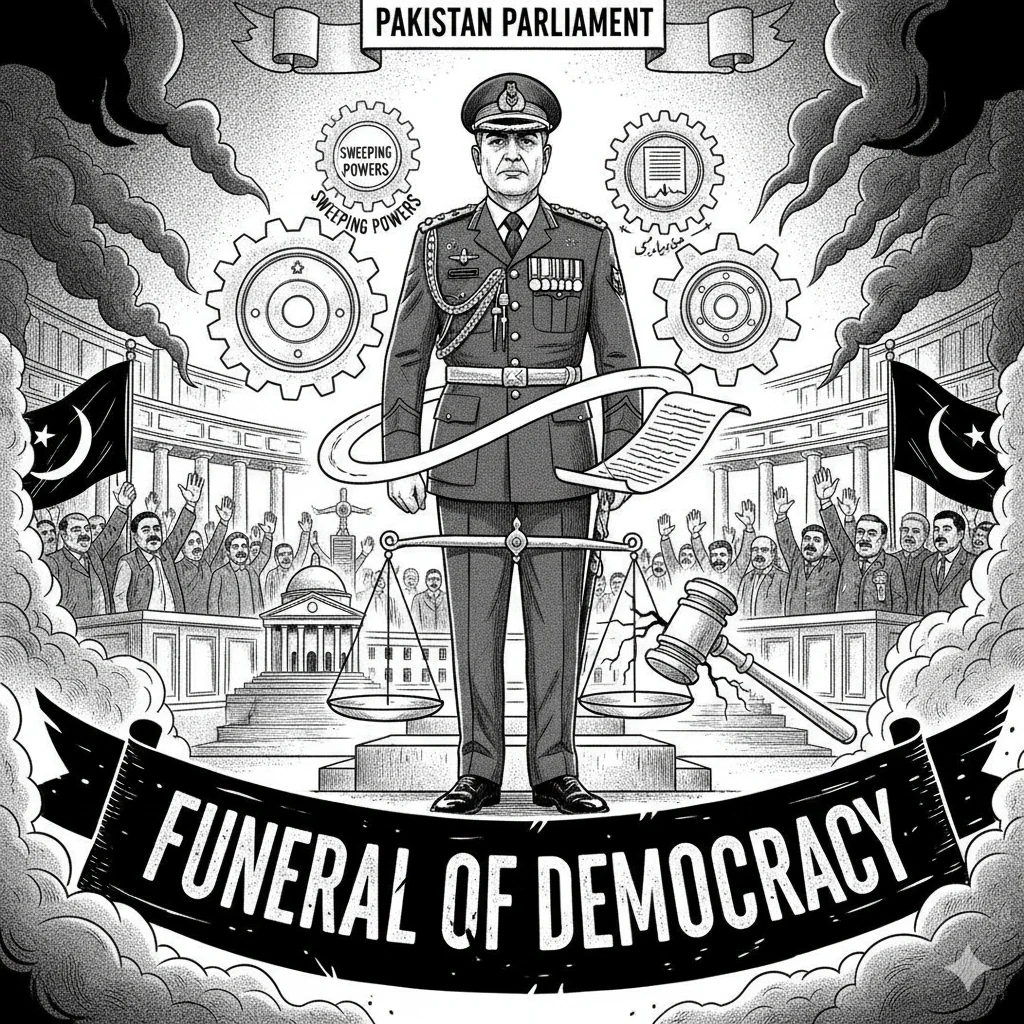
Opposition figures and civil society groups described the Pakistan Constitutional Amendment as the “funeral of democracy,” arguing that it formalizes military intervention in governance. Critics accuse the government of bypassing proper constitutional debate and rushing the bill through parliament without transparency or public consultation.
Human rights organizations added that the amendment undermines separation of powers by placing a politically appointed court above the Supreme Court, effectively “tampering with the constitution” and eroding checks and balances.
Government Defends Amendment as Necessary for Institutional Modernization
Despite widespread criticism, the government has defended the amendment as essential for strengthening national security and modernizing Pakistan’s defense structure. Prime Minister Shehbaz Sharif and coalition leaders argue that granting the military chief expanded authority will streamline defense operations and enhance coordination among armed forces.
Supporters claim that the new constitutional court is intended to reduce case backlog and speed up constitutional interpretations, though legal experts dispute these explanations, pointing to the executive’s expanded control over judicial appointments.
A Nation Divided as Political Uncertainty Grows
The Pakistan Constitutional Amendment has further polarized public opinion at a time of ongoing political instability. The move raises significant questions about the future of civilian rule, judicial independence and democratic governance in Pakistan.
As reactions continue to unfold, analysts warn that the amendment’s long-term effects may reshape Pakistan’s institutional landscape for decades. Many fear that the concentration of military power and diminishing judicial oversight will leave limited room for democratic recovery.
For now, Pakistan enters a new era—one defined by a dramatic reconfiguration of constitutional authority, escalating civil-military tensions and uncertainty about what comes next for its democratic institutions.