
The Nikkei 225 gains represent a significant shift in the Asian financial landscape as Tokyo equities hit multi-month highs during Thursday’s active trading session. Investors flooded the market with buy orders following a string of positive corporate earnings reports and a stabilizing yen, which provided a much-needed tailwind for the nation’s massive export sector. This sudden surge in liquidity suggests that international hedge funds are repositioning their portfolios toward Japanese assets in anticipation of continued fiscal support. As global markets look for stability, Japan’s unique blend of technological prowess and industrial reliability makes it a primary focus for institutional capital.
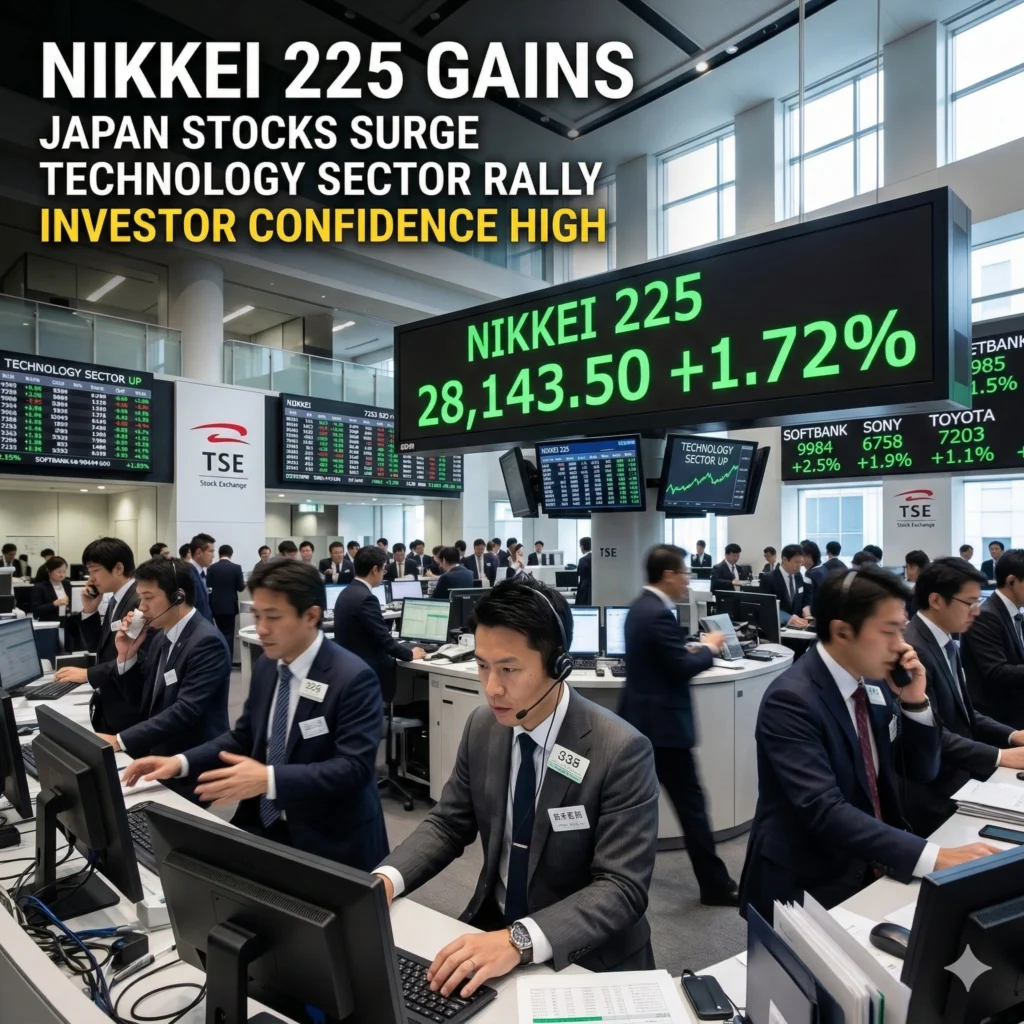
Nikkei 225 Gains Drive Global Investor Sentiment
The recent Nikkei 225 gains have sent a ripple of confidence through the global financial community as traders react to the index’s 1.72 percent jump. Market analysts noted that the upward movement was not merely a technical bounce but rather a fundamental shift driven by domestic demand and international interest. Large-scale buying was observed across the electronics and automotive sectors, which traditionally lead the charge during periods of economic recovery. This broad-based participation indicates a healthy market internal structure that could support higher valuations in the coming weeks.
Economic indicators released earlier in the day showed that manufacturing output in Japan is reaching levels not seen since the previous fiscal year. Consequently, the Nikkei 225 gains are being viewed as a validation of the current industrial policy aimed at digitizing the economy. Firms specializing in robotics and factory automation saw their share prices climb as orders from North America and Europe continued to exceed expectations. If this trend persists, the Tokyo Stock Exchange could see a prolonged period of outperformance compared to its regional peers in Asia.
Technology Sector Leads Market Momentum
High-tech industries played a pivotal role in securing the Nikkei 225 gains during this high-volume session. Semiconductor manufacturers and suppliers of specialized chemical components for chips were the top performers, benefiting from the global artificial intelligence boom. As companies worldwide rush to build data centers, Japanese firms providing the necessary hardware and cooling systems are seeing record-breaking contract wins. This technological dominance ensures that the Japanese market remains a critical node in the global supply chain, attracting long-term strategic investment.
Furthermore, software development companies and digital infrastructure providers are seeing increased valuation multiples as the government pushes for nationwide digital transformation. The Nikkei 225 gains reflect the market’s belief that Japan is closing the digital gap with its Western counterparts. Investors are particularly optimistic about the integration of AI into traditional manufacturing processes, which is expected to boost productivity across the board. This synergy between old-guard industry and new-age technology is a unique selling point for the Nikkei 225 index.
Nikkei 225 Gains
The Nikkei 225 gains are fundamentally supported by the Bank of Japan’s cautious but steady approach to monetary policy. While other central banks have struggled with aggressive interest rate hikes, Japan has maintained a level of predictability that appeals to risk-averse investors. This stability allows corporations to plan long-term capital expenditures without the fear of sudden spikes in borrowing costs. As a result, many Nikkei-listed companies have announced ambitious share buyback programs, further fueling the upward trajectory of the index.
Corporate governance reforms are also contributing to the Nikkei 225 gains by making companies more accountable to their shareholders. Improved transparency and a focus on return on equity have made Japanese stocks more attractive to pension funds and sovereign wealth funds. These institutional players provide the “sticky” capital that prevents excessive volatility and encourages steady growth over time. The combination of fiscal responsibility at the corporate level and supportive government policy creates a “goldilocks” scenario for equity markets in Tokyo.
Export Resilience and Currency Stability
A key factor behind the Nikkei 225 gains is the resilience of Japan’s major exporters in the face of fluctuating global trade conditions. Major automakers and machinery producers have successfully navigated supply chain disruptions to meet the rising demand for high-quality Japanese goods. The stabilizing yen has made these exports more competitive on the world stage without causing significant inflationary pressure at home. This balance is crucial for maintaining the profit margins that investors look for when allocating funds to the Nikkei 225 index.
The shipping and logistics sectors also contributed to the Nikkei 225 gains as trade volumes between Japan and Southeast Asia reached new heights. Regional trade agreements have opened up fresh markets for Japanese consumer products, providing a diversified revenue stream for the index’s largest constituents. As global trade routes evolve, Japan’s strategic location and advanced port infrastructure give it a logistical advantage. This logistical edge translates directly into corporate earnings, which are the ultimate engine driving the current market rally.
Institutional Allocation and Future Outlook
As we analyze the Nikkei 225 gains, it is clear that institutional investors are no longer viewing Japan as a peripheral market. The Tokyo Stock Exchange is increasingly seen as a safe haven with significant growth potential, especially given the current geopolitical uncertainties elsewhere. Analysts expect that more capital will flow into the Nikkei 225 gains as the fiscal year comes to a close and investment targets are revised upward. The current momentum suggests that the 1.72 percent gain is just the beginning of a larger cyclical upswing.
Looking ahead, the sustainability of the Nikkei 225 gains will depend on the continued innovation within the private sector and the maintenance of a favorable interest rate environment. If the technology sector continues to deliver groundbreaking solutions in the fields of green energy and automation, the index could test new historical resistance levels. Retail investors are also beginning to return to the market, adding another layer of support to the current price action. For now, the sentiment remains overwhelmingly positive as the Nikkei 225 gains dominate the financial headlines.
Impact of Semiconductor Demand on Equities
The global hunger for advanced processors has been a primary catalyst for the Nikkei 225 gains seen this week. Japanese firms that produce the lithography equipment and high-purity wafers required for chip fabrication have seen their order books fill up for the next two years. This visibility into future revenue provides a level of certainty that is highly prized by equity analysts. Because these companies hold significant weight within the index, their success is almost synonymous with the Nikkei 225 gains.
Moreover, the government’s subsidies for domestic chip production are starting to bear fruit, with new facilities being constructed across the country. These projects create thousands of jobs and stimulate local economies, which in turn boosts consumer spending and benefits the broader stock market. The Nikkei 225 gains are a reflection of this virtuous cycle where industrial investment leads to economic prosperity. As long as the world remains dependent on silicon, the Japanese technology sector will likely continue to thrive and drive index performance.
Consumer Confidence and Domestic Spending
While exports are vital, the Nikkei 225 gains are also being supported by a noticeable uptick in domestic consumer confidence. Wages in several key industries have begun to rise, giving households more disposable income to spend on retail goods and services. This internal demand provides a buffer against external economic shocks and ensures that the Nikkei 225 gains are built on a solid foundation of domestic growth. Retailers and department store chains within the index have reported strong sales figures, further validating the bullish narrative.
The tourism sector has also staged a remarkable comeback, with millions of international visitors contributing to the bottom lines of transport and hospitality companies. This influx of foreign currency adds to the overall liquidity of the Japanese economy and supports the Nikkei 225 gains. As airlines and railway operators see their passenger numbers return to pre-pandemic levels, their stock prices have responded accordingly. This multifaceted recovery across different sectors illustrates why the Nikkei 225 gains are so comprehensive and resilient in the current environment.
Strategic Importance of the Tokyo Stock Exchange
The Tokyo Stock Exchange has worked tirelessly to modernize its listing requirements, which has directly influenced the Nikkei 225 gains. By encouraging companies to focus on shareholder value and divest from non-core assets, the exchange has created a more dynamic and efficient marketplace. These structural changes are attracting a new generation of investors who prioritize transparency and ethical management. The Nikkei 225 gains are the reward for these long-term efforts to make the Japanese market a world-class destination for capital.
Furthermore, the rise of “green” investing has benefited the Nikkei 225 gains, as many Japanese firms are leaders in environmental technology and sustainable manufacturing. Companies that excel in ESG (Environmental, Social, and Governance) metrics are receiving higher weightings in global indices, leading to automatic inflows of capital. This trend is expected to accelerate as more countries commit to carbon neutrality goals. By positioning itself as a leader in sustainable industry, Japan ensures that the Nikkei 225 gains remain relevant in a changing global economy.
Summary of Market Performance and Liquidity
The high-volume trading observed during the Nikkei 225 gains highlights the deep liquidity available in the Japanese market. Unlike smaller exchanges that can be prone to erratic swings, the Nikkei 225 provides a stable environment for large-scale transactions. This liquidity is essential for pension funds and insurance companies that need to move large amounts of capital without significantly impacting the market price. The ability of the index to absorb such high volume while maintaining an upward trajectory is a testament to its current strength.
In conclusion, the Nikkei 225 gains of 1.72 percent represent a convergence of positive factors ranging from technological leadership to prudent monetary policy. As the index closes at these elevated levels, the focus will shift to whether these gains can be sustained in the long term. Given the current economic indicators and the positive sentiment among both domestic and international investors, the outlook remains bright. The Nikkei 225 gains are more than just a number; they are a sign of a rejuvenated and powerful Japanese economy ready to compete on the global stage.
For more details & sources visit: Meyka
For the latest updates from Japan, visit our Japan news page.