
The Netherlands Space Operations Centre (NSpOC) has officially integrated GMV’s Ecosstm® software, marking a pivotal shift toward Dutch strategic autonomy in orbit. By selecting this Spanish-developed technology, the Royal Netherlands Air and Space Force (RNLAF) is moving to independently monitor the increasingly congested space environment, ensuring the protection of critical national navigation and intelligence assets without total reliance on external partners.
The implementation of the Netherlands Space Operations GMV platform allows the Dutch military to track satellites, manage complex space traffic, and detect potential collisions in real-time. This move aligns the Netherlands with other European powerhouses like Germany and Spain, which already utilize the Ecosstm® system to maintain sovereign space situational awareness (SSA). As low Earth orbit (LEO) becomes more crowded with commercial mega-constellations and military hardware, the ability to independently assess conjunction risks has transitioned from a strategic luxury to an operational necessity.
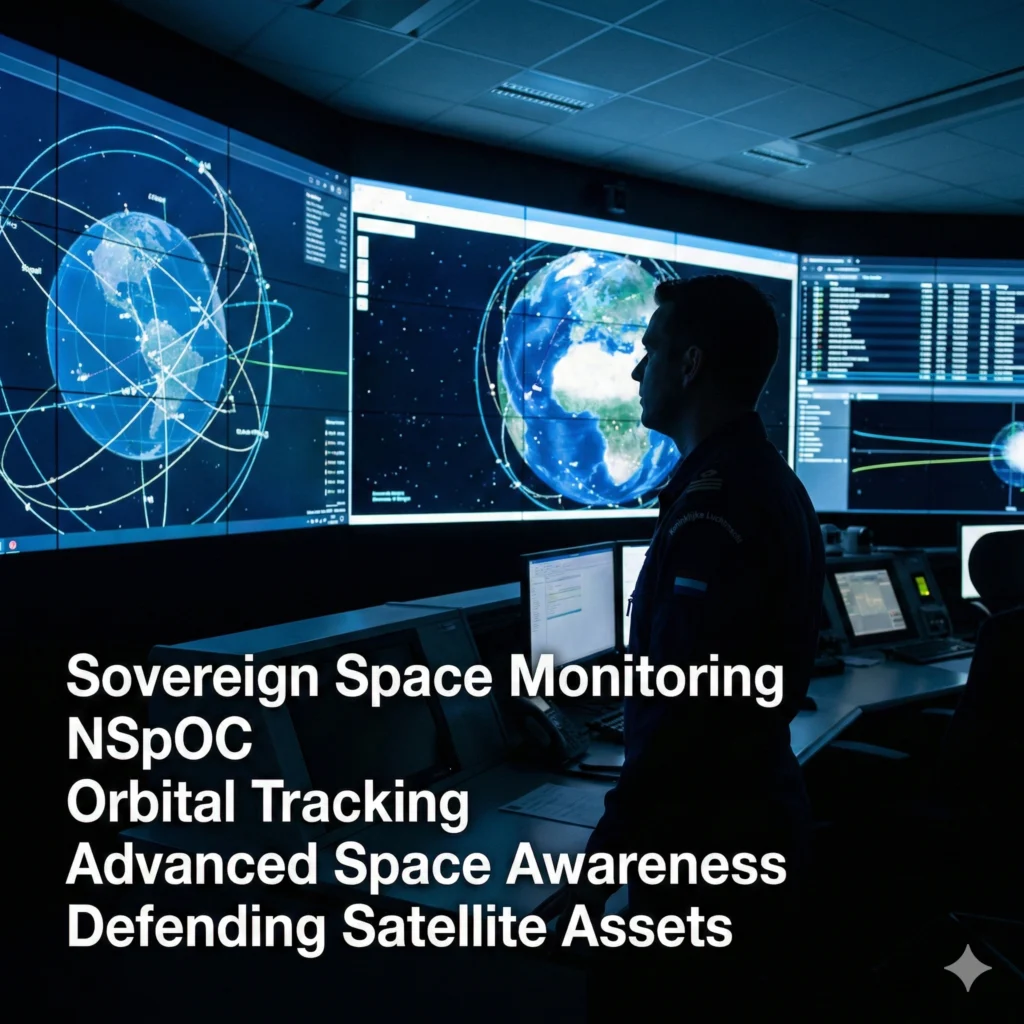
Netherlands Space Operations GMV and the Ecosstm® Integration
The core of the Netherlands Space Operations GMV initiative is the Ecosstm® software suite, a globally recognized platform for Space Surveillance and Tracking (SST). This system provides the RNLAF with a sophisticated “dashboard” for the cosmos, capable of processing massive datasets to identify anomalies or sudden changes in satellite behavior. By establishing a national operational architecture around this software, the Netherlands can now conduct its own independent audits of the space environment.
Beyond simple tracking, the Netherlands Space Operations GMV system supports advanced orbital mechanics calculations. This is essential for “conjunction assessment,” the process of predicting when two objects—such as a Dutch military satellite and a piece of space debris—might collide. With the Ecosstm® platform, NSpOC can issue early warnings and recommend evasive maneuvers, significantly extending the operational lifespan of expensive orbital hardware.
The software also plays a critical role in monitoring “re-entry events,” where decommissioned satellites or rocket stages fall back into the atmosphere. The Netherlands Space Operations GMV system allows the Dutch government to predict impact zones with greater accuracy, enhancing public safety and coordinating with international maritime and aviation authorities during high-risk descents.
Building Sovereign Capabilities in Low Earth Orbit
The decision to pursue the Netherlands Space Operations GMV contract reflects a growing trend across Europe toward “strategic autonomy.” For decades, many European nations relied heavily on U.S. Space Command data for their orbital awareness. However, as space becomes a contested warfighting domain, the Netherlands has recognized the need for a sovereign “eyes-on” capability that remains under national control during times of geopolitical tension.
- Independent maintenance of a high-accuracy space object catalog.
- Detection of foreign overflight events for national security.
- Direct integration with Dutch-owned radar and optical sensor networks.
- Reduced latency in receiving and processing critical orbital alerts.
By utilizing the Netherlands Space Operations GMV technology, the NSpOC can tailor its monitoring priorities to the specific needs of the Dutch armed forces and commercial partners. This includes protecting the “Galileo” navigation signals and “Copernicus” Earth observation data that the Dutch economy relies upon daily. The move ensures that the Netherlands is not just a consumer of space data, but a sophisticated provider within the European ecosystem.
Collaboration with NATO and EU Security Frameworks
While the Netherlands Space Operations GMV project focuses on national sovereignty, it is designed to be fully interoperable with NATO and European Union SST (EU SST) initiatives. The Ecosstm® software acts as a “common language” that allows NSpOC to share data seamlessly with military space centers in Spain and Germany. This collaborative approach creates a distributed network of sensors and analysts that improves the safety of all European assets in orbit.
The Netherlands Space Operations GMV integration specifically supports NATO’s recognition of space as a primary operational domain. By contributing high-quality tracking data to the alliance, the Netherlands enhances the collective defense of shared satellite networks. This synergy between national autonomy and international cooperation is a key pillar of the 2026 Dutch defense strategy.
- Shared sensor tasking to cover blind spots in the European radar network.
- Joint development of anti-jamming protocols for satellite communications.
- Collaborative tracking of “inspector satellites” and other suspicious orbital maneuvers.
- Unified reporting standards for space debris mitigation.
The Netherlands Space Operations GMV contract reinforces GMV’s position as the primary industrial partner for European space security. As more nations adopt this technology, a unified European “Space Command” structure becomes more feasible, providing a robust counterweight to other global space powers.
Managing Orbital Congestion and Collision Avoidance
As of early 2026, the number of active and inactive objects in orbit has reached record levels, making the Netherlands Space Operations GMV software more vital than ever. The Ecosstm® platform uses advanced AI to filter through thousands of potential conjunctions, highlighting only those that pose a credible threat. This prevents “alert fatigue” among operators and ensures that responses are measured and data-driven.
[Image showing the density of satellites and debris in Low Earth Orbit]
The Netherlands Space Operations GMV system is also capable of managing “automated station-keeping” for modern satellite constellations. As more Dutch commercial entities launch small-sats into LEO, the NSpOC can provide “Traffic Management as a Service” (TMAS). This ensures that the sovereign space over the Netherlands remains a safe and viable environment for future economic exploration and innovation.
Detecting “overflight events” is another specialized function of the Netherlands Space Operations GMV platform. This allows the military to know exactly when foreign reconnaissance satellites are passing over sensitive Dutch territory. Having this information in real-time allows for the implementation of camouflage or electronic masking, protecting national secrets from prying eyes in the sky.
Technology Operational Status: Germany, Spain, and Greece
The reliability of the Netherlands Space Operations GMV choice is underscored by the system’s proven track record in other European nations. Germany’s Space Situational Awareness Center (GSSAC) and Spain’s S3TOC have both successfully utilized the Ecosstm® suite for several years. This existing operational footprint provides the Dutch military with a wealth of “lessons learned” and technical documentation to speed up their own integration process.
In Greece, the technology has even been adapted for civilian space traffic management, showing the versatility of the Netherlands Space Operations GMV approach. This cross-sector reliability is important for the RNLAF, which often works in tandem with civilian aerospace organizations like the Netherlands Space Office (NSO). The unified software environment makes it easier for these different agencies to collaborate on large-scale space projects.
The Netherlands Space Operations GMV implementation is thus a “low-risk, high-reward” strategy. By adopting a system that is already the industry standard in Europe, the NSpOC can achieve operational status much faster than if they had attempted to build a bespoke system from scratch. This efficiency is critical as the pace of orbital launches continues to accelerate in 2026.
Protecting National Navigation and Intelligence Assets
The primary mission of the Netherlands Space Operations GMV system is the defense of Dutch “high-value” assets. In the modern era, the military’s ability to navigate, communicate, and gather intelligence is almost entirely dependent on satellite constellations. Any interruption to these services—whether through collision or hostile action—would have a devastating impact on national security.
By using the Ecosstm® platform, the NSpOC can create a “protective bubble” around these assets. The software can detect the subtle orbital shifts of a nearby object that might indicate a planned intercept or interference. The Netherlands Space Operations GMV system provides the early warning time required to activate defensive measures or relocate sensitive tasks to other platforms.
- Monitoring the health and telemetry of the MilSatCom (Military Satellite Communications) network.
- Ensuring the integrity of PNT (Positioning, Navigation, and Timing) signals for precision munitions.
- Tracking Earth observation satellites used for border monitoring and disaster response.
- Providing secure data links for the F-35 Lightning II’s advanced sensor suite.
The Netherlands Space Operations GMV project is an investment in the “resilience” of the Dutch state. It acknowledges that the ultimate high ground is now located 400 miles above the Earth’s surface and that controlling the information in that domain is the key to winning any modern conflict.
The Future of Dutch Space Strategic Autonomy
Looking toward the 2027 fiscal year and beyond, the Netherlands Space Operations GMV partnership is expected to expand into more advanced areas of space defense. This includes “Directed Energy” tracking and the monitoring of “Hypersonic Glide Vehicles” that travel through the upper atmosphere. The modular nature of the GMV software allows it to grow alongside the emerging threats of the next decade.
The RNLAF is also exploring the potential for “responsive space” capabilities—the ability to launch small satellites on short notice to replace those that have been damaged or destroyed. The Netherlands Space Operations GMV system would provide the initial orbital insertion parameters and immediate tracking for these emergency launches, ensuring a seamless transition from the ground to the stars.
Ultimately, the Netherlands Space Operations GMV contract is a signal to the world that the Netherlands is serious about its role as a spacefaring nation. It is a commitment to the safe and sustainable use of orbit for all mankind, backed by the technical muscle needed to enforce those standards. The Dutch “eyes on the sky” are now more powerful and more independent than ever before.
Conclusion: A Key Step Toward National Space Operations
The integration of GMV’s Ecosstm® software at the Netherlands Space Operations Centre is a definitive milestone in the modernization of the Royal Netherlands Air and Space Force. By prioritizing sovereign surveillance and tracking, the Netherlands Space Operations GMV initiative ensures that the nation can navigate the complexities of modern orbit with confidence. The transition from an optional capability to an operational necessity is now complete.
As the program becomes fully operational throughout 2026, the NSpOC will serve as a vital hub for both national and international space security. The Netherlands Space Operations GMV partnership provides the tools, the data, and the strategic edge needed to protect Dutch interests in the final frontier. The stars may be far away, but for the Dutch military, they have never been more clearly in focus.
The success of this implementation will likely serve as a model for other medium-sized powers looking to build their own space domain awareness. The Netherlands Space Operations GMV story is one of innovation, collaboration, and the unyielding pursuit of strategic autonomy. In the congested and contested environment of 2026, the Netherlands has proven it is ready to lead.
For more details & sources visit: Space & Defense
Read more on Netherland news: 360 News Orbit – Netherland.