
The Nahdlatul Ulama leadership crisis has plunged Indonesia’s largest Islamic organization into unprecedented turmoil, highlighting deep political, financial, and ideological divisions. The Supreme Council of Nahdlatul Ulama (NU) recently moved to remove Chairperson Yahya Cholil Staquf, widely known as Gus Yahya, igniting disputes that have split the organization into competing factions and raised concerns about its future political influence.
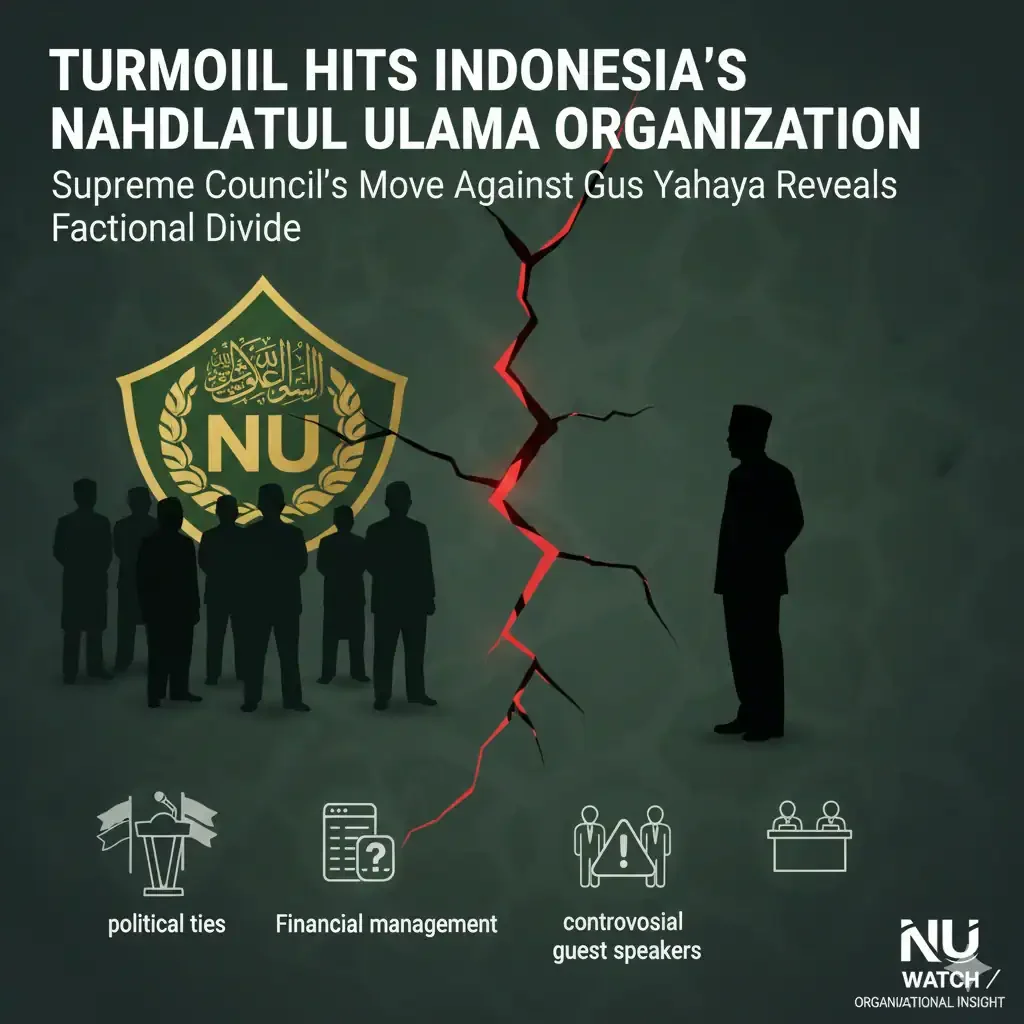
The Council cited multiple reasons for Gus Yahya’s dismissal, including allegations of financial mismanagement and his controversial invitation of a guest speaker supportive of Israel during the ongoing Gaza conflict. The decision has been met with strong resistance. Gus Yahya rejected the legitimacy of the Supreme Council’s action, refusing to step down and reshuffling key NU officials in defiance. This standoff has intensified internal friction and created a highly polarized environment within the organization.
Supreme Leader Kyai Miftachul Akhyar announced plans for an extraordinary congress to elect a successor while assuming the role of caretaker. The announcement has further formalized the division within NU, as one faction aligns with Kyai Miftach while another remains loyal to Gus Yahya. Observers note that these internal conflicts reflect broader tensions surrounding NU’s political alliances and strategic influence in Indonesian society.
Underlying the Nahdlatul Ulama leadership crisis are disputes over political affiliations, particularly NU’s relationship with President Prabowo Subianto’s administration. The organization’s engagement in national politics, combined with its control over key economic resources such as coal mining concessions, has intensified the stakes of the leadership struggle. Analysts suggest that these economic and political dimensions could reshape NU’s role in Indonesian governance and its influence over both Islamic and national elites.
The crisis has also raised questions about the organization’s ability to maintain unity and credibility amid growing factionalism. Members and observers are closely watching whether Gus Yahya’s faction or Kyai Miftach’s faction will ultimately consolidate authority. The outcome has implications not only for NU’s internal governance but also for its broader societal role, including its participation in upcoming elections and policymaking discussions.
Experts highlight that the Nahdlatul Ulama leadership crisis underscores the delicate balance between religious authority and political engagement in Indonesia. NU has historically been a major voice in shaping Islamic thought, education, and social policy, making its internal stability critical to both followers and the wider political landscape. The ongoing dispute could influence how NU engages with government authorities, civil society, and the international community, particularly on sensitive issues related to governance, human rights, and regional diplomacy.
Public reactions have been mixed. Some members view Gus Yahya as a progressive leader attempting to modernize the organization’s approach, while others criticize his leadership style and controversial decisions. Conversely, supporters of Kyai Miftach emphasize adherence to traditional structures and caution in political engagement. This internal debate reflects a broader challenge faced by religious organizations balancing tradition with modern political realities.
The resolution of the Nahdlatul Ulama leadership crisis remains uncertain, but the stakes are high. How NU navigates this internal conflict will likely determine its influence in Indonesian politics, its engagement with the Muslim community, and its ability to manage its economic and social programs effectively. Stakeholders both within Indonesia and internationally are closely monitoring developments, recognizing that the outcome could redefine the organization’s role in shaping the country’s religious and political future.
For the latest updates from Indonesia, visit our Indonesia news page.