
The Sudan Muslim Brotherhood terrorist designation has sent ripples through the international diplomatic community as the U.S. State Department officially labeled the faction a Specially Designated Global Terrorist organization. This landmark decision, announced on March 10, 2026, is a direct response to the group’s alleged role in fueling instability and its deep-seated ties to hostile foreign entities. Washington officials have clarified that the move is designed to isolate the group from the global financial system and disrupt its operational capacity within the Horn of Africa. This specific designation is scheduled to take full effect on March 16, 2026, marking a new chapter in American foreign policy toward the Sudanese conflict.
The Sudan Muslim Brotherhood terrorist designation comes at a critical juncture as the United States, Israel, and Iran remain locked in a broader regional military conflict. According to State Department reports, the Sudanese branch has maintained significant operational and financial links to the Iranian Revolutionary Guard Corps (IRGC). These connections have reportedly allowed the group to sustain its influence despite the ongoing Sudanese civil war, which has displaced millions. By targeting this specific faction, the U.S. government aims to weaken the broader network of entities supported by the Islamic Republic of Iran across the African continent.
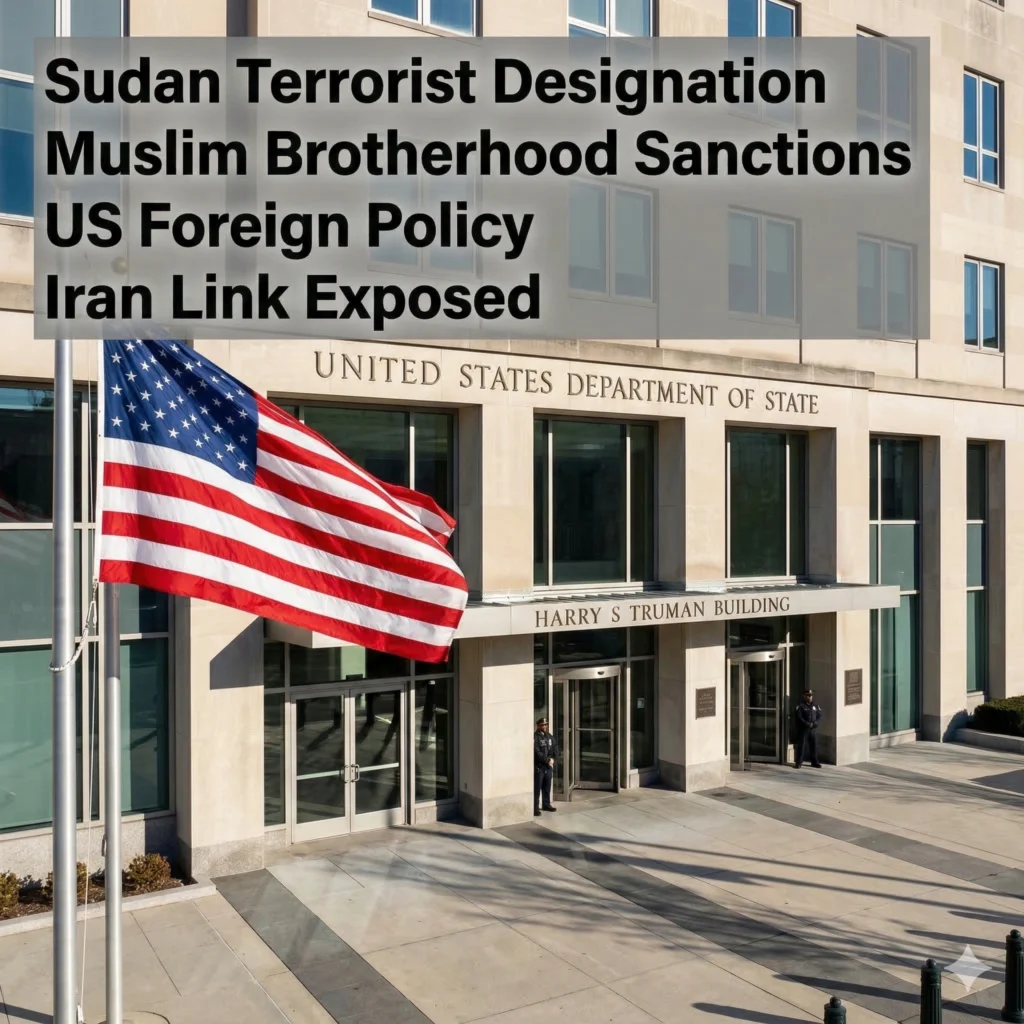
Sudan Muslim Brotherhood terrorist designation
The Sudan Muslim Brotherhood terrorist designation serves as a powerful tool to freeze the group’s assets and restrict its ability to move funds across international borders. Beyond the initial global terrorist label, State Department officials plan to categorize the faction as a Foreign Terrorist Organization (FTO) in the coming days. This dual-layered approach ensures that any individual or entity providing material support to the group faces severe legal and financial consequences. U.S. officials claim the group has actively hindered negotiated solutions and peace talks intended to end the devastating Sudanese civil war, making this intervention necessary for regional peace.
Furthermore, the Sudan Muslim Brotherhood terrorist designation is part of a wider strategy that has recently seen similar labels applied to chapters in Egypt, Jordan, and Lebanon. Washington believes these organizations represent a coordinated threat to international security and the stability of the Middle East and North Africa. By cutting off the Sudanese branch, the U.S. hopes to create a “cordon sanitaire” around extremist elements that have historically benefited from the chaos of failed states. The move is also intended to signal to the IRGC that its proxies in Africa will no longer operate with impunity.
Links to the Iranian Revolutionary Guard
The primary justification for the Sudan Muslim Brotherhood terrorist designation is the group’s documented collaboration with the Iranian Revolutionary Guard Corps. Intelligence reports suggest that Tehran has used the Sudanese faction as a logistical hub for moving hardware and personnel throughout the region. This partnership has not only prolonged the domestic power struggle in Sudan but has also threatened the security of neighboring nations aligned with the West. The U.S. government views the disruption of this “Iran-Sudan axis” as a top priority for 2026, especially as maritime security in the Red Sea remains a global concern.
- Documented financial transfers from IRGC-affiliated front companies to Khartoum.
- Joint training exercises involving Sudanese militants and Iranian tactical advisors.
- Coordination of propaganda efforts to undermine Western-backed peace initiatives.
- Smuggling of advanced weaponry through clandestine routes in the Sahara desert.
By formalizing the Sudan Muslim Brotherhood terrorist designation, the Treasury Department can now track and seize these illicit financial flows with greater authority. This economic pressure is expected to strain the relationship between the group and its Iranian benefactors, who are already facing intense international sanctions. The goal is to make the group a “liability” for Tehran, eventually forcing a withdrawal of Iranian support from the Sudanese theater. This strategy of maximum pressure is central to the current administration’s approach to neutralizing extremist threats.
Obstruction of Peace and Civil War Impact
One of the most tragic aspects highlighted by the Sudan Muslim Brotherhood terrorist designation is the group’s role in obstructing humanitarian and diplomatic efforts. While millions of Sudanese citizens suffer from famine and displacement, the Brotherhood faction has reportedly prioritized its own political survival over national stability. U.S. officials state that the group has repeatedly sabotaged ceasefire agreements and transition-to-civilian-rule frameworks. This obstructionism has left the international community with few options other than direct sanctioning to remove these spoilers from the negotiation table.
International humanitarian organizations are closely monitoring how the Sudan Muslim Brotherhood terrorist designation might impact the delivery of life-saving aid. There is a concern that the sanctions could inadvertently complicate the work of NGOs operating in areas controlled by various factions. However, the State Department has emphasized that “carve-outs” and licenses will be provided to ensure that food, medicine, and basic necessities reach the civilian population. The challenge lies in navigating the complex landscape of a war-torn nation while ensuring that no resources fall into the hands of the newly designated terrorist organization.
Regional Stability and International Security
The Sudan Muslim Brotherhood terrorist designation is more than just a local policy shift; it is a significant move for international security. Sudan’s strategic location on the Red Sea makes its internal stability a matter of global importance for trade and military transit. If a terrorist-linked faction were to seize permanent control, it could turn the country into a safe haven for groups targeting the Suez Canal or Mediterranean interests. Therefore, Washington views this designation as a preventative measure to protect global shipping lanes and the territorial integrity of nearby allies like Egypt and Saudi Arabia.
- Protection of critical maritime corridors in the Red Sea and Gulf of Aden.
- Prevention of the spread of extremist ideologies into the Sahel region.
- Strengthening of the “Abraham Accords” network against Iranian encroachment.
- Support for a democratic transition that excludes designated terrorist entities.
The move follows a pattern of heightened vigilance against non-state actors that use asymmetric warfare to achieve political goals. The Sudan Muslim Brotherhood terrorist designation sends a clear message that the U.S. will use all available diplomatic and financial tools to counter these threats. As the civil war in Sudan continues to evolve, the exclusion of the Brotherhood from the legitimate political process is expected to empower more moderate, pro-democracy voices. This shift in the internal power struggle could be the catalyst needed for a lasting resolution to the conflict.
Strategic Isolation of the Islamic Republic
At its core, the Sudan Muslim Brotherhood terrorist designation is a component of a larger campaign to isolate the Islamic Republic of Iran. By labeling its proxies as terrorists, the U.S. makes it legally hazardous for any third-party nation or corporation to engage with them. This “secondary sanction” effect is often more damaging than the primary designation itself, as it scares away potential investors and diplomatic partners. For Iran, the loss of a reliable partner in Khartoum would represent a significant setback in its quest for “strategic depth” across the Middle East and Africa.
The State Department’s focus on the Sudanese branch highlights the changing nature of the Muslim Brotherhood itself, which has fractured into various national factions with differing levels of radicalization. In the case of Sudan, the alignment with the IRGC was the “red line” that triggered the Sudan Muslim Brotherhood terrorist designation. This case-by-case evaluation allows Washington to be precise in its targets, focusing on the most dangerous elements of the movement while maintaining a dialogue with more moderate groups in other countries. This nuance is key to the 2026 counter-terrorism strategy.
Impact on Domestic Sudanese Politics
Sudanese political analysts suggest that the Sudan Muslim Brotherhood terrorist designation could significantly alter the internal dynamics of the domestic power struggle. For years, the group has exerted influence through a combination of military presence and social services, often acting as a “state within a state.” The sudden loss of legal status and financial access will likely lead to internal splintering and a loss of prestige. Moderate factions within the Sudanese military and civil society may see this as an opportunity to distance themselves from extremist elements and seek renewed international support.
However, there is also the risk that the Sudan Muslim Brotherhood terrorist designation could drive the group further underground, leading to more radicalized and desperate tactics. History has shown that when political paths are closed, some groups turn toward purely kinetic operations. The U.S. and its regional partners must be prepared for a potential spike in insurgent activity as the group reacts to its new pariah status. Ensuring that the Sudanese people see the benefits of peace will be the best defense against any recruitment efforts by the now-outlawed organization.
Global Financial Restrictions and Asset Freezes
The technical side of the Sudan Muslim Brotherhood terrorist designation involves the integration of the group into global “no-fly” and financial watchlists. Banks around the world utilize these lists to flag suspicious transactions, effectively “de-banking” the organization and its top leadership. This process is incredibly thorough, often involving the tracking of shell companies and crypto-currency wallets. By the time the sanctions take full effect on March 16, 2026, the group will find it nearly impossible to pay its fighters or purchase equipment through traditional channels.
This financial strangulation is a cornerstone of modern counter-terrorism. The Sudan Muslim Brotherhood terrorist designation allows the U.S. Treasury to work with international partners through the Financial Action Task Force (FATF) to close loopholes in the region. Since Sudan is already struggling with a fragile economy, the added pressure on the Brotherhood is intended to force a choice between total collapse and a genuine commitment to peace. The effectiveness of these measures will be closely watched by other nations facing similar proxy-led insurgencies.
Humanitarian Monitoring and Aid Delivery
As mentioned, the Sudan Muslim Brotherhood terrorist designation has raised concerns among humanitarian groups like the Red Cross and Doctors Without Borders. The fear is that the “terrorist” label might create a “chilling effect” where aid workers fear prosecution for working in areas where the group is present. To mitigate this, the U.S. has pledged to maintain an open dialogue with these organizations to ensure the flow of aid is not interrupted. Protecting the most vulnerable Sudanese citizens remains a stated priority, even as the government pursues its national security objectives.
- Regular briefings between the State Department and major NGOs.
- Clear guidelines on “permissible engagement” for humanitarian purposes.
- Monitoring of aid routes to prevent diversion by designated groups.
- Continued funding for refugee camps in neighboring Chad and Egypt.
The balance between security and humanitarianism is delicate. The Sudan Muslim Brotherhood terrorist designation is a test of the U.S. government’s ability to wage a targeted financial war without harming the population it claims to be helping. If successful, this policy could serve as a template for future designations in conflict zones where terrorist organizations and civilian populations are deeply intertwined. The ultimate measure of the policy’s success will be a reduction in violence and an increase in the reach of international relief efforts.
Conclusion and Future Outlook
The Sudan Muslim Brotherhood terrorist designation is a bold move that reaffirms the United States’ commitment to a stable and sovereign Sudan. By calling out the group’s links to Iran and its obstruction of peace, Washington has set a clear boundary for what is acceptable in international politics. As the March 16, 2026, deadline approaches, the global community will be watching to see how the group responds and whether this action leads to a breakthrough in the civil war. The transition from a local political actor to a global terrorist entity is a fall from grace that will have lasting repercussions for years to come.
Ultimately, the goal of the Sudan Muslim Brotherhood terrorist designation is to pave the way for a more inclusive and peaceful future for the Sudanese people. By removing a major spoiler from the equation, the international community hopes to restart the stalled transition to democracy. While the road ahead is fraught with challenges, the isolation of extremist elements is a necessary step toward healing a nation torn apart by war. The world remains hopeful that this decisive action by the U.S. State Department will contribute to the long-awaited silence of the guns in Khartoum and beyond.
For more details & sources visit: Atalayar
Read more on Sudan news: 360 News Orbit – Sudan.