
Mohamed Tadjadit, an Algerian poet and activist who became a powerful voice during the country’s 2019 Hirak protest movement, is facing the prospect of a life sentence amid an escalating crackdown on freedom of expression in Algeria. Rights groups warn that his case reflects a broader pattern of repression that continues despite Algeria’s formal democratic institutions and repeated government claims of reform.
Once a street fruit seller, Mohamed Tadjadit rose to national prominence by reciting sharp, politically charged poetry criticizing Algeria’s ruling elite. His words resonated widely during the Hirak protests, which mobilized millions of Algerians demanding political accountability, an end to corruption, and genuine democratic change.
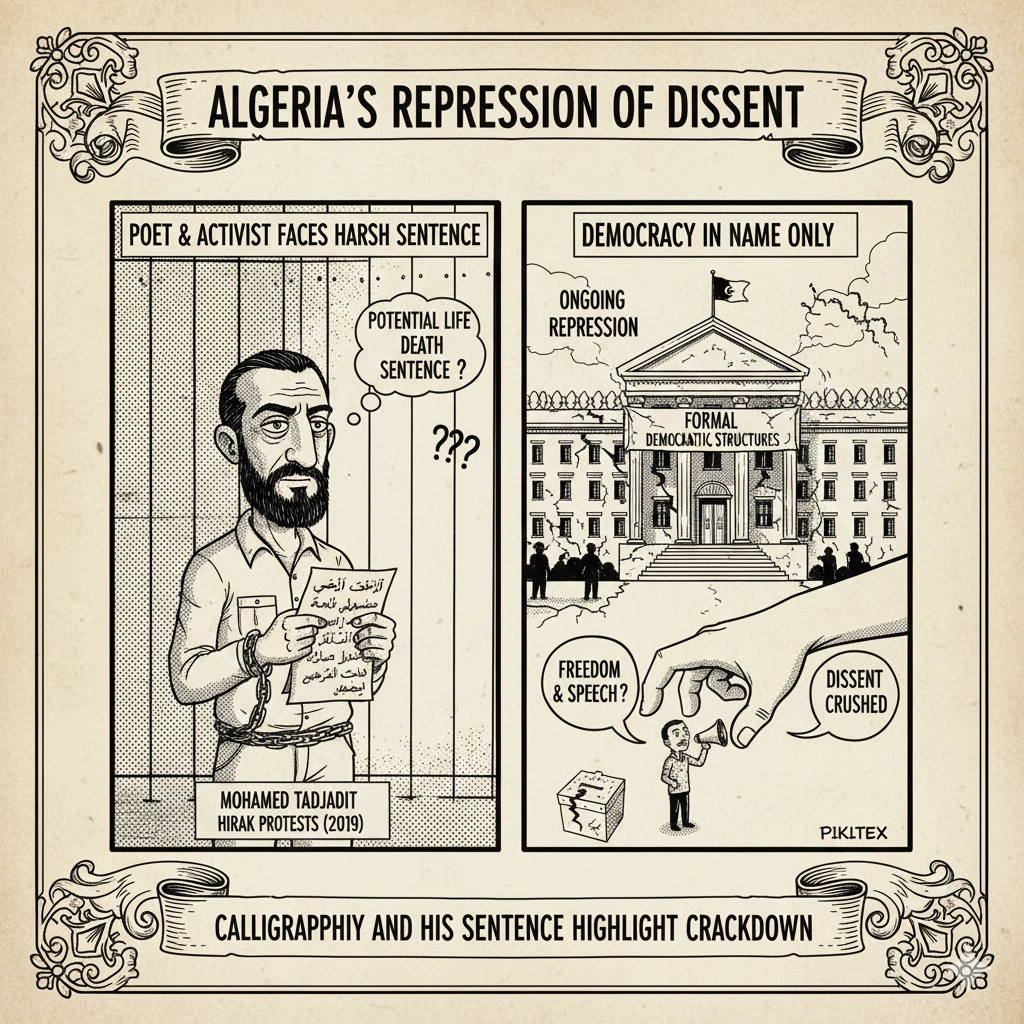
Mohamed Tadjadit’s Arrests and Escalating Legal Threats
Authorities have arrested Mohamed Tadjadit multiple times over the past several years, often shortly after he published or performed new poetry critical of those in power. In January 2025, he was jailed again, and his sentence was recently extended to five years in prison.
However, activists and legal observers say the situation has worsened dramatically. Algerian authorities are now reportedly considering charges that could lead to a life sentence, and some sources claim prosecutors have even discussed the possibility of the death penalty, though this has not been formally confirmed.
The charges against Mohamed Tadjadit include vague accusations such as producing publications “likely to harm the national interest,” a phrase frequently used by Algerian courts to silence dissenting voices, journalists, and activists.
Hunger Strike and Deteriorating Health
As pressure mounts, Mohamed Tadjadit is currently on hunger strike to protest his detention and what supporters describe as judicial harassment. His family and lawyers report that he is suffering from severe kidney pain and other health complications, raising fears for his life if his detention continues.
Medical access inside Algerian prisons has long been criticized by international watchdogs, and Tadjadit’s condition has become a focal point for urgent appeals by human rights organizations.
International Recognition Highlights the Case
In a stark contrast to his treatment at home, Mohamed Tadjadit was recently awarded the Index on Censorship Freedom of Expression Award, an honor that brought renewed international attention to his plight. The award recognized his courage in using poetry as a tool of peaceful resistance and his commitment to speaking truth to power despite repeated imprisonment.
Supporters argue that the award underscores the disconnect between Algeria’s international image and the reality faced by critics inside the country.
Calls for International Oversight Rejected
Human rights activists have urged the United Kingdom and other Western governments to send observers to Mohamed Tadjadit’s upcoming trial, warning that proceedings may fall short of international standards of fairness and transparency.
However, the UK Foreign Office has declined to intervene, citing a policy of non-interference in Algeria’s internal judicial matters. This response has drawn criticism from advocacy groups, who argue that silence effectively enables repression.
Observers note that Western governments have often prioritized regional stability, energy partnerships, and migration cooperation with Algeria over human rights concerns.
Symbol of a Wider Crackdown
For many Algerians, Mohamed Tadjadit has become more than an individual case—he symbolizes the fate of hundreds of citizens imprisoned for activism, online speech, or participation in protests since the Hirak movement was forcefully curtailed.
Despite constitutional reforms and elections promoted by the government as democratic milestones, critics say Algeria’s security apparatus and judiciary continue to operate with broad powers to suppress dissent.
Journalists, lawyers, bloggers, and artists have all faced prosecution under laws designed to criminalize criticism of the state, the military, or public institutions.
What Tadjadit’s Case Means for Algeria
The potential life sentence facing Mohamed Tadjadit sends a chilling message to Algerians who continue to advocate for political reform. Analysts warn that such cases erode public trust and risk reigniting unrest by closing peaceful avenues for expression.
International human rights groups argue that Algeria’s long-term stability depends not on silencing voices like Tadjadit’s, but on addressing the grievances that fueled the Hirak movement in the first place.
For now, Mohamed Tadjadit remains behind bars—his poetry silenced by prison walls, yet his case echoing far beyond them.
For more updates about Algeria, visit the Algeria News Section.