
Summary
Scientists have discovered dozens of new methane seeps emerging from the seafloor of Antarctica’s Ross Sea, alarming researchers who warn the leaks could trigger a dangerous climate feedback loop. The study, published in Nature Communications (October 2025), shows that methane — 80 times more potent than carbon dioxide — is escaping from previously frozen sediments, suggesting global warming is destabilizing Antarctica’s undersea permafrost.
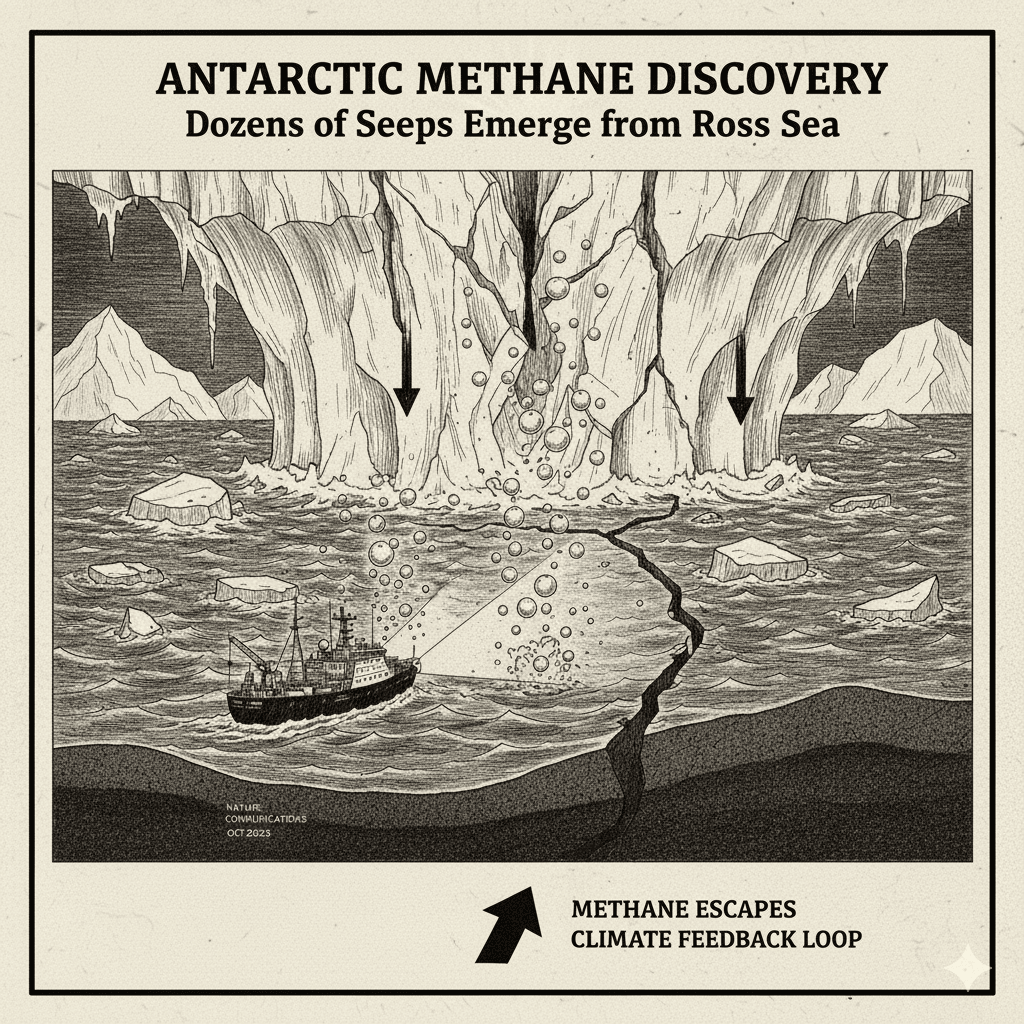
A research team from Earth Sciences New Zealand, led by Dr. Sarah Seabrook, uncovered the methane seeps between 5 and 240 meters deep near Cape Evans in the Ross Sea. Using divers, acoustic sonar mapping, and a remotely operated vehicle, scientists identified multiple streams of gas bubbles and microbial mats, clear signs of methane release.
Before this, only one methane seep had ever been confirmed in Antarctica, discovered in 2011. The team initially intended to revisit that site but instead found dozens of new active leaks. “We expected to find one small bubbling area,” Dr. Seabrook said. “Instead, we found the seafloor littered with them.”
Methane seeps form when trapped gases escape as the ocean warms and ice layers degrade. The study suggests that rising temperatures and melting sea ice are releasing methane once locked beneath frozen sediments. This could create a positive feedback loop, where warming releases more methane, which in turn fuels further warming.
Scientists warn that while it’s unclear how much methane is reaching the atmosphere, the trend mirrors processes seen in the Arctic, where thawing permafrost has unleashed large volumes of greenhouse gases.
Dr. Seabrook emphasized the urgency of global cooperation to study the phenomenon:
“If these seeps keep emerging, we need to understand how fast this system is changing. What we’re seeing in Antarctica could reshape global climate dynamics within the next decade.”