
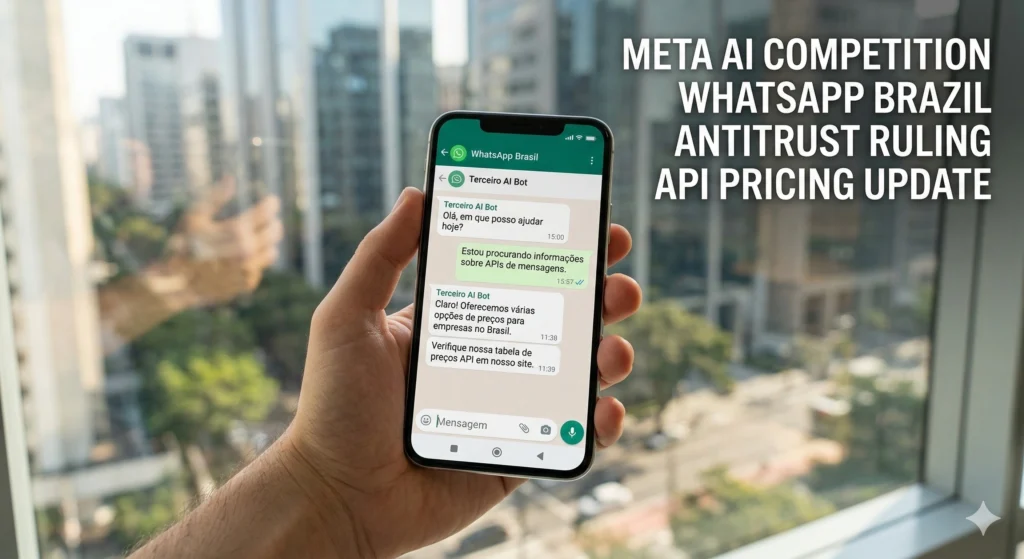
Meta permits third-party AI chatbots to integrate with WhatsApp in Brazil following a monumental directive from the nation’s antitrust regulator, CADE. This decision marks a historic shift in how global tech giants manage their proprietary ecosystems in South America, effectively ending Meta’s exclusive control over AI on the platform. By opening its doors to external competitors, the social media giant is responding to intense legal pressure aimed at fostering a more transparent and competitive artificial intelligence market. This shift is not merely a technical update but a strategic pivot that aligns Brazil with international digital standards.
The Regulatory Pressure from CADE in Brazil
The Administrative Council for Economic Defense, known as CADE, played a pivotal role in dismantling the barriers that previously restricted external AI. Initially, Meta attempted to block the mandate that required them to host rival chatbots, arguing that the platform was not built for such large-scale external integrations. However, the antitrust regulator dismissed these appeals, ruling that prohibiting rival bots would be harmful to a burgeoning digital economy. This decision emphasizes a growing global trend where regulators prioritize consumer choice over the walled-garden strategies of major technology conglomerates.
Brazil’s legal framework is increasingly focused on ensuring that messaging dominance does not become a bottleneck for local innovation. By forcing the company to provide access to its Business API, CADE ensures that local developers can offer diverse AI services ranging from customer support to complex financial advice. This level of openness is expected to spark a wave of localized AI development specifically tailored to the nuances of the Brazilian market. Consequently, WhatsApp is transforming from a simple messaging app into a neutral infrastructure for various specialized service providers.
Meta permits third-party AI chatbots
Under the new regulatory framework, Meta permits third-party AI chatbots by allowing developers to utilize the WhatsApp Business API for a designated fee. This transition requires the implementation of a specific technical and financial structure to manage the influx of external data processing while maintaining security. This structural change ensures that while competitors can reach a massive user base, the platform still maintains a level of control over the quality of the interactions. It is a delicate balance between complying with antitrust laws and protecting the core user experience that millions rely on.
The integration of these rival bots will likely change how users interact with businesses and automated services within the application. Instead of being limited to a single proprietary AI, users can now select specialized bots that might offer better integration with local banks or retail services. This variety is the primary goal of the regulatory directive, as it prevents a single entity from monopolizing the AI assistant space in Brazil. As these third-party tools become more common, the distinction between “official” and “external” AI services will become a key factor in long-term user trust.
Understanding the New Fee Structure and Costs
To offset the costs of hosting rival services, a specific pricing model has been introduced for developers operating within the Brazilian market. Starting March 11, the company plans to charge $0.0625 per non-template message sent through the API for AI purposes. This move mirrors the “pay-to-play” model established in the European Union, providing a revenue stream for the parent company even when users choose a competitor. While the regulator has mandated access, it has not prohibited the platform from seeking compensation for the use of its expensive messaging infrastructure.
However, the announcement of these fees has met with significant pushback from the developer community in São Paulo and beyond. Many AI startups claim that the $0.0625 rate is significantly higher than previous API costs, potentially making it difficult for smaller companies to remain profitable. There is a concern that while the platform is technically “open,” the financial barrier to entry might still favor larger, well-funded AI corporations over local innovators. This debate over “fair and reasonable” pricing is expected to be the next major battleground between tech giants and regional antitrust authorities.
Comparison to European Union Regulatory Models
The policy update in Brazil is not an isolated incident but rather a continuation of a strategy first seen in the European Union under the Digital Markets Act. Meta permits third-party AI chatbots in both regions as part of a global effort to adapt its business model to comply with varying regional laws. By applying a similar fee structure in Brazil as it does in Europe, the company is attempting to create a standardized approach to regulatory compliance. This strategy helps manage legal obligations across different jurisdictions without completely redesigning its core business API for every individual country.
The European model focuses on preventing “gatekeeping” by ensuring that smaller players have access to large user bases without unnecessary friction. Brazil’s CADE has adopted a similar stance, viewing the messaging app as an essential service for the modern digital economy that must remain open. Fee structures in both regions are designed to balance the platform owner’s right to earn revenue with the competitor’s right to fair access. Technical documentation for the API is being updated simultaneously in both markets to ensure a smooth transition for international developers looking to expand.
Meta AI vs. Third-Party Rivals: The Battle for Dominance
Despite opening its doors to competitors, the platform continues to heavily promote its own proprietary Meta AI chatbot within the messaging interface. This internal tool is designed to provide a seamless experience, often integrated directly into the search bar or through a dedicated chat icon. The challenge for third-party developers will be to offer enough unique value to convince users to seek out their bots over the built-in option. The internal advantage lies in deep integration with the app’s user interface and the ability to offer services without the per-message fees charged to rivals.
Competitive AI providers are focusing on niche markets and specialized tasks to differentiate themselves from the more general-purpose internal AI assistant. For example, some Brazilian developers are creating bots that specialize in Portuguese legal documents or specific agricultural data relevant to the region. By focusing on these high-value, specialized use cases, third-party bots can justify the higher API costs to their end-users and investors. This competition is exactly what regulators hoped to achieve, as it drives innovation and forces all players to improve their underlying models.
Impact on Brazilian Consumers and Digital Choice
For the average user in Brazil, this change means a significant increase in the utility of the application they use every single day. The ability to access a wide variety of AI assistants means that the app can function as a “super-app” similar to ecosystems seen in other global markets. Consumers will benefit from more localized services, better customer support from their favorite brands, and a wider range of AI personalities to interact with. CADE maintains that preserving this access is essential for protecting consumer choice and ensuring the public is not left behind.
Furthermore, the introduction of third-party bots may lead to better privacy options as different providers compete on their specific security features. While the platform provides end-to-end encryption for the messages themselves, different AI providers may have different policies regarding how they process data. This creates a market for privacy-conscious AI, where users can choose a bot that aligns with their personal data protection preferences. As the sector matures, clear labeling of which AI is proprietary versus which is third-party will be crucial for maintaining transparency.
Technical Challenges of Large-Scale AI Integration
Spokespeople have consistently highlighted that the Business API was not originally designed to handle the massive data loads required by modern large language models. Meta permits third-party AI chatbots now, but scaling the infrastructure to support millions of concurrent interactions from different providers is a significant engineering hurdle. The company has had to invest in new server capacity and optimized routing protocols to ensure the messaging service remains fast and reliable. These technical constraints are often cited as a justification for the per-message fees they are currently imposing.
For developers, the challenge lies in optimizing their bots to be efficient enough to handle the high costs associated with the messaging API. Every message must be crafted to provide maximum value to the user to avoid wasting the $0.0625 fee on redundant or unhelpful interactions. This economic reality is pushing Brazilian AI startups toward more sophisticated “agentic” AI models that can solve complex problems in fewer steps. Consequently, the high costs might inadvertently drive a higher standard of AI quality within the Brazilian digital ecosystem over the next few years.
Future Projections for AI Interoperability Globally
The decision in Brazil is likely to set a precedent for other nations currently investigating market dominance, such as India or the United States. As more countries observe the success of the Brazilian and European models, the pressure for global AI interoperability will only intensify. Meta permits third-party AI chatbots in Brazil today, and it may eventually find it more efficient to open its API globally rather than fighting individual legal battles. This would mark the end of the “closed platform” era for messaging apps and the beginning of a more interconnected digital world.
Global regulators are closely watching the economic impact of the $0.0625 per-message fee on the Brazilian startup scene to determine if it is fair. Interoperability mandates may eventually expand from AI chatbots to other services like integrated payments and secure file sharing. The success of these third-party integrations could lead to a new “App Store” model within messaging platforms that redefines mobile software distribution. Security protocols will need to be standardized to ensure that external bots do not compromise the integrity of the encrypted network.
Corporate Strategy and Compliance in South America
The decision to allow rival bots is a strategic retreat designed to avoid even more severe penalties or a potential ban of AI services. By complying with CADE’s directive, the company protects its primary revenue-generating assets while appearing cooperative with regional local authorities. This “compliance-first” approach allows the platform to maintain its massive user base in one of its most important global markets. The company is essentially trading a small piece of its AI monopoly to ensure the long-term survival of the ecosystem as a whole.
This shift also reflects a broader change in corporate culture, where the legal department now plays a massive role in product development. Features are no longer designed solely for user engagement; they are built to withstand the scrutiny of international antitrust regulators from the start. As the company navigates these complex legal waters, the ability to rapidly adapt its platform to local laws will be a key competitive advantage. The Brazilian case serves as a blueprint for how tech giants can pivot their strategies when faced with irresistible regulatory force.
The Role of Antitrust Laws in the AI Era
The intervention by CADE highlights the evolving nature of antitrust law, which is now focusing on “data moats” and “digital bottlenecks” rather than just price-fixing. In the AI era, the most valuable resource is not just the software, but the distribution network that allows the software to reach billions of users. By identifying the messaging app as a bottleneck, the Brazilian government has effectively declared that access to users is a public-interest concern. This reinterpretation of competition law is a significant development that will influence how AI companies are regulated for decades.
Critics of the decision argue that it might stifle internal innovation by forcing the sharing of hard-earned infrastructure with direct rivals. However, proponents point out that without such mandates, the barrier to entry for new AI companies would be completely insurmountable. The Brazilian model attempts to find a middle ground where the platform owner is compensated for their investment while the market remains open. This balanced approach is being hailed by many as a sophisticated way to manage the power of “Big Tech” in a rapidly changing technological landscape.
Managing the Risks of Third-Party Integrations
One of the primary concerns for the platform is the potential for third-party bots to be used for spam or the spread of misinformation. Because these bots are not under direct internal control, ensuring they adhere to community standards is a complex and ongoing task. Meta permits third-party AI chatbots with the caveat that they must still follow certain safety guidelines to maintain their API access. This creates a secondary layer of regulation where the platform owner acts as a private enforcer of safety standards for its competitors.
Providers must undergo a rigorous verification process to ensure they are legitimate business entities before they can begin sending messages. Bots are subject to automated monitoring to detect patterns of abuse or high-volume spamming that could annoy the general user base. Users have the ability to report specific third-party bots, which can lead to their permanent removal from the Business API if violations are found. Data privacy audits may also be required for bots that handle sensitive financial or personal information in the Brazilian market.
Economic Outlook for the Brazilian AI Sector
The opening of the messaging app is expected to provide a massive boost to the Brazilian tech economy, attracting global venture capital. Investors are more likely to fund a company that has a guaranteed distribution channel to millions of active users in the region. This could lead to a “Silicon Valley” style boom in cities like Florianópolis, where tech talent is already highly concentrated. The long-term economic benefits of a competitive AI market could far outweigh the initial friction caused by the new fee structure.
As these companies grow, they will also create high-paying jobs in software development, data science, and AI ethics across the country. Brazil is positioning itself as a leader in the global South for digital innovation, and the CADE decision is a cornerstone of that strategy. By ensuring that the country’s most popular communication tool is an open platform, the government is laying the groundwork for an inclusive future. The eyes of the global tech community remain fixed on Brazil as it conducts this high-stakes experiment in digital competition.
Final Summary of the WhatsApp Policy Change
The decision to allow competitor AI on the flagship messaging app in Brazil represents a turning point in the history of social media. It proves that even the largest tech companies must eventually yield to the collective will of national regulators committed to fair competition. While the per-message fees present a challenge for developers, the opportunity to reach the Brazilian public through this platform is an unprecedented advantage. This new era of interoperability will likely lead to more creative, diverse, and localized AI experiences for everyone involved in the digital economy.
As we move forward, the relationship between platform owners, regulators, and third-party developers will continue to evolve and adapt. The success of this model will depend on whether the $0.0625 fee remains sustainable and if security can be maintained amidst increased external access. For now, Brazil has sent a clear message to the world: the future of AI will not be controlled by a single company. Instead, it will be shaped by a vibrant ecosystem of competing ideas and technologies that serve the public interest.
For more details & sources visit: The News International
For more regional updates and industry insights, visit our Brazil News Page.