
President Emmanuel Macron will visit Paphos this week to address the urgent Mediterranean security crisis while strengthening regional alliances against escalating Iranian maritime threats. This high-stakes diplomatic mission follows the recent deployment of the French aircraft carrier Charles de Gaulle after several Iranian-made drones targeted Cyprus last week. The Elysee Palace confirmed on Sunday that the French President intends to meet with Nikos Christodoulides and Kyriakos Mitsotakis to demonstrate unwavering European solidarity. As the Middle East conflict enters its second week of heightened volatility, France has already positioned a frigate and advanced air defense units on Cypriot soil to neutralize emerging aerial dangers.
The arrival of the French leader in Cyprus marks a significant turning point in how European powers respond to direct aggression within their maritime borders. Consequently, this strategic visit aims to reinforce the defense partnership between Paris and Nicosia after the island nation endured multiple missile strikes and drone incursions. Macron has been engaging in a flurry of high-level telephonic discussions with global leaders, including those from the United States and Iran, to prevent a total regional collapse. During these talks, he specifically urged Iranian President Masoud Pezeshkian to immediately cease all strikes against neighboring sovereign states and ensure the freedom of international navigation.
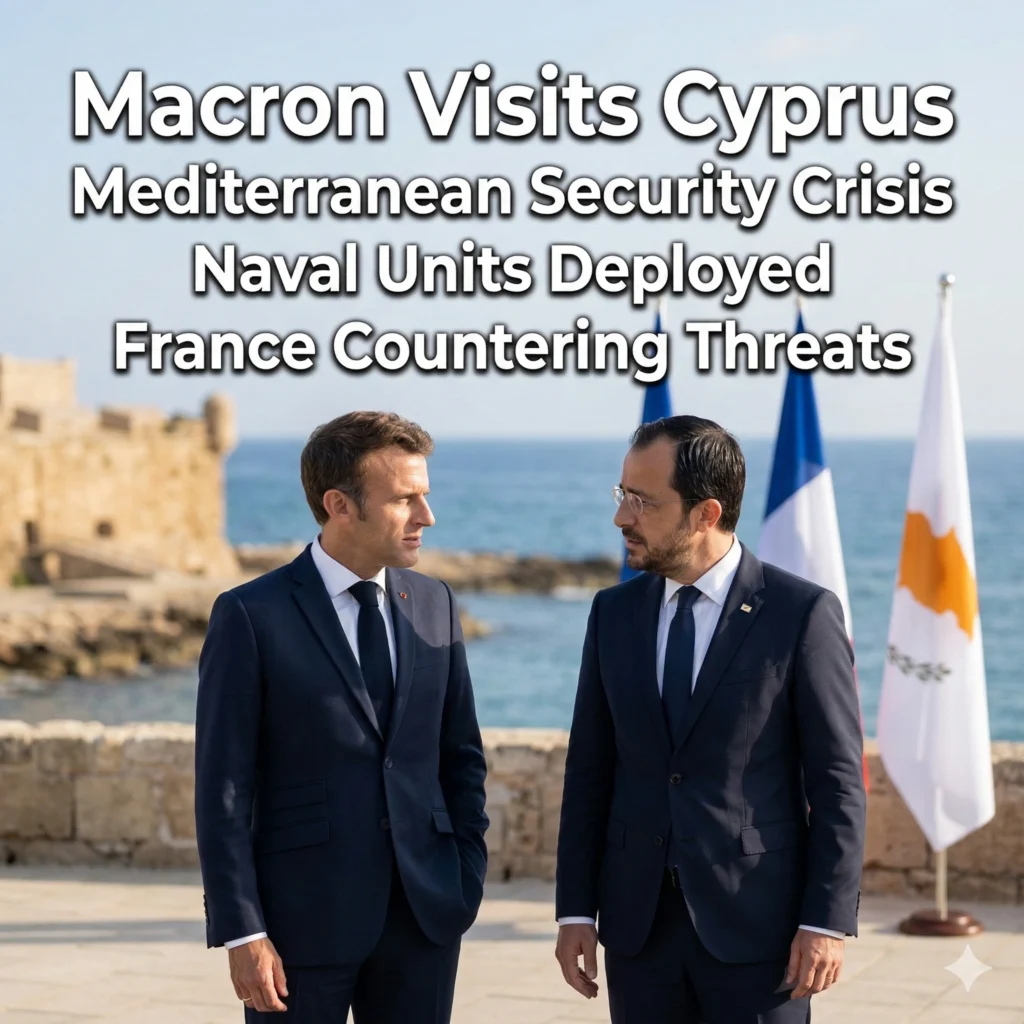
Mediterranean Security Crisis
The current Mediterranean security crisis represents the most significant challenge to European maritime stability in recent decades due to the involvement of sophisticated drone technology. Iranian officials have warned that any foreign military participation in the region will be viewed as a direct escalation and met with robust national defense measures. Despite these warnings, French officials maintain that their military posture in the Mediterranean and the Red Sea remains strictly defensive and intended only to safeguard commercial lanes. Security in the Strait of Hormuz has also become a primary concern for the international community following numerous maritime attacks reported since late February.
As a result of these threats, additional naval support has been deployed to the region by Italy and the United Kingdom to assist in protecting Cypriot sovereignty. President Macron has also extended French diplomatic support to nations like Azerbaijan and Egypt to address broader maritime transport security and potential conflict spillover. The upcoming summit in Paphos will serve as a critical platform for regional leaders to assess the high level of coordination between European naval forces. By aligning military resources and intelligence, France and its allies hope to create a credible deterrent against further Iranian-backed incursions in the Eastern Mediterranean.
Tactical Naval Deployments in the Levant
The deployment of the Charles de Gaulle carrier strike group provides a massive boost to the surveillance capabilities of the European coalition currently monitoring the Levant. This naval presence is intended to create a protective umbrella over Cyprus, which has become a focal point for regional tensions due to its geographic proximity. Furthermore, the integration of French air defense units with local Cypriot forces ensures a rapid response mechanism against low-flying suicide drones. Such coordination is essential because the evolving nature of hybrid warfare requires a blend of traditional naval power and modern electronic countermeasures.
Military analysts suggest that the Mediterranean security crisis could worsen if diplomatic channels fail to establish a clear “red line” regarding drone launches from proxy territories. France is positioning itself as the leading security guarantor in the region, filling a void that has occasionally been left by fluctuating American focus. This leadership role involves not only hardware deployment but also the creation of a unified political front among Mediterranean member states. Consequently, the Paphos meeting is expected to produce a formal declaration regarding the sanctity of European maritime borders and the consequences of further provocations.
Iran’s Response to European Intervention
The diplomatic tension between Paris and Tehran reached a boiling point after President Pezeshkian warned France against providing military support to those he labeled as regional aggressors. This rhetoric underscores the fragile nature of the Mediterranean security crisis, where defensive maneuvers are often interpreted by adversaries as offensive preparations. However, the French government has remained firm in its commitment to Nicosia, citing international law and the right to collective self-defense. This stalemate has led to an increase in electronic warfare activities across the Eastern Mediterranean, as both sides test each other’s radar and communication resilience.
Furthermore, the Iranian government has stated that its national defense measures are a response to what it perceives as Western encroachment on its sphere of influence. This perspective ignores the fact that the drone strikes on Cyprus targeted civilian infrastructure and international shipping lanes. In response, Macron has emphasized that France will not be intimidated by threats aimed at restricting the freedom of navigation in global waterways. The ongoing dialogue between Paris and Tehran remains cold, with little evidence of a breakthrough that would de-escalate the current military buildup.
Economic Impact of Maritime Instability
The Mediterranean security crisis is not merely a military concern but also a significant threat to the economic stability of the entire European Union. Disruptions in the Red Sea and the Eastern Mediterranean have already caused a noticeable spike in insurance premiums for commercial vessels operating in these zones. If the conflict persists, the cost of transporting energy and consumer goods could rise significantly, fueling inflation across the continent. Therefore, the French mission is as much about protecting the European economy as it is about defending the physical territory of a member state.
Moreover, the tourism industry in Cyprus and Greece is feeling the pressure of being situated so close to an active theater of regional conflict. Many international travel agencies are monitoring the situation closely, and any further escalation could lead to a massive wave of cancellations. By deploying high-profile assets like the Charles de Gaulle, France aims to project a sense of safety and control that reassures both markets and travelers. The presence of a formidable naval coalition serves as a psychological buffer against the fear of a broader Mediterranean war breaking out.
Strengthening the Cypriot-French Defense Pact
For several years, France and Cyprus have been building a strategic partnership that includes frequent joint military exercises and the sharing of sensitive intelligence. The current Mediterranean security crisis has accelerated the implementation of these agreements, moving them from theoretical cooperation to active operational engagement. President Macron’s visit will likely result in a new series of long-term defense contracts involving the sale of French-made radar systems and interceptor missiles. This move would permanently enhance the ability of the Cypriot National Guard to detect and neutralize incoming threats without immediate foreign intervention.
- France has committed to maintaining a permanent naval presence in the port of Limassol for the duration of the current hostilities.
- Cypriot air traffic controllers are now working directly with French military advisors to manage the crowded airspace over the island.
- New electronic jamming stations are being established along the southern coast to intercept signals from hostile drone operators.
- Joint search and rescue missions have been standardized to ensure that any maritime incidents are handled with maximum efficiency and speed.
These developments signify a deepening of ties that will likely outlast the immediate conflict involving Iran. By anchoring its security strategy in Cyprus, France gains a forward operating base that is crucial for monitoring developments across the Levant and North Africa. This relationship is a cornerstone of Macron’s vision for “European strategic autonomy,” where EU nations take primary responsibility for their own regional safety. The Paphos summit will solidify this vision, making it clear that an attack on one Mediterranean state is viewed as an attack on the collective interests of the Union.
Coordination with Italy and the United Kingdom
While France is leading the diplomatic charge, the Mediterranean security crisis has also seen significant contributions from other major European naval powers. Italy has dispatched several specialized frigates to monitor underwater cables and energy pipelines that are vital for European energy security. Simultaneously, the United Kingdom has increased its patrols from its sovereign base areas in Cyprus, providing a layered defense strategy that covers both sea and sky. This multinational effort demonstrates a level of military cohesion that has rarely been seen outside of formal NATO operations.
The high level of coordination between these nations is being managed through a joint command center that facilitates real-time data sharing. This ensures that a drone detected by a British radar can be intercepted by a French missile or an Italian electronic countermeasure. Such interoperability is a direct response to the sophisticated nature of the threats posed by Iranian-made hardware, which often utilizes swarm tactics to overwhelm traditional defenses. The Paphos meeting will review the effectiveness of this joint command and determine if further resource allocation is necessary to maintain the current level of protection.
Global Diplomatic Efforts and the Role of Egypt
Beyond the immediate European coalition, President Macron has been working to bring regional heavyweights like Egypt into a broader security framework. Egypt’s control over the Suez Canal makes it a vital partner in any effort to resolve the Mediterranean security crisis and ensure the flow of global trade. Macron has recently held discussions with President El-Sisi to coordinate maritime transport security and prevent the conflict from spilling over into the Red Sea. This diplomatic outreach is intended to isolate the aggressors by building a consensus among all nations that rely on stable Mediterranean shipping routes.
- The Egyptian Navy has increased its presence in the northern reaches of the Red Sea to act as a buffer against southern incursions.
- Cairo and Paris have agreed to share satellite imagery of maritime traffic to identify suspicious vessels before they reach the Mediterranean.
- Diplomatic teams from both countries are working at the UN to condemn the use of drones against civilian maritime infrastructure.
By involving Egypt, France is acknowledging that the Mediterranean security crisis cannot be solved by European military power alone. It requires a geopolitical solution that addresses the root causes of regional instability and the influence of external actors. Macron’s ability to bridge the gap between European interests and Arab concerns will be a defining factor in the success of this diplomatic mission. The cooperation with Cairo also serves to stabilize the gas markets, as both nations have a vested interest in protecting the vast offshore energy fields in the Levant Basin.
The Threat to the Strait of Hormuz and Global Energy
While the focus remains on Cyprus, the Mediterranean security crisis is inextricably linked to the escalating tensions in the Strait of Hormuz. Iran has frequently used its influence over this narrow waterway to exert pressure on the international community, and the current conflict is no exception. Multiple maritime attacks have been reported in the area since February, leading to a massive redirection of oil tankers and increased shipping costs. Macron has warned that any attempt to close the strait would be met with a coordinated international response to restore the freedom of navigation.
The French Navy has maintained a presence in the Persian Gulf for years, but recent events have forced a repositioning of assets to cover both theaters simultaneously. This stretching of resources is a primary challenge for the Elysee, as it requires careful balancing of domestic defense needs with international commitments. The Charles de Gaulle’s current location allows it to project power into both regions, but the demand for its presence remains high. During the Paphos summit, Macron will likely call for other EU nations to contribute more to the naval missions in the Gulf to alleviate the burden on the French fleet.
Addressing Conflict Spillover into the Caucasus
Another worrying aspect of the Mediterranean security crisis is the potential for violence to spread toward Azerbaijan and the Caucasus. Macron has extended French support to Baku to ensure that the maritime and land-based transport corridors remain secure from external interference. This region is a critical link for energy exports to Europe, and any instability there would compound the problems already faced in the Mediterranean. The French President’s holistic approach to security reflects the interconnected nature of modern geopolitical conflicts, where a drone launch in one region can have ripples thousands of miles away.
Azerbaijan has welcomed the French outreach, as it seeks to diversify its security partnerships amidst a changing regional landscape. By providing diplomatic and technical support, France is helping to build a “ring of stability” around the peripheries of the conflict zone. This strategy is designed to contain the Mediterranean security crisis and prevent it from evolving into a multi-theater war that would be much harder to manage. The Paphos talks will include a briefing on these outreach efforts, ensuring that all regional partners are aligned in their defensive objectives.
Future Outlook for Mediterranean Stability
The outcome of the meeting in Paphos will determine the trajectory of the Mediterranean security crisis for the coming months. If the leaders can successfully project a unified front, it may force a recalculation in Tehran regarding the costs of continued provocation. However, if cracks appear in the European coalition, it could embolden the use of proxy forces and asymmetrical tactics against EU interests. Macron’s role as a mediator and military leader is therefore under intense scrutiny from both his domestic constituency and international observers.
Looking ahead, the permanent presence of advanced French military hardware in Cyprus suggests that the Mediterranean security crisis has fundamentally changed the regional defense architecture. We are likely moving toward a period of sustained “armed peace,” where high-tech surveillance and rapid-response capabilities are the new norm. The strategic partnership between France, Greece, and Cyprus will remain at the heart of this new reality, serving as a bulwark against any further attempts to destabilize the Eastern Mediterranean. As Macron prepares for his flight to Paphos, the stakes for European sovereignty and global maritime security could not be higher.
Technology and the Evolution of Modern Warfare
One of the most concerning elements of the Mediterranean security crisis is the rapid advancement of drone technology used by non-state actors and state proxies. These Iranian-made systems are inexpensive to produce but capable of inflicting significant damage on high-value targets like naval vessels and power plants. The French military has responded by deploying specialized electronic warfare units that can hijack the control signals of incoming drones. This technological arms race is a defining feature of the conflict, necessitating constant innovation and adaptation from European defense forces.
Furthermore, the use of AI-driven surveillance has allowed the coalition to monitor vast areas of the sea with unprecedented precision. By analyzing patterns of maritime movement, French analysts can identify “vessels of interest” that may be carrying illicit cargo or launching platforms. This proactive approach is essential for managing the Mediterranean security crisis, as it allows the military to neutralize threats before they reach the Cypriot coastline. The Paphos summit will likely discuss the establishment of a permanent regional center for maritime technological cooperation to stay ahead of these evolving threats.
Public Perception and Domestic Support in France
Within France, the Mediterranean security crisis has become a major point of political debate as Macron’s administration commits more resources to the region. While there is general support for protecting a fellow EU member state, some critics argue that the focus should remain on domestic economic challenges. Macron has countered these arguments by linking regional security directly to the price of energy and the safety of French citizens living abroad. His visit to Cyprus is also a way to demonstrate that France remains a global power capable of leading on the world stage.
The deployment of the Charles de Gaulle is always a moment of national pride, but it also carries significant financial and political risks. If the carrier strike group were to be involved in a direct kinetic engagement, the domestic pressure on the government would intensify overnight. Therefore, Macron’s diplomatic efforts are aimed at ensuring that the military presence remains a deterrent rather than a catalyst for war. The success of the Paphos mission will be measured by its ability to maintain this delicate balance between strength and restraint.
The Role of the United Nations and International Law
Throughout the Mediterranean security crisis, France has consistently framed its actions within the boundaries of international law and UN conventions. By emphasizing the “freedom of navigation” and the “right to self-defense,” Paris is seeking to build a broad international coalition that goes beyond just the EU. This legal framework is crucial for maintaining the legitimacy of the naval deployments and the air defense missions on Cyprus. Macron has called for the UN Security Council to take a more active role in condemning the use of drones against civilian targets, although consensus remains elusive due to the veto power of rival nations.
- The French legal team has submitted dossiers to the UN documenting the debris of Iranian drones found on Cypriot soil.
- International maritime observers have been invited to join French patrols to provide an independent account of the defensive nature of the operations.
- The Elysee is pushing for a new international convention specifically targeting the proliferation of long-range suicide drones to non-state actors.
By sticking to these legal principles, France hopes to win the “war of narratives” that often accompanies modern military conflicts. The Paphos summit will likely reiterate these points, framing the Mediterranean security crisis as a challenge to the entire rules-based international order. This approach helps to unify allies who might otherwise be hesitant to support a purely military solution. As the conflict continues, the battle in the halls of the UN will be just as important as the maneuvers in the waters of the Levant.
Conclusion of the Paphos Summit Objectives
As the leaders gather in Paphos, the primary objective is to send a clear message that the Mediterranean security crisis will not be allowed to fragment the European Union. The symbolic importance of Macron standing alongside Christodoulides and Mitsotakis cannot be overstated in this context. They represent a unified front that is prepared to defend the eastern borders of the Union with all available diplomatic and military tools. The specific outcomes of the meeting, from new defense pacts to increased naval coordination, will provide a roadmap for the region’s stability over the next year.
Ultimately, the Mediterranean security crisis serves as a reminder of the fragility of modern geopolitical peace and the constant need for vigilant leadership. France’s willingness to deploy its most powerful military assets shows a commitment to the region that goes beyond rhetoric. While the path to de-escalation with Iran remains uncertain, the strength of the Mediterranean alliance has never been more apparent. Macron’s visit to Paphos is a testament to the fact that in times of crisis, Europe’s southern flank will not be left to stand alone against the storm.
Ensuring Energy Independence through Security
A final critical component of the Mediterranean security crisis is the protection of the burgeoning EastMed energy hub. Cyprus, Israel, and Egypt have discovered massive offshore gas reserves that are intended to reduce Europe’s reliance on external energy suppliers. Any threat to these installations from Iranian drones or naval harassment is a direct threat to the EU’s long-term energy strategy. By securing the waters around these platforms, the French Navy is effectively acting as a guard for Europe’s future heating and electricity needs.
For more details & sources visit: France 24
For the latest updates from France, visit our France news page.