
Libya Energy Council and Business France MoU marks a significant step toward strengthening economic cooperation between Libya and France. The agreement, signed on January 24, 2026, aims to deepen collaboration between French and Libyan companies across oil, gas, and renewable energy projects, reflecting growing bilateral trade and renewed international engagement with Libya’s energy sector.
The memorandum of understanding was announced during a France–Libya roundtable at the Libya Energy & Economic Summit 2026, where officials also discussed the possibility of launching joint ventures to support long-term investment and project development.
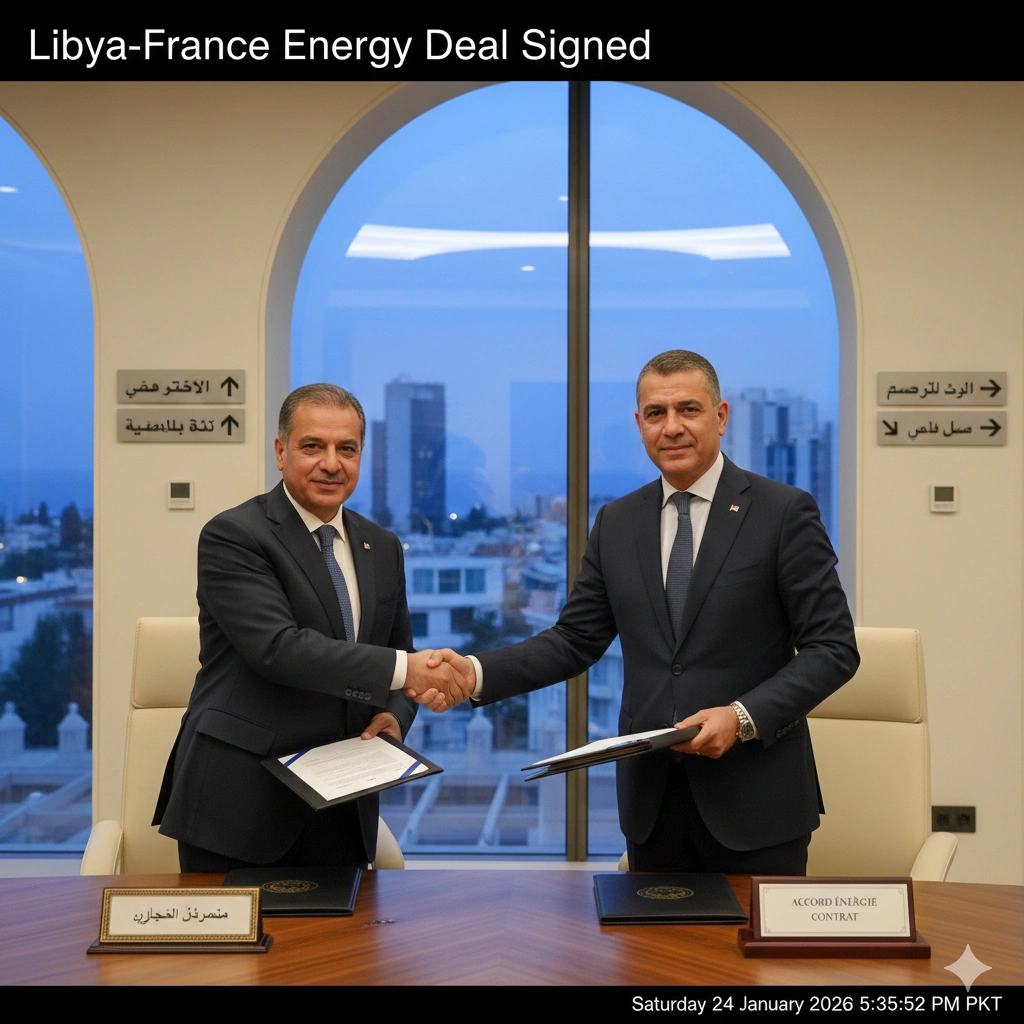
Libya Energy Council and Business France MoU Signed at Energy Summit
The MoU was signed by Philippe Garcia, North Africa Director at Business France, and Dr. Khaled Ben Othman, Chairman of the Libyan Council for Oil, Gas and Renewable Energy (LCOGRE). The agreement establishes a framework for cooperation designed to connect businesses, facilitate investment, and strengthen commercial partnerships across Libya’s energy value chain.
Officials emphasized that the Libya Energy Council and Business France MoU will help create structured support mechanisms for companies seeking opportunities in Libya’s evolving energy market, particularly as the country works to modernize infrastructure and diversify energy sources.
Focus on Oil, Gas, and Renewable Energy Development
Under the agreement, both parties plan to support cooperation in:
- Oil and gas exploration and production
- Natural gas development
- Renewable energy projects, including solar and emerging clean technologies
Garcia stated that Business France aims to support Libya’s private oil and gas sector by leveraging French technical expertise, engineering capabilities, and energy technology. He highlighted France’s experience in complex energy projects and its ability to provide industrial solutions suited to Libya’s needs.
Dr. Ben Othman added that while oil and gas remain central, Libya is increasingly interested in gas and renewable energy expansion, signaling a broader transition strategy aligned with global energy trends.
Growing Libya–France Trade Relations
The MoU comes amid rapidly expanding bilateral trade between Libya and France. According to figures cited in the announcement, Libya–France trade reached €470 million in 2025, representing a 50 percent year-on-year increase.
This growth reflects improving commercial confidence and increased engagement between businesses in both countries. Energy remains the cornerstone of the relationship, but officials on both sides see opportunities extending far beyond hydrocarbons.
Business France has already played a key role in facilitating engagement for 150 to 200 French companies, organizing trade missions, business-to-business meetings, and sector-focused events to connect French firms with Libyan partners.
Potential Joint Ventures and Investment Support
During the France–Libya roundtable, participants also discussed the possibility of establishing joint ventures to support project execution and technology transfer. Such partnerships could help mitigate investment risks, enhance local capacity, and accelerate the delivery of strategic energy projects.
The Libya Energy Council and Business France MoU is expected to provide a foundation for these initiatives by improving coordination between public institutions and private-sector stakeholders in both countries.
Expansion Beyond the Energy Sector
While energy cooperation is the primary focus, Business France confirmed plans to broaden collaboration into other economic sectors, including:
- Infrastructure development
- Logistics and transport
- Healthcare services
- Consumer goods and manufacturing
This broader scope reflects Libya’s reconstruction and development needs, as well as France’s interest in supporting long-term economic stability through diversified commercial engagement.
Strategic Importance for Libya’s Energy Future
For Libya, the agreement aligns with national efforts to attract foreign investment, modernize the energy sector, and position the country as a reliable regional energy supplier. Strengthening ties with established European partners such as France is seen as critical to achieving these goals.
The MoU also supports Libya’s ambition to balance traditional oil and gas production with renewable energy development, helping the country adapt to shifting global energy markets.
Conclusion
The Libya Energy Council and Business France MoU represents a strategic milestone in Libya–France relations, reinforcing cooperation at a time of renewed economic momentum. With trade volumes rising, joint ventures under discussion, and collaboration expanding beyond energy, the agreement signals a deeper, more diversified partnership.
As Libya continues to rebuild and modernize its economy, such international cooperation is likely to play a central role in shaping the country’s energy and commercial future.
For more details & sources visit: Energy Capital & Power
For the latest updates from France, visit our France news page.