
Kuwait security crisis 2026 remains a defining challenge as missile and drone strikes reshape daily life and national stability. The persistent surge in aerial attacks linked to regional confrontations with Iran has placed the Gulf state under immense strategic pressure. Targeting critical oil infrastructure and military facilities, these hostilities have forced authorities to implement unprecedented security measures. From the cancellation of public celebrations to strict maritime bans, the atmosphere in Kuwait City reflects a nation on high alert.
The current escalation involves sophisticated technology that has brought the front lines of a regional shadow war directly to Kuwaiti soil. Iranian missiles and drones are frequently intercepted by advanced defense systems, with reports suggesting an interception rate of approximately 98 percent. While these statistics provide some comfort, the remaining percentage represents a significant threat to civilian safety and infrastructure integrity. Falling shrapnel from successful interceptions has caused substantial property damage and tragic loss of life in residential areas. These incidents have shattered the sense of security that has defined Kuwait for decades, replacing it with a constant vigil against threats from the sky.
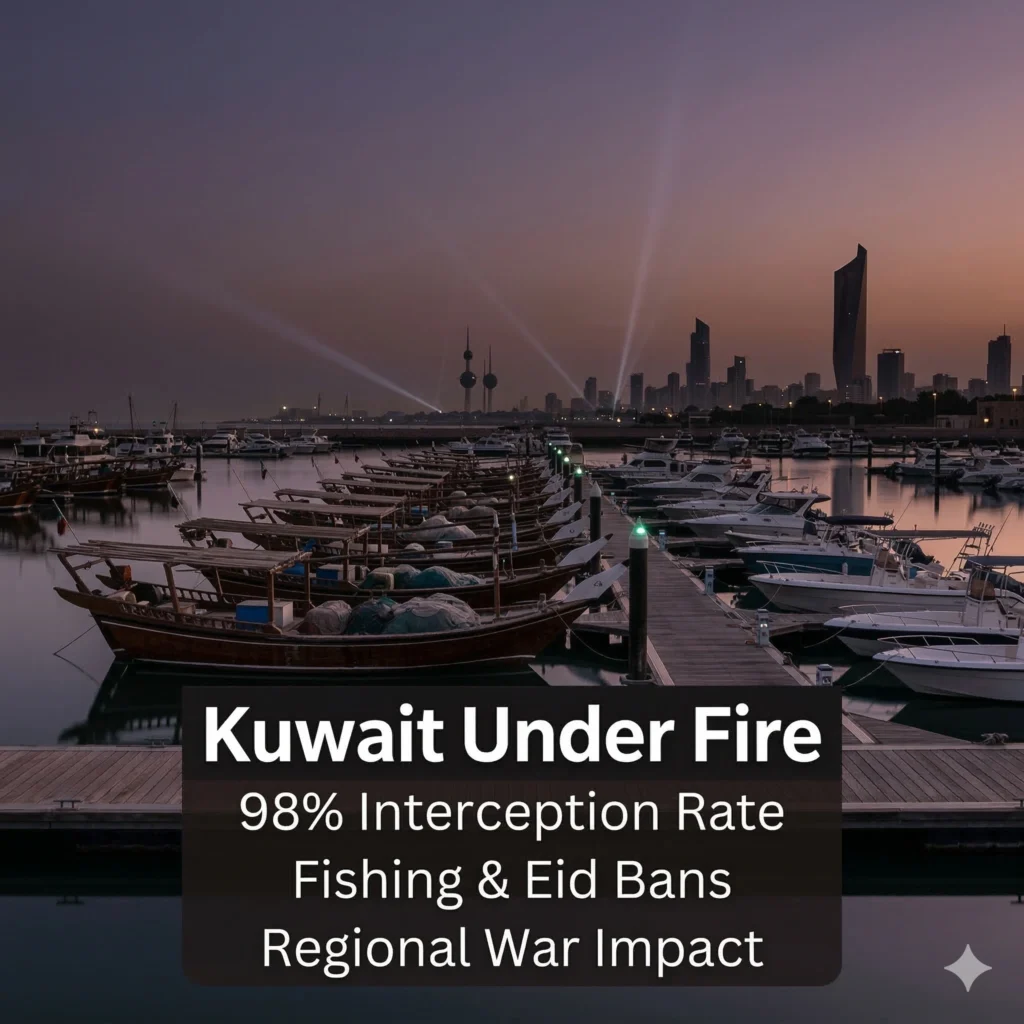
Kuwait security crisis 2026
The Kuwait security crisis 2026 has fundamentally altered how the government manages public safety and national resources during the holy month. Following a series of strikes that targeted areas near civilian hubs, authorities officially prohibited wedding celebrations and large concerts during the upcoming Eid al-Fitr holiday. This directive aims to prevent large public gatherings that could become high-casualty targets in the event of a missile breach. For many Kuwaitis, the absence of these traditional festivities serves as a somber reminder of the gravity of the current military situation. The government insists these precautions are vital to ensure that the joy of the holiday does not turn into a national tragedy.
Beyond social restrictions, the maritime sector has faced a total ban on fishing and coastal activities to mitigate risks from low-flying drones. This decision has hit the local economy hard, as the fishing industry is a staple of Kuwaiti culture and commerce. Officials cited the danger of missile fragments falling into the sea and the potential for drones to use coastal corridors to evade radar detection. As a result, the once-bustling piers and markets are uncharacteristically quiet, reflecting the heavy toll of the Kuwait security crisis 2026 on traditional livelihoods. The disruption of these sectors illustrates how regional military tensions can paralyze the essential functions of a neutral state.
Strategic Impact on Energy Infrastructure
Kuwait serves as a primary target in this conflict due to its geographical proximity to Iran and the presence of strategic United States military bases. Analysts believe that the deliberate targeting of energy infrastructure is a calculated move to drive up global oil prices. By threatening the flow of crude from one of the world’s most reliable producers, regional actors apply indirect diplomatic pressure on Washington. The Kuwait security crisis 2026 has thus become a focal point for global energy markets, which react sharply to every reported explosion near the oil terminals. Protecting these assets remains the top priority for the Kuwaiti military and its international security partners.
The defense of these terminals is not just a matter of national pride but of total economic survival for the Gulf nation. Any prolonged disruption to oil exports would have catastrophic effects on the state budget and the funding of public services. To counter this, the government has deployed additional ground forces and sensors around the Shuaiba and Mina Al-Ahmadi refineries. Despite these efforts, the psychological impact of the Kuwait security crisis 2026 on the global workforce within these facilities is palpable. International contractors and engineers are increasingly hesitant to remain in zones that are subject to frequent aerial bombardment and high-intensity electronic warfare.
Human Toll and Civilian Casualties
The statistics of interception often mask the individual tragedies that occur when defenses are bypassed or when debris falls on homes. At least five fatalities have been officially reported within the country since the latest round of hostilities began earlier this year. Among the victims of the Kuwait security crisis 2026 were four dedicated Kuwaiti service members who were killed while operating defensive batteries. Perhaps most heart-wrenching was the death of an 11-year-old girl who was struck by falling shrapnel while sleeping in her family home. These losses have sparked a wave of national mourning and a fierce debate over the necessity of even stronger protective measures.
- Four Kuwaiti service members killed during active duty at defense stations.
- One 11-year-old civilian casualty caused by falling missile fragments in a residential zone.
- Dozens of injuries reported due to glass breakage and structural collapses following nearby blasts.
- Significant psychological trauma among children and the elderly living near military installations.
Public frustration is growing as the conflict shows no signs of a quick resolution, with many fearing a long-term war of attrition. The memory of the 1990 Iraqi invasion has been revived for older generations, who see parallels in the sudden disruption of peace. Young Kuwaitis, who have only known prosperity and stability, are now learning to navigate a world of sirens and bunkers. The Kuwait security crisis 2026 has effectively bridged a generational gap of trauma, uniting the population in a shared experience of vulnerability. As the government provides counseling and emergency resources, the focus remains on building national resilience against an unpredictable and invisible enemy.
Expatriate Exodus and Economic Shifts
The instability has triggered a noticeable departure of expatriate residents who feel that the risks of staying outweigh the professional benefits. Many foreign workers, particularly those from Western nations, have begun relocating their families to safer regions as the strikes intensify. This “brain drain” poses a secondary threat to the economy, as the private sector relies heavily on international expertise for specialized roles. The Kuwait security crisis 2026 is therefore not just a military problem but a demographic one that could alter the country’s social fabric. If the exodus continues, the recovery process after the conflict will be significantly hampered by a lack of skilled labor.
Real estate markets in areas previously considered “premium” have seen a dip in demand as residents move away from potential targets. Conversely, areas in the far south or interior of the country are seeing a surge in temporary rentals as people seek distance from the coast. The economic shifts caused by the Kuwait security crisis 2026 are reshaping the urban planning priorities of the state in real-time. Investors are now prioritizing “bunker-grade” construction and advanced security features in new developments to attract wary buyers. This adaptation shows the pragmatic side of the Kuwaiti people, who are determined to find ways to thrive despite the ongoing threats.
Resilience in the Face of Hostility
While the headlines focus on the devastation, there is an underlying current of resilience seen in the historic souks and local cafes. Many residents insist on maintaining their daily routines as a form of silent protest against the disruption of their lives. This defiance is a key component of the national strategy to manage the Kuwait security crisis 2026 without descending into total panic. By keeping businesses open and social circles active, Kuwaitis are demonstrating that their society cannot be easily broken by external aggression. The government encourages this spirit while simultaneously urging citizens to adhere to all safety protocols and blackout orders.
- Local businesses in Souk Al-Mubarakiya remain operational despite reduced foot traffic.
- Community volunteer groups have formed to assist families displaced by property damage.
- Educational institutions have shifted to hybrid models to ensure students remain safe during high-alert periods.
- National blood drives have seen record participation as citizens look for ways to support the military.
The role of social media has been double-edged during this period, acting as both a tool for information and a source of misinformation. Authorities have warned against sharing videos of interceptors, as this can provide intelligence to the attackers regarding the location of batteries. Navigating the Kuwait security crisis 2026 requires a high level of media literacy from the public to avoid spreading fear or compromising national security. Official channels have become the most trusted source of news, providing real-time updates on air raids and safety instructions. This centralized communication has been essential in maintaining order during chaotic moments of the conflict.
Diplomatic Efforts and Regional Stability
On the international stage, Kuwait is leveraging its longstanding reputation as a mediator to seek a diplomatic de-escalation of the violence. The foreign ministry is in constant contact with global powers to highlight the impact of the Kuwait security crisis 2026 on neutral parties. There is a strong push for a ceasefire that recognizes the sovereignty of smaller Gulf nations caught in the crossfire of larger powers. However, the complexity of the Iranian-American relationship makes a swift diplomatic breakthrough unlikely in the current climate. Kuwaiti officials continue to advocate for a regional security framework that protects non-combatant states from being used as battlegrounds.
The involvement of the United States military, which maintains a significant presence in Kuwait, adds a layer of complexity to the security dynamic. While American bases provide a robust defensive umbrella, their presence also makes the country a magnet for retaliatory strikes. Balancing this partnership with the need for national safety is the greatest challenge of the Kuwait security crisis 2026 for the ruling family. As long as regional tensions remain high, Kuwait must navigate a narrow path between its security commitments and the safety of its civilian population. The outcome of these diplomatic maneuvers will determine the trajectory of the country for the next decade.
Future Outlook for National Defense
Looking ahead, the government is expected to significantly increase its spending on autonomous defense technologies and long-range radar systems. The lessons learned from the Kuwait security crisis 2026 are already being integrated into a new national defense white paper. There is a growing consensus that traditional military structures must evolve to counter the “swarm” tactics of modern drone warfare. By investing in indigenous defense capabilities, Kuwait hopes to reduce its reliance on external powers and create a more self-sufficient security environment. This strategic shift is viewed as a necessary evolution for a small state in a volatile neighborhood.
Military analysts predict that the current level of hostilities could persist for another six to seven months before any meaningful de-escalation occurs. During this time, the Kuwait security crisis 2026 will continue to test the endurance of the nation’s infrastructure and the patience of its people. The goal is to emerge from this period with a more resilient economy and a more unified national identity. While the costs have been high, the shared experience of overcoming these challenges may ultimately strengthen the bond between the government and its citizens. The focus remains on a future where the skies over Kuwait are once again synonymous with peace rather than peril.
Civil Defense and Emergency Preparedness
A critical component of the state’s response has been the rapid modernization of civil defense protocols across all six governorates. In response to the Kuwait security crisis 2026, the government has retrofitted thousands of public buildings with reinforced shelters and modern air filtration systems. Regular drills are now a part of life for school children and office workers, ensuring that everyone knows the quickest route to safety. These measures have been instrumental in keeping the casualty rate low despite the frequency of the attacks. The proactive approach to civil defense is a cornerstone of the nation’s survival strategy during this turbulent period.
- Distribution of emergency kits to households in high-risk zones near the northern border.
- Implementation of a national mobile alert system that provides a 90-second warning before potential impacts.
- Standardization of first-aid training for all government employees and public sector workers.
The psychological well-being of the population is also being addressed through state-funded mental health initiatives. Living under the constant threat of aerial strikes can lead to long-term anxiety and trauma, particularly in the younger population. The Kuwait security crisis 2026 has prompted the opening of several specialized clinics dedicated to conflict-related stress. By acknowledging the hidden wounds of war, the government is taking a holistic approach to national security that goes beyond hardware and missiles. This commitment to public health is a vital part of maintaining a stable and functioning society under pressure.
Impact on Global Energy Markets
The ripples of the conflict are felt far beyond the borders of the Middle East, affecting gas prices and industrial production worldwide. As the Kuwait security crisis 2026 threatens the stability of one of the world’s leading oil exporters, market volatility has become the new normal. Energy analysts monitor the situation in Kuwait City as a primary indicator of regional risk levels, often pricing in a “conflict premium” on every barrel. This global economic interconnectedness means that the resolution of Kuwait’s security issues is a matter of international importance. The world has a vested interest in seeing a return to stability in the Gulf.
Strategic reserves in various countries are being tapped to offset any potential sudden drops in Kuwaiti production. However, these are temporary solutions to a problem that requires a political and military resolution on the ground. The Kuwait security crisis 2026 serves as a stark reminder of the fragility of the global energy supply chain in an era of decentralized warfare. As countries look to diversify their energy sources, the long-term demand for Gulf oil may face new challenges. For Kuwait, the immediate task is to prove it can remain a reliable supplier even while under direct military threat.
Conclusion and Path to Recovery
The journey through the Kuwait security crisis 2026 has been one of the most challenging periods in the nation’s modern history. From the tragic loss of life to the disruption of the economy, the impact of the drone and missile strikes has been profound. Yet, through advanced air defenses and national unity, the country has managed to avoid a total collapse of its daily systems. The resilience shown by the people of Kuwait serves as a testament to their strength and their commitment to a peaceful future. As diplomatic efforts continue, there is a cautious hope that the current storm will eventually pass.
Recovery will not happen overnight, but the foundations for a stronger Kuwait are already being laid in the midst of the conflict. By learning from the Kuwait security crisis 2026, the state is becoming more prepared, more technologically advanced, and more diplomatically active. The focus will eventually shift from defense to reconstruction and the restoration of the vibrant social life that defines the country. Until that day comes, the vigilance of the military and the courage of the civilians remain the ultimate defense against aggression. Kuwait stands as a beacon of endurance in a region that is once again being reshaped by the forces of history.
For more details & sources visit: The Business Standard
Read more about Kuwait news on 360 News Orbit – Kuwait.