
Kuwait Implements Oil Production Cuts as Storage Facilities Reach Capacity in 2026 Crisis. This urgent measure comes as the nation grapples with a localized energy surplus that cannot be moved to global markets. The Kuwait oil production cuts represent a significant shift in regional energy dynamics, as one of the world’s most reliable producers is forced to throttle its primary economic engine due to physical infrastructure limitations and geopolitical bottlenecks.
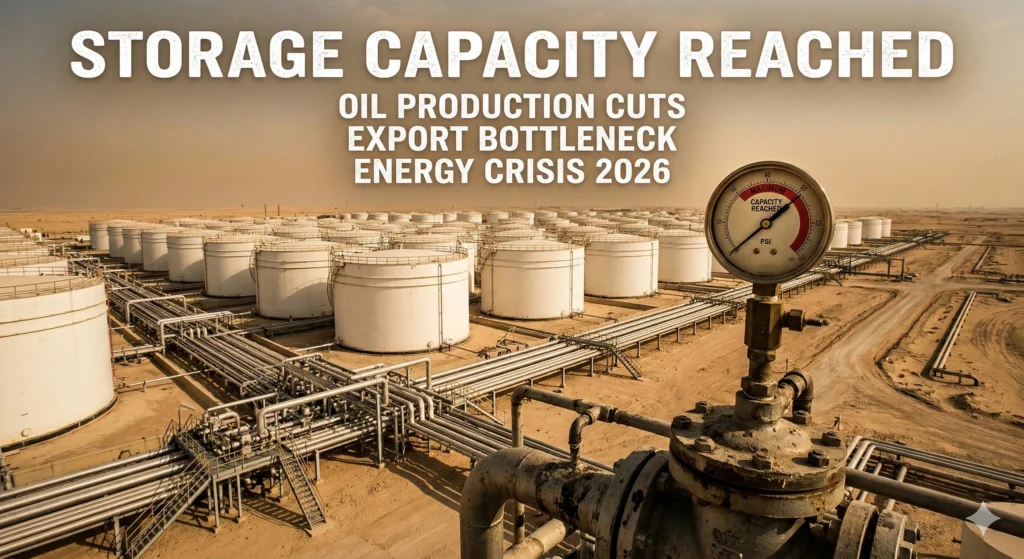
As storage tanks across the country hit their maximum limits, the government has been left with no choice but to initiate shutdowns at various production sites. This decision was accelerated by the closure of the Strait of Hormuz, which has effectively trapped millions of barrels of crude within the country’s borders. Without an outlet to international refineries, the physical constraints of overflowing reservoirs have necessitated an immediate and tactical reduction in active extraction activities across the desert fields.
Kuwait Oil Production Cuts
The primary driver behind the Kuwait oil production cuts is a critical lack of available storage space for unexported petroleum. When the nation’s massive tank farms reached 100% capacity this week, engineers began the delicate process of winding down operations at several major domestic fields. This is not a voluntary market maneuver but a technical necessity to prevent environmental hazards and infrastructure damage associated with over-pressurized storage systems.
Industry analysts at Kpler had warned that regional storage facilities were filling at an accelerated rate prior to these measures. The current situation highlights the vulnerability of oil-dependent economies when transit corridors are compromised. Because Kuwait oil production cuts are now a reality, the focus has shifted toward maintaining just enough flow to meet the essential energy needs of the local population while keeping critical infrastructure in a state of readiness for a future restart.
Geopolitical Bottlenecks and Export Routes
The closure of the Strait of Hormuz to commercial tanker traffic has created a historic bottleneck for Kuwaiti energy exports. Since the majority of the nation’s wealth is generated through maritime trade, the inability to move tankers has caused an immediate backup in the supply chain. This maritime blockade is the underlying reason why the Kuwait oil production cuts were implemented so rapidly following the escalation of regional tensions.
Unlike some of its neighbors, Kuwait relies heavily on this single transit point for its global shipments. While some regional players have explored overland pipelines, the sheer volume of Kuwaiti crude requires functional sea lanes to reach its primary customers in Asia and Europe. Consequently, the Kuwait oil production cuts serve as a barometer for the severity of the current shipping crisis, reflecting a total halt in the traditional export mechanism that sustains the national budget.
Regional Ripple Effects in Energy Markets
Kuwait is not alone in this struggle, as the storage crunch spreads across the Middle East. Iraq has already taken similar measures by winding down production at three of its largest oilfields earlier this week to avoid a total system failure. The United Arab Emirates is also reportedly facing a similar storage dilemma, suggesting that Kuwait oil production cuts are part of a broader regional trend of forced technical shutdowns across the OPEC membership.
These coordinated, yet involuntary, reductions are beginning to exert upward pressure on global oil prices. Even though the oil exists, its unavailability on the global market creates a phantom shortage that worries international energy traders. The Kuwait oil production cuts, combined with Iraqi and Emirati reductions, have effectively removed several million barrels of daily supply from the global balance, leading to increased volatility in energy futures.
Technical Challenges of Shutting Down Fields
Restarting shut-in oil wells is a complex and costly process that weighs heavily on the minds of Kuwaiti officials. Depending on the age and geological condition of the fields, a total halt can lead to pressure changes or equipment degradation that makes a future restart difficult. This technical risk is why the Kuwait oil production cuts are being managed with extreme caution, prioritizing the preservation of well integrity over simple volume reduction.
Engineers are working around the clock to ensure that the fields undergoing Kuwait oil production cuts are placed in a “warm standby” mode. This involves maintaining specific pressure levels and utilizing chemical inhibitors to prevent corrosion while the pumps are silent. The cost of these protective measures adds a significant financial burden to the state, further complicating an already stressed economic forecast driven by the lack of export revenue.
Domestic Consumption and Refining Strategy
Kuwaiti leadership is currently discussing a strategy to limit all energy operations strictly to the requirements of the local population. This means that refining and extraction will only continue at levels necessary to power local desalination plants, electricity grids, and domestic transportation. By focusing on internal needs, the Kuwait oil production cuts help preserve what little storage remains for refined products that are essential for daily survival.
This “inward-looking” energy policy represents a drastic departure from Kuwait’s traditional role as a global energy heavyweight. However, officials believe that the Kuwait oil production cuts are the only way to manage the current physical surplus without wasting precious resources. Ensuring that the lights stay on in Kuwait City is now the top priority, even as the country’s massive oil wealth remains trapped underground or in overflowing tanks.
Impact on Global Energy Supply Chains
As a founding member of OPEC, Kuwait typically maintains significant influence over global energy supply chains. The implementation of Kuwait oil production cuts sends a shockwave through the organization, as it limits the group’s ability to stabilize prices or respond to global demand shifts. When a major producer is forced to stop due to storage capacity rather than policy, it signals a breakdown in the global logistics network.
International markets are closely watching for a final decision on the total scale of the production ceiling expected in the coming days. If the Kuwait oil production cuts are extended or deepened, it could lead to long-term shifts in how Asian refineries source their crude. Many buyers are already looking toward West African or American suppliers to fill the void left by the sidelined Middle Eastern producers, potentially altering trade patterns for years to reach.
Future Economic Outlook for Kuwait
The financial implications of the Kuwait oil production cuts are profound, as the national budget relies almost entirely on oil sales. Without the ability to export, the government may need to tap into its sovereign wealth funds to maintain public services and payrolls. This period of forced inactivity is testing the fiscal resilience of the state, highlighting the urgent need for economic diversification that has been discussed for decades.
Despite the current crisis, the long-term outlook remains tied to the resolution of regional conflicts. Once the shipping lanes reopen, the challenge will shift from managing Kuwait oil production cuts to rapidly scaling up operations to recapture lost market share. The speed at which Kuwait can transition from these technical shutdowns back to full capacity will determine how quickly the national economy can recover from this unprecedented storage emergency.
For more details & sources visit: Business Recorder
Read more about Kuwait news on 360 News Orbit – Kuwait.