
Kuwait naval base units have successfully neutralized a hostile unmanned aerial vehicle targeting a key naval installation during a period of intense regional conflict. The military confirmed that the interception was executed according to operational plans, ensuring the safety of national territory on Saturday. The Kuwaiti Ministry of Defense announced that the Mohammed Al-Ahmad Naval Base was the specific target of the drone. Air defense units acted with high readiness to intercept the hostile unmanned aerial vehicle before it reached its objective.
Official statements confirmed that the military successfully protected Kuwaiti airspace and safeguarded national sovereignty during the incident. This interception followed established procedures and reflected seamless coordination among various branches of the armed forces. This event occurred as five Arab nations hosting United States military bases reported various aerial threats and explosions. Qatar, Bahrain, the United Arab Emirates, and Jordan also documented missile interceptions throughout the day on Saturday.
The regional instability stems from a joint military operation launched by the United States and Israel against Iran. Iran responded to these strikes by launching a series of missiles and drones toward Israeli and American assets in the Gulf. Foreign Minister Abbas Araghchi stated that the Iranian counterattacks were strictly limited to military sites in the region. The Kuwaiti government remains in a state of high alert to counter any further violations of its territorial integrity.
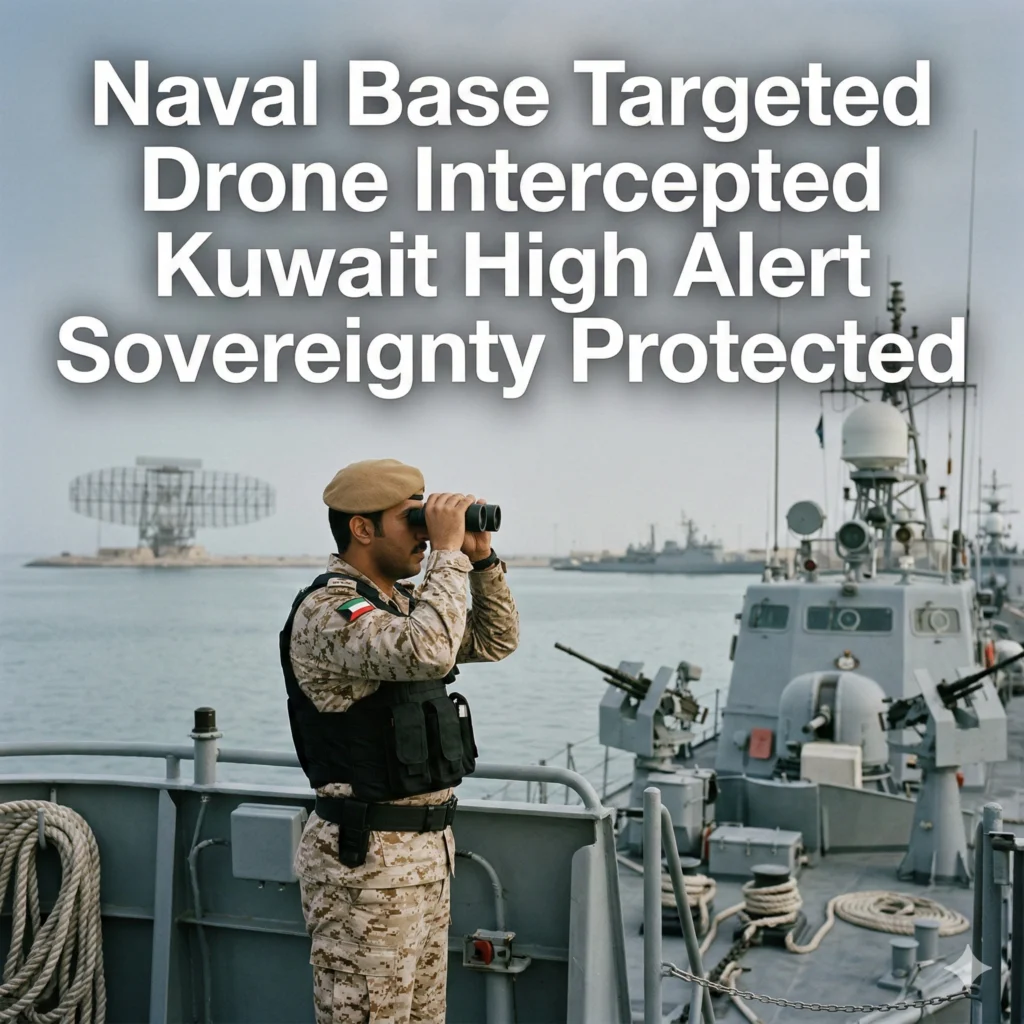
Kuwait Naval Base
Kuwait naval base security protocols were immediately upgraded to the highest level following the detection of the incoming drone. The Mohammed Al-Ahmad Naval Base serves as a primary hub for maritime security and international cooperation in the Northern Gulf. Military engineers are currently inspecting the perimeter to ensure that no secondary devices were deployed during the aerial attack. This facility is vital for the protection of Kuwaiti territorial waters and its valuable energy exports.
The successful defense of the Kuwait naval base demonstrates the high level of training and readiness maintained by the national air defense corps. Technicians utilized advanced radar systems to track the unmanned aerial vehicle from the moment it entered sovereign airspace. By neutralizing the threat over the sea, the military prevented potential collateral damage to nearby civilian maritime traffic. The government has praised the rapid response of the personnel stationed at the site.
International observers are closely watching the situation at the Kuwait naval base as a barometer for regional maritime safety. Any disruption to the operations at this facility could have implications for global energy markets and shipping routes. The Ministry of Defense has reaffirmed its commitment to using all necessary means to defend its borders. Further reinforcements have been dispatched to the coastal regions to bolster existing defensive batteries.
Retaliatory Strikes and Regional Impact
The targeting of the Kuwait naval base is part of a wider wave of retaliatory actions following US and Israeli strikes. In the United Arab Emirates, a retaliatory Iranian missile strike targeted the Fairmont The Palm hotel in Dubai, causing a significant fire. This attack resulted in four injuries and highlighted the vulnerability of high-profile civilian and commercial landmarks during military escalations. The debris from intercepted drones also sparked a secondary blaze on the exterior of the Burj Al Arab.
These incidents, alongside the threat to the Kuwait naval base, show that the conflict is no longer confined to military zones. The use of ballistic missiles and drones against various targets across five Arab nations has created a state of emergency. Jordan, Bahrain, and Qatar have all reported similar aerial incursions over the past twenty-four hours. Each nation is struggling to balance its defensive needs with the desire to avoid direct involvement.
The Iranian government maintains that its actions are a legitimate response to the initial joint military operation. However, the impact on neutral ground, such as the Kuwait naval base, has drawn sharp criticism from the international community. The deployment of drones against naval installations suggests a strategic intent to degrade regional maritime surveillance. Authorities are now coordinating with GCC partners to create a unified air defense umbrella.
Tactical Analysis of the Drone Interception
The drone that targeted the Kuwait naval base was reportedly a high-tech unmanned aerial vehicle equipped with explosive payloads. Military analysts believe the craft was designed to bypass traditional radar signatures by flying at low altitudes over the water. Despite these stealth features, Kuwaiti air defense units successfully identified and destroyed the target before impact. This success at the Kuwait naval base is being studied by regional allies.
Following the explosion, specialized recovery teams were sent to the waters surrounding the Kuwait naval base to collect debris. The wreckage is expected to provide critical information regarding the manufacturing and guidance systems used by the attackers. Such data is essential for updating electronic warfare suites and jamming technologies used by the Kuwaiti Armed Forces. The military remains tight-lipped about the specific weapons used to down the drone.
The persistence of these threats indicates that the Kuwait naval base remains a high-priority target for regional actors. Constant patrols by both sea and air have been established to provide a multi-layered defense. The coordination between the navy and the air defense force has been described as seamless and highly effective. Residents in the vicinity of the base have been advised to stay alert for further official announcements.
- Kuwaiti air defense intercepted the drone at 02:00 local time.
- The Mohammed Al-Ahmad Naval Base reported zero structural damage.
- Military assets in Bahrain and Qatar also engaged multiple targets.
Escalation in Dubai and the UAE
While the Kuwait naval base was successfully defended, the situation in Dubai took a more destructive turn on Saturday. The missile strike on Fairmont The Palm represents a significant shift in targeting towards high-density tourist areas. Emergency services responded quickly to the resulting blaze, which took several hours to fully contain and extinguish. The four injured individuals are currently receiving medical treatment at local specialized hospitals.
The secondary fire at the Burj Al Arab, caused by drone debris, further emphasizes the danger of aerial interceptions over urban centers. Even when a threat is neutralized, the resulting fragments can cause significant damage to iconic structures. The UAE government has condemned these attacks as a violation of international law and a threat to global security. Like the Kuwait naval base, UAE military sites are also on high alert.
Tourism and business sectors in the region are monitoring these developments with deep concern for future stability. The images of fire at luxury hotels have sent shockwaves through the global travel industry. Security experts are calling for enhanced missile defense systems to be installed near critical civilian infrastructure. The link between the attack in Dubai and the attempt on the Kuwait naval base is undeniable.
Diplomatic Responses to Gulf Instability
The Kuwaiti Foreign Ministry has issued a formal protest regarding the attempted strike on the Kuwait naval base. Diplomatic channels are being used to communicate the kingdom’s rejection of being used as a battleground for external conflicts. The government is seeking assurances that its sovereignty will be respected by all combatants involved in the current escalation. Stability at the Kuwait naval base is considered a non-negotiable priority.
Regional leaders are calling for an immediate de-escalation of hostilities to prevent further civilian and military casualties. The Arab League is expected to hold an emergency session to discuss the threats facing Kuwait and its neighbors. There is a growing consensus that the targeting of facilities like the Kuwait naval base is a dangerous provocation. Diplomatic missions in Kuwait City are operating under increased security protocols today.
The United States has reaffirmed its commitment to the security of its partners in the Gulf region. As a host to US assets, the Kuwait naval base remains a central component of this strategic partnership. Joint training exercises conducted in the past have clearly paid off during this real-world defensive operation. The international community is being urged to support a peaceful resolution to the Iranian-Israeli-US conflict.
- Five Arab nations have documented confirmed aerial threats.
- Kuwaiti officials confirmed the interception followed operational plans.
- The Iranian Red Crescent reported 201 deaths within Iran from initial strikes.
Kuwait’s Defense Strategy and Readiness
The Ministry of Defense has stated that the Kuwait naval base will continue to operate at full capacity despite the threat. The resilience of the military infrastructure is a key deterrent against future unmanned aerial vehicle attacks. Specialized anti-drone technology is being deployed more widely across all military installations in the country. The successful defense of the Kuwait naval base is a testament to this ongoing modernization effort.
Personnel at the base are undergoing continuous drills to prepare for potential swarm attacks or multi-vector threats. The experience gained from Saturday’s interception is being integrated into future tactical planning. The Kuwait naval base is now a focal point for national pride and military competence in the face of adversity. The government has promised to invest further in high-tech defense systems to ensure total airspace control.
Civilian authorities are also coordinating with the military to ensure that the public is informed without causing panic. Clear communication regarding the safety of the Kuwait naval base has helped maintain social stability during the crisis. The transparency of the Ministry of Defense has been welcomed by local and international media outlets. Every effort is being made to keep the ports and naval facilities secure for national interest.
Technical Specifications of Regional Interceptions
Data from the Kuwait naval base interception suggests that the drone used was a medium-range tactical model. These drones are often used for reconnaissance but can be easily converted into “kamikaze” style weapons. The ability of Kuwaiti forces to distinguish such threats from civilian aircraft is a critical skill. This technical proficiency saved the Kuwait naval base from a potentially devastating explosion.
Similar technical challenges are being faced by air defense units in Qatar and Bahrain this weekend. The sheer variety of projectiles, from ballistic missiles to small drones, requires a diverse range of interceptors. The Kuwait naval base is equipped with a mixture of short-range and medium-range defense batteries. This combination provides a robust shield against the different types of hardware being deployed in the region.
The environmental impact of the debris falling near the Kuwait naval base is also being monitored by ecological experts. Metallic fragments and residual fuel can have a negative effect on local marine life if not properly managed. The navy has deployed specialized vessels to ensure the water remains clean and safe for maritime traffic. This holistic approach to the Kuwait naval base defense covers both security and environmental safety.
The Role of US Bases in the Conflict
The presence of United States military bases in the region is a central factor in the current targeting patterns. Because the Kuwait naval base and other regional sites host American personnel, they have become focal points for Iranian retaliation. This dynamic has placed host nations in a difficult position as they attempt to maintain their own sovereignty. The attack on the Kuwait naval base is seen as a direct response to US actions.
Military cooperation agreements ensure that these bases are protected by some of the most advanced technology in the world. However, the high volume of incoming threats can still test the limits of even the most sophisticated systems. The Kuwait naval base successfully proved its defensive capabilities under these extreme conditions on Saturday. Future security arrangements may need to be adjusted to account for the increasing use of drone technology.
Arab nations hosting these bases are in constant communication to share intelligence and coordinate their defensive postures. A threat to the Kuwait naval base is often preceded or followed by threats to installations in neighboring countries. This interconnected security environment requires a high degree of trust and data sharing among allies. The current crisis has strengthened the military bonds between the GCC member states.
- Qatar and Bahrain reported missile interceptions on Saturday.
- The Mohammed Al-Ahmad base is the primary target identified by Kuwait.
- US and Israeli strikes against Iran triggered the current wave of attacks.
Economic Implications of the Naval Threat
The proximity of the Kuwait naval base to major oil loading terminals makes its security a matter of global economic importance. Any perceived threat to the safety of the Northern Gulf can lead to a spike in international oil prices. The successful interception on Saturday helped to stabilize market fears regarding potential supply disruptions. Protecting the Kuwait naval base is, therefore, an economic necessity as much as a military one.
Insurance rates for shipping in the Gulf are also affected by the security situation at the Kuwait naval base. Maritime companies require constant updates on the safety of the waters to continue their operations. The Ministry of Interior has been working with the port authorities to ensure that commercial shipping remains unaffected. The defense of the Kuwait naval base ensures that the lifeblood of the economy continues to flow.
In the long term, the government may seek to diversify its security investments to reduce the risk to critical infrastructure. The lesson from the Kuwait naval base incident is that even a single drone can have an outsized impact on regional perception. Robust defense spending is likely to remain a priority for the Kuwaiti government in the coming years. Investors are looking for continued stability and strong military leadership in the region.
Public Safety and Civil Defense Measures
The Kuwaiti government has issued a series of safety guidelines to the public following the attack on the Kuwait naval base. While the military handled the threat effectively, citizens are reminded to report any unusual aerial activity immediately. Civil defense units have been placed on standby to assist in the event of any debris falling in residential areas. The protection of the Kuwait naval base remains a national effort involving all sectors.
Emergency sirens were tested in areas near the coast as part of a general readiness check on Saturday evening. The public has been praised for their calm and orderly response to the heightened security presence. Education campaigns regarding the dangers of unexploded ordnance are being broadcast on national television and social media. These measures complement the kinetic defense provided at the Kuwait naval base.
As the regional situation remains fluid, the government will provide regular updates to ensure transparency. The safety of the people is the ultimate goal of all operations at the Kuwait naval base and beyond. Authorities are confident that their current strategies are sufficient to handle any further escalations. Vigilance and cooperation are the keywords for the Kuwaiti public during these challenging times.
Conclusion and Future Outlook
In conclusion, the successful defense of the Kuwait naval base is a significant achievement for the national armed forces. By intercepting the hostile drone, the military protected a vital piece of national infrastructure and prevented potential casualties. The broader regional conflict continues to pose a challenge to all nations in the Gulf, as seen in the UAE and Jordan. The Kuwait naval base stands as a symbol of the country’s readiness and resolve.
The international community must continue to work towards a diplomatic solution to prevent the conflict from spreading further. Until then, the Kuwait naval base will remain on high alert, ready to intercept any and all threats to sovereign territory. The lessons learned from Saturday’s events will be used to further refine the kingdom’s defensive capabilities. We will continue to monitor the situation at the Kuwait naval base and provide updates as they emerge.
The resilience of the Kuwaiti people and their military ensures that the nation remains a pillar of stability in a volatile region. The Kuwait naval base is more than just a military installation; it is a guardian of the nation’s peace and prosperity. As we move forward, the focus remains on de-escalation, security, and the protection of all residents. Stay safe and follow official instructions as the regional situation continues to evolve.
For more details & sources visit: Anadolu Agency
Read more about Kuwait news on 360 News Orbit – Kuwait.