
KL mayor election study has become the latest flashpoint in Malaysia’s long-running debate over race, power, and political reform, after a government-backed feasibility review proposed the possibility of electing Kuala Lumpur’s mayor instead of continuing with federal appointments.
What began as an academic exercise has quickly escalated into a highly charged political confrontation, exposing deep anxieties about ethnic representation, urban demographics, and the future direction of local governance in the country’s most diverse city.
From Administrative Reform to Political Firestorm
The controversy erupted after it emerged that the International Islamic University Malaysia (IIUM) is conducting a study on whether Kuala Lumpur should shift to an elected mayoral system. The research, commissioned under the federal territories ministry, follows a previous private member’s bill introduced by Kuala Lumpur Members of Parliament seeking broader local government reforms.
Critics, particularly from Malay-nationalist and opposition parties, argue that such a move risks destabilizing ethnic balance in the capital. They fear that an elected mayor could reflect non-Malay urban voting patterns, challenging long-standing political arrangements designed to safeguard Malay primacy.
Perikatan Nasional secretary-general Takiyuddin Hassan dismissed the initiative as “naive,” warning it could inflame racial tensions in an already polarized political climate.
Government Clarifies Scope of the Study
Federal Territories Minister Hannah Yeoh moved to contain the backlash, stressing that the initiative is purely a feasibility study, not a policy decision. She emphasized that the research aligns with democratic discussions already raised in Parliament and is expected to deliver findings by March 2026.
Yeoh rejected accusations that she was politicizing Kuala Lumpur City Hall, arguing instead that evaluating governance structures is a normal part of democratic reform. The study, she said, is intended to explore accountability, transparency, and efficiency—not to pre-determine outcomes.
Kuala Lumpur’s Demographics at the Center of the Debate
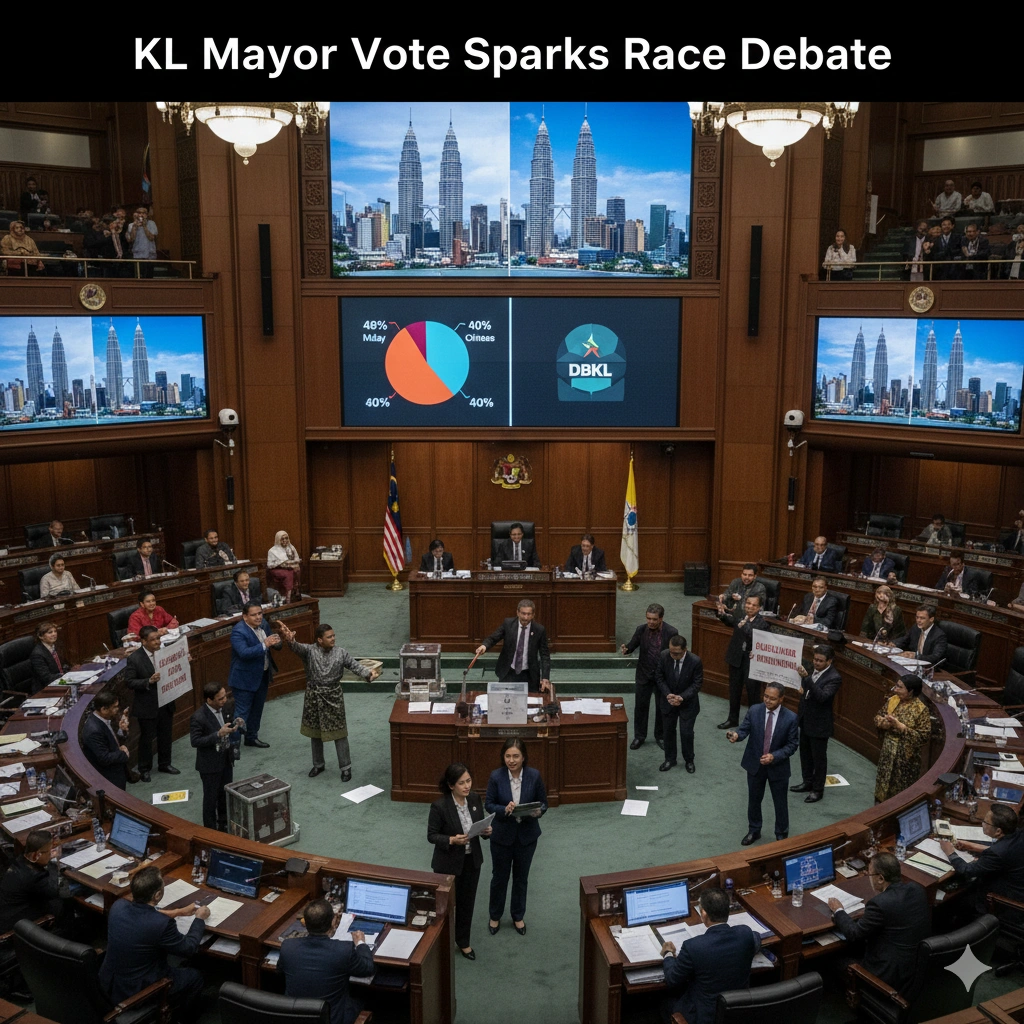
The intensity of the reaction reflects Kuala Lumpur’s unique demographic makeup, which differs sharply from much of the country. Of the city’s 2.07 million residents, approximately 48% are Malay, 40% Chinese, and 10% Indian, making it Malaysia’s most ethnically mixed urban center.
Local elections in Kuala Lumpur were suspended decades ago, and since then, mayors have been appointed by the federal government every three years. The current mayor, Fadlun Mak Ujud, assumed office in November 2025 after succeeding Maimunah Mohd Sharif.
Opponents of mayoral elections argue that this appointment system ensures stability and prevents ethnic polarization in municipal leadership.
Opposition Fears and Ethnic Anxiety
Parties such as Umno and PAS have warned that introducing an elected mayor could open the door to political syndicates, intensify federal–city conflicts, and weaken Malay political influence in the capital.
Some critics frame the issue as part of a broader struggle over urban dominance, suggesting that electoral reforms disproportionately favor non-Malay communities concentrated in cities. These concerns echo long-standing narratives in Malaysian politics, where local governance is often viewed through an ethnic lens rather than an administrative one.
Reformists Push Back: Debate Is Healthy
Supporters of the study argue that such fears reflect resistance to accountability rather than genuine governance concerns. Transport Minister Anthony Loke defended the public debate, calling it a sign of democratic maturity and urging Malaysians to engage with the issue without resorting to racial alarmism.
Reform advocates note that many global cities operate under elected local leadership without undermining national cohesion. They argue that greater accountability at City Hall could improve service delivery, reduce corruption, and give residents a stronger voice in urban planning.
Alternative Proposal: Reducing Mayoral Power
Notably, reformers are not united around a powerful elected mayor model. In November 2025, seven Kuala Lumpur MPs tabled a bill proposing a councillor-based system that would dilute mayoral authority rather than concentrate it.
Former environment minister Nik Nazmi Nik Ahmad explained that the proposal aims to decentralize power, aligning with Pakatan Harapan’s manifesto pledge to strengthen local democracy while avoiding personality-driven politics.
This approach, supporters argue, could serve as a compromise between democratic participation and ethnic sensitivity.
What the KL Mayor Election Study Represents
At its core, the KL mayor election study is about more than city administration. It reflects Malaysia’s unresolved struggle over identity, representation, and reform, where even technical governance discussions quickly become proxies for ethnic competition.
As the IIUM-led research moves toward its March deadline, political tensions are likely to intensify. Whether the study leads to concrete reform or is shelved under pressure, it has already reopened fundamental questions about who governs Malaysia’s cities—and in whose name.
For more details & sources visit: South China Morning Post
Read more about Malaysia news on 360 News Orbit – Malaysia.