
Kite-Skiers Battle Winds And Injury In Antarctica as the 2025–2026 Antarctic expedition season closed with dramatic triumphs and serious setbacks. Elite polar athletes faced gale-force winds, brutal terrain, and life-threatening injuries while attempting record-breaking crossings on the world’s harshest continent.
French explorers Matthieu Tordeur and Heidi Sevestre successfully completed an extraordinary 4,000-kilometer kite-ski journey from the South Pole of Inaccessibility to Hercules Inlet on January 21, 2026. Their expedition spanned 80 relentless days, testing both physical endurance and mental resilience.
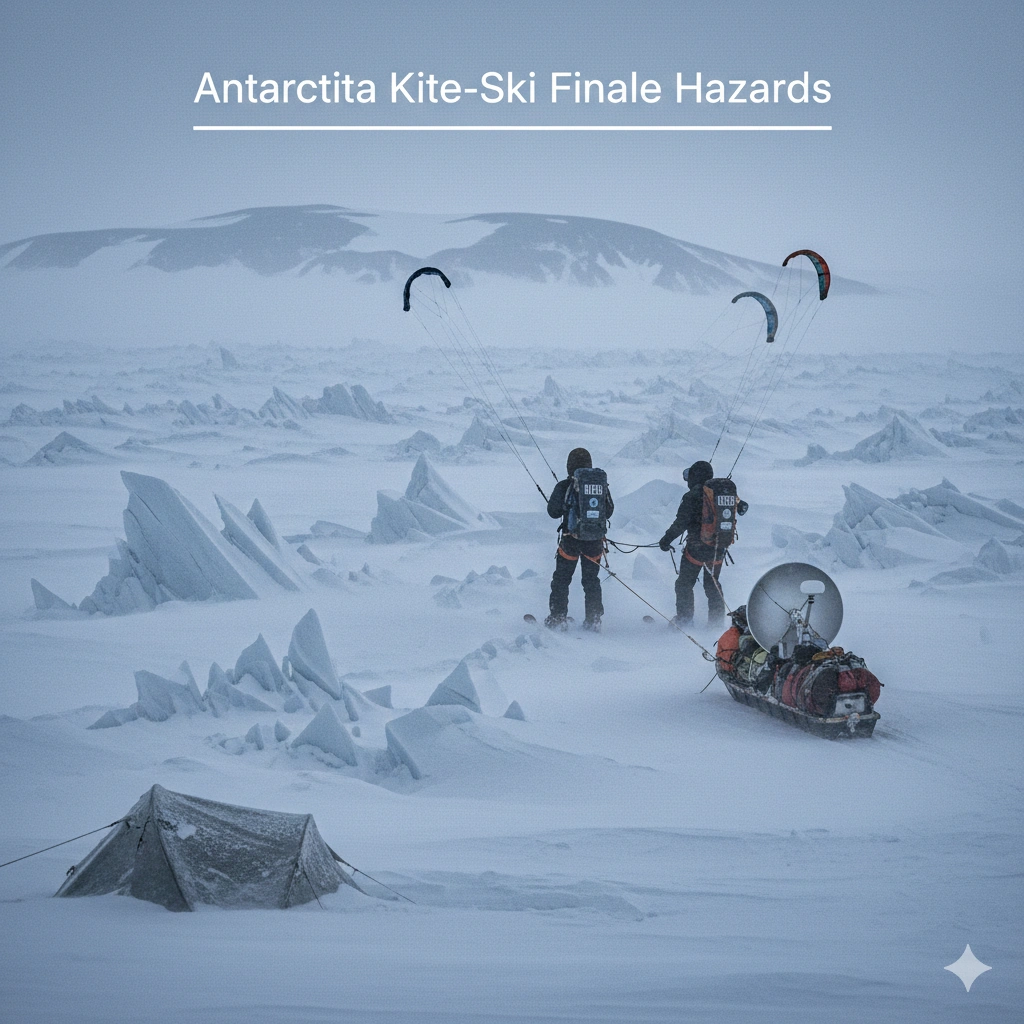
French Duo Completes 4,000km Antarctic Crossing
After passing Thiels Corner, Tordeur and Sevestre encountered some of the most punishing conditions of the journey. Violent Antarctic winds forced them to downsize their kites to 7m² and 4m², and at one point, conditions were so extreme that they remained confined to their tent for an entire wind day.
The plateau beyond was riddled with concrete-hard sastrugi, deep wind-carved ridges that slowed progress and increased injury risk. Despite the obstacles, the pair reached Hercules Inlet, completing one of the season’s most demanding expeditions.
In addition to endurance travel, the team conducted radar mapping of subglacial features, contributing valuable data for UNESCO climate research and expanding scientific understanding of Antarctica’s hidden ice structures.
Norwegian Team Suffers Devastating Near-Finish Accident
While success marked one expedition, tragedy struck another. Norwegian kite-skiers Kathinka and Emma Gyllenhammar were just 40 kilometers from the finish when disaster unfolded during a descent across rough sastrugi.
Their sled abruptly snagged on the ice, causing a sudden kite surge that violently lifted and slammed Kathinka into the terrain. She sustained three pelvic fractures and a broken rib, bringing their expedition to an immediate halt.
Emma Gyllenhammar acted quickly, triggering an emergency signal. Antarctic Logistics & Expeditions (ALE) coordinated a rapid evacuation, transporting Kathinka to Chile, where she is now recovering.
Solo Adventurer Battles Antarctica Alone
As team expeditions concluded, solo explorer Colin O’Brady remained on the ice. On day 78 of his unsupported Antarctic crossing, O’Brady pushed through shoulder-high sastrugi at 87° South, facing some of the most dangerous terrain of the journey.
His route included life-threatening crevasses on the Reedy Glacier, requiring extreme caution and precision. According to ALE records, O’Brady achieved the first solo ascent of this specific route, though his overall Ross Ice Shelf crossing ranks third historically, following Børge Ousland (1996) and Tryggvi Tryggvason (2025).
Antarctica’s Unforgiving Finale
The season finale once again proved why Antarctica remains the ultimate test of human endurance. From record-setting success to sudden evacuation, the stories of these kite-skiers highlight the thin line between achievement and catastrophe in polar exploration.
As the Antarctic sun dips lower on another expedition season, these journeys reinforce a timeless truth: on the ice, experience, preparation, and humility are as critical as strength.
Why Kite-Skiers Battle Winds And Injury In Antarctica
Kite-skiing in Antarctica pushes human capability to its limits, which is why kite-skiers battle winds and injury in Antarctica more frequently than in any other polar discipline. The continent’s volatile weather can shift within minutes, turning favorable winds into dangerous gusts capable of dragging sleds, snapping lines, or flipping skiers across jagged ice.
Beyond wind, the physical toll is relentless. Constant exposure to sub-zero temperatures, dehydration, and exhaustion weakens reaction time, increasing the likelihood of accidents. Even experienced athletes must continuously balance speed, safety, and survival, knowing that medical help may be hundreds of kilometers away.
Lessons From a Season Where Kite-Skiers Battle Winds And Injury In Antarctica
The 2025–2026 season offered hard-earned lessons on preparation and risk management in extreme exploration. As kite-skiers battle winds and injury in Antarctica, success increasingly depends on conservative decision-making, real-time weather analysis, and the ability to stop when conditions cross the line from challenging to dangerous.
Equally important is the role of modern logistics and rescue coordination. Rapid response from organizations like Antarctic Logistics & Expeditions (ALE) has become a critical safety net, allowing explorers to push boundaries while knowing emergency evacuation remains possible. These systems, combined with improved training and equipment, are reshaping how future Antarctic expeditions will be planned.
For more details & sources visit: ExplorersWeb
Read more on Antarctica news: 360 News Orbit – Antarctica