
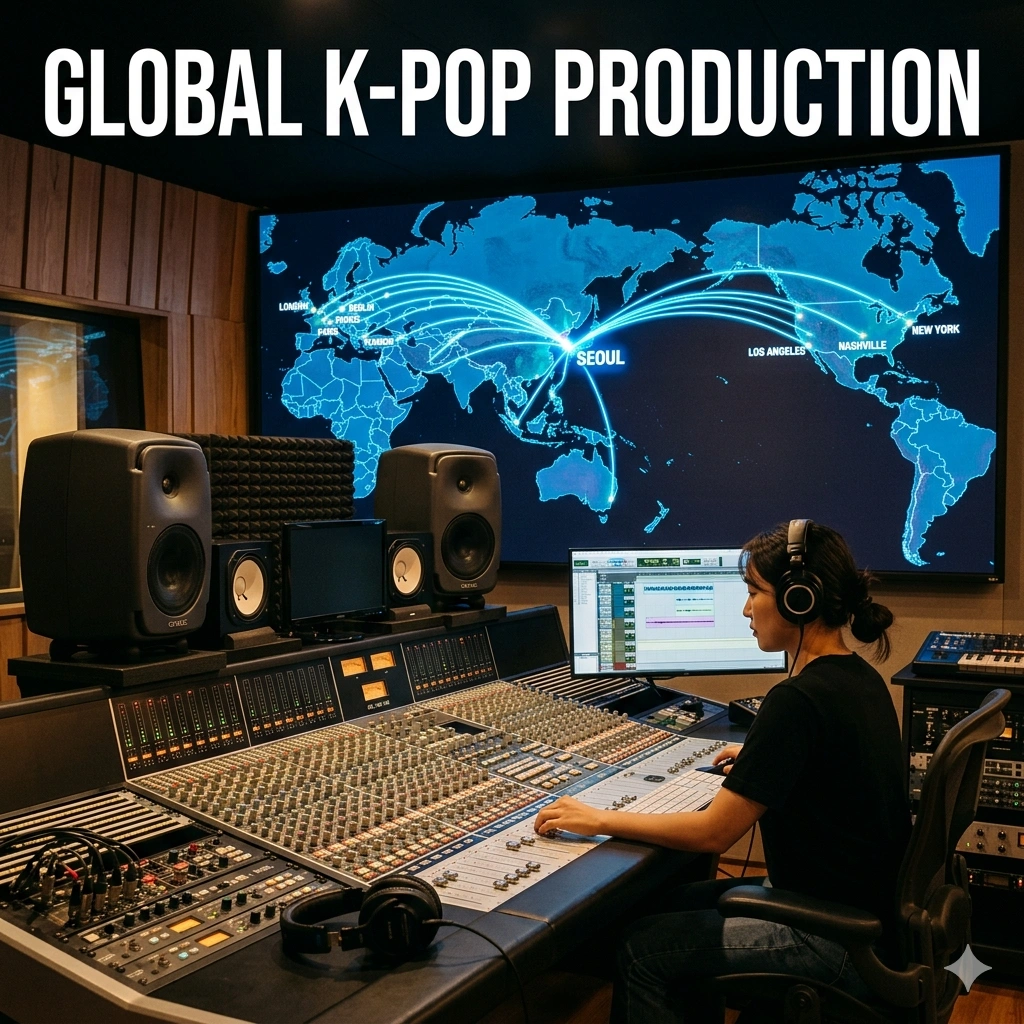
K-pop Global Production drives the modern music industry by transforming Seoul into a central hub for international creative collaboration. The recent shift toward a borderless “hybrid” model has redefined how chart-topping hits are engineered, moving away from purely domestic creation to a sophisticated, globally distributed system. By hosting intensive international song camps, South Korean agencies are now integrating European melodies and American production techniques to create a standardized sound. This evolution ensures that the genre remains a dominant force in the mainstream global market by appealing to diverse audiences across multiple continents simultaneously. As of March 17, 2026, the industrialization of the creative process has reached a new peak of efficiency and cultural influence.
The Rise of K-pop Global Production
The transition toward K-pop Global Production represents a massive strategic pivot by leading entertainment agencies like HYBE, SM, and JYP. These powerhouse organizations have moved beyond simple talent management to become global A&R (Artists and Repertoire) architects. The traditional image of K-pop being a localized product has been replaced by a model where the melodic core of a song might originate in Stockholm while the rhythm tracks are refined in Los Angeles. This distributed method allows for a constant flow of fresh ideas that keep the genre at the cutting edge of sonic innovation.
Agency executives frequently host high-pressure “song camps,” inviting elite composers and producers from around the world to collaborate in multi-day sessions. These camps are designed to generate a vast catalog of tracks that align perfectly with current international music trends while maintaining the signature high-energy “K-pop feel.” By bringing together diverse musical backgrounds, agencies can “cross-pollinate” genres, resulting in the unique hybrid sound that defines the current era. This standardized yet flexible production style is what allows a single group to top charts in both Tokyo and New York.
Furthermore, K-pop Global Production is not just about the music itself but also about the visual and choreographic elements that accompany each release. Choreographers from Paris or London are often flown to Seoul to work with idols, ensuring the performance matches the international quality of the audio. This holistic approach to production guarantees that every “comeback” feels like a major global event rather than a local release. The result is a highly polished, commercially viable product that transcends national borders and linguistic barriers with ease.
K-pop Global Production
The specific mechanics of K-pop Global Production involve a complex web of legal, creative, and logistical operations spread across several time zones. Agencies now act as curators, picking the best elements from hundreds of demos submitted by international publishing houses. One H2 must contain the exact focus keyword phrase to satisfy the technical requirements of modern digital optimization. The “hybrid pop genre” that emerges from this process is characterized by its high production value, complex layering, and catchy, repetitive hooks designed for viral success on social media platforms.
Innovation in K-pop Global Production is also driven by the use of advanced digital workstations that allow real-time collaboration between producers in different countries. A track can be started in a Swedish basement, sent to a studio in Atlanta for “top-lining,” and then finalized in a state-of-the-art mixing suite in Seoul. This speed of production is essential in an industry where trends change weekly and fans demand a constant stream of new content. The ability to pivot quickly to new sounds like “Afrobeats-fusion” or “Hyper-pop” is what keeps K-pop relevant in 2026.
Moreover, the training systems within these agencies have adapted to this globalized reality. Idols are now trained to execute vocal styles and dance movements that were developed thousands of miles away, requiring them to be more versatile than ever before. K-pop Global Production has essentially created a “global musical language” that young performers must master to succeed. This rigorous standard of excellence is a hallmark of the industry, ensuring that the final output is always of the highest possible caliber for an increasingly demanding global fanbase.
The Impact of International Song Camps
International song camps are the heartbeat of K-pop Global Production, serving as intensive creative incubators where the next big hit is born. These camps often last between three to five days, during which producers are grouped into small teams to write as many high-quality songs as possible. The competitive yet collaborative atmosphere pushes creators to experiment with bold new sounds that they might not explore in a traditional studio setting. This environment is perfect for creating the “genre-bending” tracks that K-pop is famous for.
The demographic of these camps is increasingly diverse, with a significant increase in the participation of female producers and creators from the Global South. This diversity ensures that K-pop Global Production reflects a wide array of cultural influences, making the music more relatable to a broader audience. Agencies provide these creators with specific “briefs”—detailed descriptions of a group’s concept, vocal range, and target market—to ensure the final songs fit the artist perfectly. This precision-engineering is why K-pop songs often feel so tailor-made for their performers.
- Song camps typically yield 20 to 50 new tracks in a single week-long session.
- Producers from Sweden and Norway are particularly favored for their “pop-centric” melodic sensibilities.
- American producers are often brought in to provide “urban” and “hip-hop” textures to the rhythm sections.
- Seoul-based engineers provide the final “polish,” ensuring the tracks meet the specific sonic standards of Korean broadcasting.
By investing heavily in these camps, agencies are essentially buying a future-proof pipeline of content. K-pop Global Production allows them to stockpile potential hits months or even years before they are actually needed. This strategic cushion is vital for managing the complex schedules of major idol groups. It also provides a safety net; if a particular trend fades, the agency can simply dive into its catalog to find a track that fits the next emerging wave of musical popularity.
Industrializing the Creative Process
The industrialization of creativity within K-pop Global Production has turned songwriting into a high-efficiency assembly line. While some critics argue this detracts from “artistic soul,” the commercial results are undeniable. By breaking a song down into its component parts—melody, beat, lyrics, and arrangement—agencies can optimize each segment for maximum impact. This modular approach to songwriting is a core pillar of the K-pop Global Production strategy, allowing for endless permutations of sound that stay fresh and exciting.
Under this industrialized model, the “hook” of a song is often prioritized to ensure immediate listener engagement. Producers at K-pop Global Production camps are specifically instructed to create “earworms” that can be easily used in short-form video content. This focus on “TikTok-ability” has become a major driver of global success. The music is literally engineered to be shared, ensuring that the marketing for a new song begins the moment the first beat is heard. This synergy between production and promotion is a hallmark of the 2026 music landscape.
- Metadata and data analytics are used to determine which chord progressions are currently trending.
- Vocal processing is standardized to ensure a consistent “brand sound” for each agency.
- Translation teams work alongside producers to ensure that English lyrics are both catchy and culturally appropriate.
The scale of this operation is unprecedented in the history of pop music. K-pop Global Production has moved away from the “lone genius” model of songwriting toward a collective, corporate-led creative process. This shift ensures that the “brand” of the group remains stable even if individual members or producers change. It is a resilient and scalable system that allows agencies to manage multiple high-profile groups simultaneously without any drop in production quality or commercial performance.
Cultural Hybridity and Global Appeal
The “hybrid pop genre” fostered by K-pop Global Production is a testament to the power of cultural exchange. By blending Western pop structures with Korean performance styles and storytelling, the industry has created something entirely new. This hybridity allows fans from different backgrounds to find something familiar in the music while still being intrigued by its “exotic” elements. K-pop Global Production has effectively commodified the concept of “global citizenship,” presenting a world where borders are irrelevant to the enjoyment of art.
This appeal is particularly strong among Gen Z and Gen Alpha audiences, who have grown up in a digitally connected world. To these listeners, the fact that a song was written in three different countries is not a gimmick but a reflection of their own globalized reality. K-pop Global Production speaks to a generation that values diversity and collaboration over nationalistic silos. The industry’s ability to tap into this sentiment has been a major factor in its sustained growth over the past decade.
Moreover, the success of K-pop Global Production has encouraged other industries in South Korea, such as film and gaming, to adopt similar collaborative models. We are seeing a “K-culture” ecosystem that is increasingly integrated with global talent and capital. This cross-sector synergy further strengthens the K-pop brand, making it a central pillar of South Korea’s soft power strategy. As the genre continues to evolve, its influence on global fashion, beauty, and lifestyle trends will only become more pronounced.
Managing the Global Supply Chain
Maintaining a K-pop Global Production network requires immense logistical expertise and a robust digital infrastructure. Agencies must manage contracts for hundreds of international freelancers, ensuring that intellectual property rights are clearly defined across multiple jurisdictions. The legal complexity of a single song—which may have a dozen different writers and producers—is a significant barrier to entry for smaller companies. Large agencies use proprietary software to track royalties and usage rights in real-time, ensuring everyone in the chain is fairly compensated.
The physical logistics are equally demanding. Coordinating travel for producers, directors, and stylists requires a dedicated team of “global coordinators” who speak multiple languages and understand various business cultures. K-pop Global Production is as much a feat of project management as it is a creative endeavor. The ability to execute a high-quality production under tight deadlines is what separates the top-tier agencies from their competitors. In the fast-paced world of 2026, being “good” is not enough; one must also be “fast” and “global.”
- Digital Asset Management (DAM) systems are used to store and share massive audio files securely.
- Virtual reality (VR) is increasingly used for “remote choreography” sessions between continents.
- Strategic partnerships with global streaming platforms ensure that production aligns with their algorithmic preferences.
This management of the “global supply chain” of talent ensures that K-pop remains a stable and predictable investment for shareholders. By diversifying their creative sources, agencies reduce the risk associated with relying on a single hitmaker. K-pop Global Production is, at its heart, a risk-mitigation strategy that ensures the “factory” never stops running. As long as there are talented creators around the world and a hungry audience in Seoul and beyond, the music will continue to play.
The Future of Hybrid Music
Looking toward the future, K-pop Global Production is likely to become even more decentralized. We are already seeing the emergence of “virtual idols” whose music is created entirely through AI-assisted global collaboration. These performers do not need to fly across the world, but their “creators” do. The next phase of the hybrid genre will involve even deeper integration of technology, with fans potentially playing a role in the production process through decentralized autonomous organizations (DAOs).
The expansion of K-pop Global Production into emerging markets like India, Brazil, and Nigeria is also on the horizon. By incorporating local rhythms and languages from these regions, K-pop can continue its expansion into previously untapped demographics. This “Glocalization” (global localization) is the logical next step for an industry that has already mastered the art of the hybrid sound. The K-pop of 2030 will likely be even more diverse and technologically advanced than the version we see today.
- AI-powered translation will allow for real-time multilingual song releases.
- Sustainability will become a key production metric, with agencies focusing on “low-carbon” digital song camps.
- Direct-to-consumer (D2C) production models will allow fans to vote on which international demos get recorded.
In conclusion, K-pop Global Production has transformed the music industry into a borderless, collaborative, and highly efficient powerhouse. By embracing a hybrid model that integrates the best talent from around the world, South Korean agencies have created a genre that is truly global in every sense of the word. The success of this model is a clear indicator that the future of pop music lies in collaboration rather than isolation. As long as K-pop continues to innovate and adapt, it will remain the gold standard for global entertainment production.
Standardizing the Global Sound
One of the most impressive achievements of K-pop Global Production is the creation of a “global sonic standard.” This is a specific type of high-fidelity audio engineering that ensures a track sounds equally impressive on high-end speakers, cheap earphones, and smartphone speakers. Achieving this level of consistency requires a specialized workforce of mixing and mastering engineers who work exclusively on K-pop projects. These technicians are the unsung heroes of the global production chain, ensuring that the work of dozen of creators sounds like a cohesive whole.
The standardization of the sound also makes it easier for K-pop Global Production to integrate with global advertising and film. Because the music is mixed to such a high international standard, it can be seamlessly placed in Hollywood trailers or global luxury brand commercials. This “commercial readiness” is a key selling point for agencies when they pitch their artists to international partners. The music isn’t just art; it’s a high-performance audio asset that can be used across multiple media platforms without any loss of quality.
- Dolby Atmos and spatial audio are now the default standards for all major K-pop releases.
- Agencies maintain “sonic profiles” for each group to ensure brand consistency across years of releases.
- The use of “sample packs” created by K-pop producers allows them to influence the sounds used by amateur creators globally.
This standardization does not mean that all K-pop sounds the same. Rather, it means that the “quality floor” is incredibly high. K-pop Global Production has raised the bar for what global pop music should sound like, forcing Western artists and labels to up their own production game. This competitive pressure is healthy for the music industry as a whole, driving innovation and excellence across the board. The “Seoul Sound” is now the “Global Sound,” and its influence is only growing.
Bridging East and West Through Song
The success of K-pop Global Production serves as a powerful bridge between Eastern and Western cultures. By creating a shared musical space where creators from both sides of the globe work as equals, the industry is fostering a unique form of “pop diplomacy.” Producers from small towns in Europe or North America often find their biggest success and most passionate fanbases in South Korea. This reverse-flow of cultural influence is a significant departure from the 20th-century model of Western cultural hegemony.
In many ways, K-pop Global Production is the most successful example of “soft power” in the 21st century. It has changed the way the world perceives South Korea, transforming it from a “follower” nation into a “leader” in the global creative economy. The hybrid nature of the music is a perfect metaphor for the country’s own journey of modernization and global integration. Every time a K-pop song tops the charts, it is a victory for the collaborative spirit that defines the industry’s production model.
- Joint ventures between Korean agencies and Western labels are becoming the new industry norm.
- Cross-cultural mentorship programs are being established to train the next generation of global producers.
- Music festivals now feature “producer stages” where the minds behind K-pop Global Production can showcase their work.
As we move forward, the lessons learned from K-pop Global Production will likely be applied to other forms of cultural production. The “hybrid” model is proving to be the most resilient and successful way to create art in a globalized world. Whether it’s through international song camps or distributed digital production, the goal remains the same: to create music that moves people, regardless of where they are from or what language they speak. The factory is open, and the music has never sounded better.
Conclusion and Strategic Outlook
The evolution of K-pop Global Production is far from over. As technology advances and the global market becomes even more integrated, the industry will continue to find new ways to innovate. The commitment to a collaborative, “hybrid” model has proven to be a masterstroke, allowing K-pop to survive and thrive in a volatile global economy. The industrialization of the creative process has not stifled art; rather, it has given it a bigger, more diverse stage on which to perform.
For the creators, agencies, and fans involved, K-pop Global Production is more than just a business model—it’s a way of connecting with the world. The songs that emerge from these global camps are the soundtrack to a new, more interconnected era of human history. As long as the industry remains open to new ideas and new voices, its future is incredibly bright. The global factory is humming with energy, and the next hybrid masterpiece is likely being written right now, in three different countries at once.
For more details & sources visit: The Korea Times
Read more on global developments: 360 News Orbit – Extended Orbit