
The Jordan falling objects crisis has escalated significantly following the recent Iranian counterattacks against regional targets. The Jordanian Interior Ministry recently confirmed that dozens of incidents involving missile debris occurred across the country. Authorities reported property damage in multiple regions but confirmed that no injuries or fatalities have been recorded yet. The Jordan Public Security Directorate responded to 73 separate incidents involving falling objects and debris since Saturday.
Civil defense and police teams were deployed to the regions of Amman, Zarqa, Madaba, and West Balqa to manage the aftermath. Additional reports of falling debris originated from the areas of Jerash, Irbid, Aqaba, and Central Badia during the night. The Jordanian Armed Forces announced they successfully intercepted 49 unmanned aerial vehicles and ballistic missiles over their sovereign territory. Military officials stated that the incoming projectiles were targeting various locations within the kingdom’s borders.
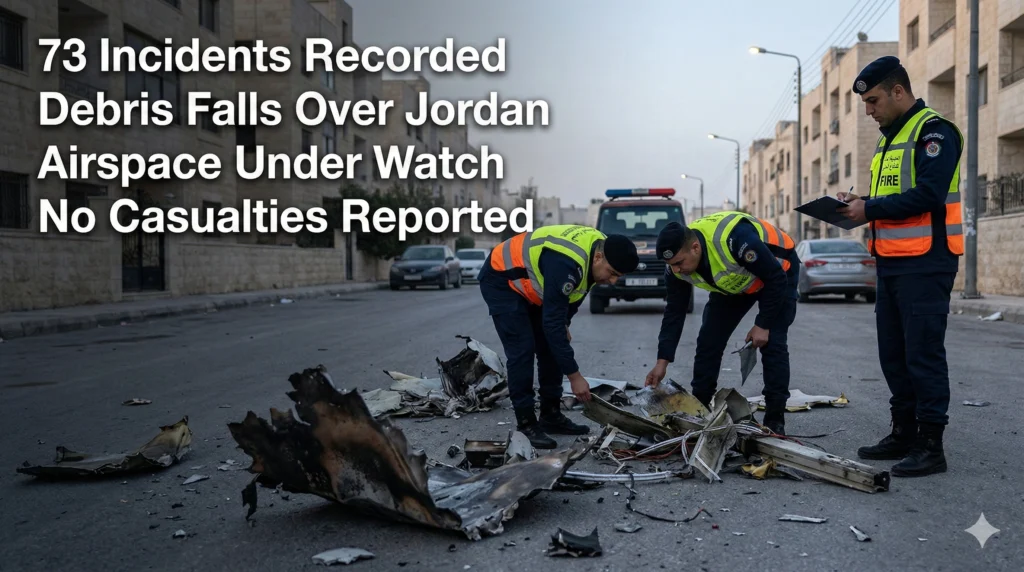
Jordan Falling Objects
The Jordan falling objects have created a sense of urgency among the local population in Amman and surrounding cities. Residents reported hearing loud explosions throughout the night as air defense systems engaged incoming threats. The Ministry of Interior is currently assessing the total cost of property damage caused by these falling fragments. Specialized teams are working around the clock to clear debris from residential streets and public highways.
The government has established a dedicated task force to handle the Jordan falling objects reports coming from various governorates. This task force includes military engineers and civil defense personnel trained in explosive ordnance disposal. Their primary goal is to neutralize any unexploded components that may have reached the ground. Local authorities are using drones to survey remote areas for any missed debris or impact craters.
International observers are closely monitoring how the Jordan falling objects will influence the kingdom’s future defense policy. Jordan has long maintained a delicate balance in its regional foreign relations, but this direct impact changes the calculus. The frequency of these incidents suggests that the aerial corridor over Jordan is becoming increasingly contested. Officials are now calling for enhanced international support to bolster their air defense capabilities.
Strategic Interceptions by Jordanian Armed Forces
The Jordanian Armed Forces played a critical role in mitigating the impact of the Jordan falling objects across the country. By intercepting 49 unmanned aerial vehicles, the military prevented potential strikes on high-value civilian infrastructure. These interceptions, while successful, resulted in the widespread scattering of metallic debris and missile components. The military has confirmed that these interceptions were necessary to protect the lives of Jordanian citizens.
Military experts note that the Jordan falling objects are a direct byproduct of modern kinetic interception technologies. When a missile is neutralized in mid-air, the resulting fragmentation can cover several square kilometers on the ground. This phenomenon explains why so many different governorates reported falling debris simultaneously. The armed forces are now focusing on identifying the specific origins of each intercepted projectile.
Public security teams have been advised to maintain a high state of readiness as the regional conflict persists. The Jordan falling objects incidents have forced several local businesses to temporarily close their doors for safety reasons. In the northern regions, farmers have reported debris landing in agricultural fields, potentially affecting crop production. The military continues to provide updates to the cabinet regarding the integrity of the national airspace.
Regional Impact of the Iran-US-Israel Conflict
The broader context of the Jordan falling objects involves a massive military exchange between Iran, the US, and Israel. This three-way escalation has turned the skies over the Middle East into a combat zone for ballistic technology. As missiles traverse international borders, neutral nations like Jordan often find themselves dealing with the physical fallout. The Jordan falling objects are a stark reminder of how regional conflicts can spill over.
Iran’s decision to target US bases in neighboring countries has directly contributed to the Jordan falling objects being found in local towns. US installations in Bahrain and Kuwait were among the primary targets mentioned in recent Iranian military communiqués. Because Jordan sits geographically between the primary combatants, it remains highly vulnerable to falling debris. The government is currently engaging in diplomatic efforts to minimize further risks to its territory.
The tragic loss of life reported within Iran has added a layer of humanitarian concern to the military crisis. While Jordan has escaped fatalities so far, the Jordan falling objects serve as a constant warning of what could happen. Regional analysts believe that without a ceasefire, the frequency of these incidents will only increase. For now, the focus remains on civilian protection and the recovery of dangerous materials.
- Amman recorded the highest frequency of falling debris.
- Zarqa and Madaba reported significant property damage to vehicles.
- West Balqa authorities cleared three major roads blocked by fragments.
- Jerash residents were advised to stay away from mountainous terrain.
Impact on Public Safety and Infrastructure
The Jordan falling objects have caused significant disruption to daily life and the functionality of public infrastructure. Multiple power lines in the Central Badia region were damaged when missile fragments struck utility poles. Maintenance crews are working under military escort to restore electricity to the affected households. This disruption highlights the vulnerability of essential services during high-level regional military escalations.
In addition to utility damage, the Jordan falling objects have impacted the transportation sector significantly. Several flights at Queen Alia International Airport were delayed or rerouted to avoid the debris-cluttered airspace. Authorities are conducting thorough inspections of runways to ensure no metallic fragments pose a risk to aircraft tires. The safety of the aviation sector remains a top priority for the Ministry of Transport.
The psychological impact of the Jordan falling objects on the civilian population cannot be underestimated. Many families have expressed fear about sending their children to school while the threat of falling debris remains. The government has responded by providing psychological support services and clear safety guidelines via mobile alerts. Understanding the risks associated with the Jordan falling objects is essential for maintaining public order during this crisis.
Security Protocols for Handling Debris
Security officials have implemented a strict protocol for the management and disposal of the Jordan falling objects. Citizens are explicitly forbidden from touching, moving, or photographing the debris up close due to the risk of chemicals. Some missile components may contain hazardous fuels or unexploded charges that require expert handling. The Public Security Directorate has set up a dedicated hotline for reporting new sightings.
Once a report is received, a specialized unit is dispatched to secure the perimeter around the Jordan falling objects. These units use advanced sensors to check for radiation or toxic leaks before removing the material. The debris is then transported to a secure military facility for forensic analysis and long-term storage. This process is vital for documenting the types of weaponry being used in the regional conflict.
The transparency regarding the Jordan falling objects is intended to prevent rumors and misinformation from spreading. Official government channels are the only authorized sources for news regarding the location and nature of the debris. By providing regular updates, the Ministry of Interior hopes to keep the public calm and informed. The management of the Jordan falling objects has become a benchmark for the country’s emergency response capabilities.
- The 73 incidents involved both missile shells and drone fragments.
- Police have cordoned off 15 sites across the Irbid governorate.
- Civil defense teams have completed 80% of debris clearance in Aqaba.
Diplomatic and Military Responses
Jordan’s diplomatic corps is working tirelessly to address the root causes of the Jordan falling objects crisis. High-level meetings are being held with regional partners to demand a reduction in aerial combat over neutral territory. The foreign ministry has issued formal statements emphasizing Jordan’s right to defend its sovereign airspace. These diplomatic efforts aim to prevent the kingdom from becoming a permanent theater for regional proxy wars.
The military has also increased its surveillance of the borders to detect incoming threats before they reach populated areas. This proactive stance is necessary to reduce the likelihood of the Jordan falling objects landing in residential neighborhoods. New radar installations are being considered to provide better early warning coverage for the southern and eastern regions. The Jordan falling objects situation has highlighted the need for more advanced interception technologies.
Partner nations have offered technical assistance to help Jordan manage the Jordan falling objects more effectively. This includes sharing intelligence on missile trajectories and providing equipment for debris identification. Such international cooperation is essential for a country caught in the crossfire of major powers. The government remains committed to ensuring that the Jordan falling objects do not lead to a broader domestic crisis.
Future Outlook for Regional Stability
The long-term implications of the Jordan falling objects will depend on the duration of the Iran-US-Israel conflict. If the military strikes continue, Jordan will likely see an increase in the number of recorded incidents. This persistent threat requires a sustainable strategy for civil defense and infrastructure resilience. The Jordan falling objects are now a permanent fixture in the nation’s contemporary security discourse.
Economic analysts are also looking at how the Jordan falling objects might affect foreign investment and tourism. The perception of instability can have a chilling effect on the economy, even if fatalities are avoided. The government is working to reassure the international community that Jordan remains a safe and stable destination. Successfully managing the Jordan falling objects is a key part of this strategic communication.
Ultimately, the resolution of the Jordan falling objects issue lies in a regional diplomatic breakthrough. Until the primary combatants agree to a de-escalation, the skies will remain dangerous for all nations in the vicinity. Jordan continues to advocate for peace while preparing its defenses for any further incidents. The 73 objects recorded this week may just be the beginning of a complex security challenge.
Summary of the Interior Ministry Reports
The Interior Ministry’s detailed reports on the Jordan falling objects provide a clear picture of the geographic spread of the debris. Most of the 73 incidents were concentrated in urban centers where the population density is highest. This concentration explains the high volume of property damage reports received by the police. The ministry is currently processing insurance claims for those affected by the Jordan falling objects.
- Emergency services handled over 500 calls related to aerial explosions.
- Military hospitals were placed on high alert as a precautionary measure.
- Educational institutions in West Balqa have transitioned to remote learning.
- State-run media is broadcasting safety drills regarding falling objects.
As the situation evolves, the government will continue to prioritize the safety of its residents above all else. The Jordan falling objects represent a multifaceted challenge that combines military, diplomatic, and civil defense elements. Through coordinated efforts, the kingdom aims to weather this storm and emerge with its sovereignty intact. The vigilance of the public remains the most important tool in managing the Jordan falling objects crisis.
Assessment of Technical Debris Characteristics
Technical experts have begun analyzing the physical characteristics of the Jordan falling objects to determine their origin. Preliminary findings suggest that the debris consists of high-grade aluminum alloys and carbon fiber composites. These materials are consistent with modern ballistic missile casings and advanced drone wings. The Jordan falling objects provide valuable data for defense analysts studying regional weapon systems.
Some of the fragments recovered show signs of extreme thermal stress, indicating they were intercepted at high altitudes. This confirms the effectiveness of the Jordanian air defense systems in neutralizing threats before they could descend. However, the sheer size of some Jordan falling objects remains a concern for ground safety. Large sections of engine housings were found in open fields near the city of Zarqa.
The analysis of the Jordan falling objects also includes an investigation into the electronic components found within the wreckage. Intelligence units are looking for guidance systems or sensors that could reveal the intended targets of the missiles. This technical work is crucial for understanding the strategic intent behind the recent Iranian counterattacks. The Jordan falling objects are being treated as both a safety hazard and a source of intelligence.
Conclusion and Safety Reminders
In conclusion, the Jordan falling objects crisis is a direct result of the ongoing regional military escalation. With 73 incidents reported across the country, the government is taking every possible step to protect its citizens. The absence of injuries is a testament to the effectiveness of the early warning systems and public cooperation. However, the threat posed by the Jordan falling objects remains active and unpredictable.
Citizens are urged to remain vigilant and report any new sightings of the Jordan falling objects to the authorities immediately. Following the safety guidelines issued by the Interior Ministry can save lives and prevent unnecessary accidents. As the world watches the Middle East, Jordan remains focused on maintaining its internal stability. The Jordan falling objects will continue to be monitored with the highest level of scrutiny by all security agencies.
The kingdom’s resilience in the face of the Jordan falling objects serves as a model for other nations in the region. By combining military strength with transparent communication, Jordan is successfully navigating a period of intense geopolitical pressure. We will continue to provide updates as more information about the Jordan falling objects becomes available from official sources. Stay safe and stay informed as the situation develops over the coming days.
For more details & sources visit: Anadolu Agency
Read more about Jordan news on 360 News Orbit – Jordan.