
The Jeffrey Epstein Middle East links have surfaced in a massive Department of Justice document dump, sending shockwaves through the global financial and political landscape. These newly declassified files detail a sophisticated web of influence that the disgraced financier attempted to weave across the United Arab Emirates, Qatar, and Saudi Arabia. As investigators peel back the layers of these high-level interactions, the immediate fallout has already claimed the career of one of Dubai’s most prominent corporate figures. The sheer scale of these connections suggests that Epstein’s reach extended far beyond the Western social circles previously scrutinized by federal authorities.
The revelation of the Jeffrey Epstein Middle East links has triggered an unprecedented corporate governance crisis in the Gulf region. Following the release of personal correspondence dating back to 2007, Sultan Ahmed Bin Sulayem, the long-time Chairman of DP World, announced his immediate resignation. This move came after the DOJ documents highlighted a series of private exchanges between the two men, raising questions about the depth of their professional relationship. While the nature of their discussions varied, the mere association with Epstein in a federal document of this magnitude proved tenable enough to force a leadership change at the world-renowned ports operator.+1
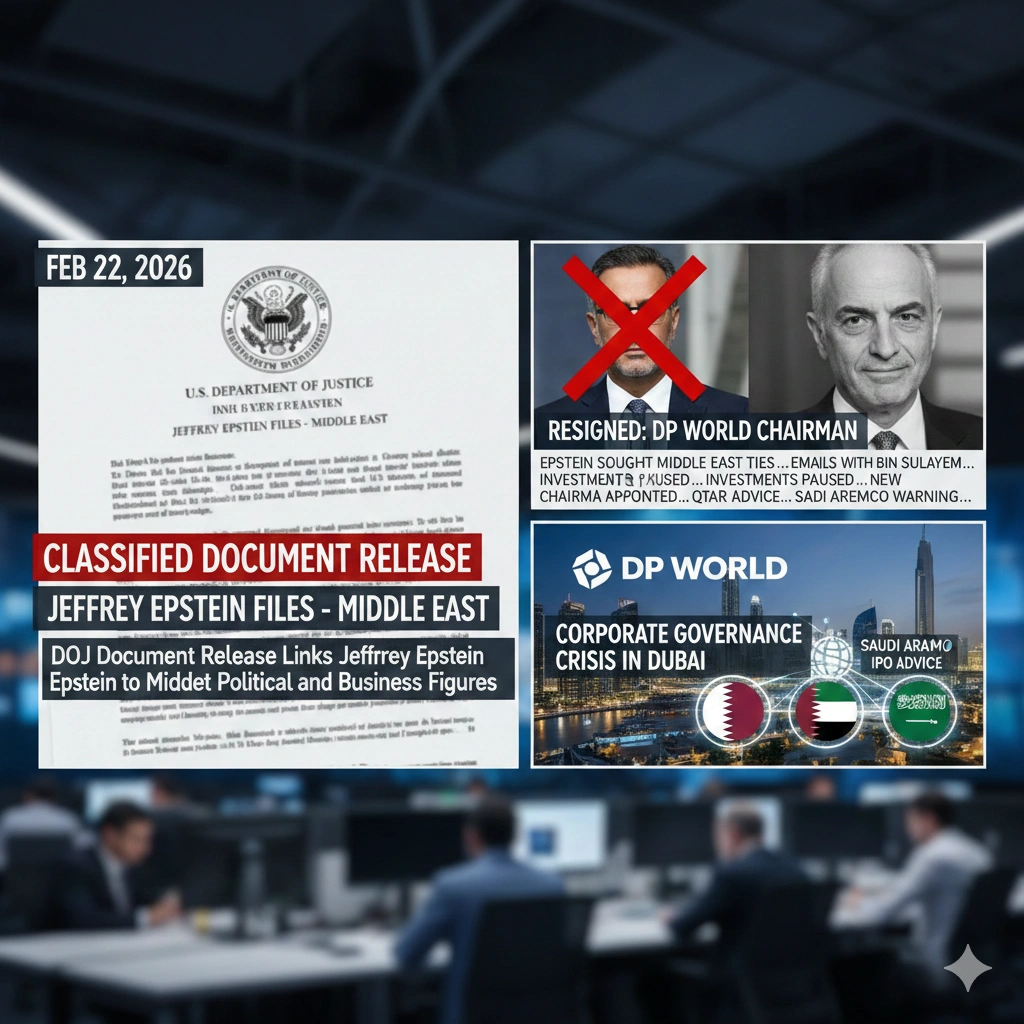
Jeffrey Epstein Middle East links
The Jeffrey Epstein Middle East links reveal a calculated effort by the financier to position himself as a shadow diplomat during periods of intense regional friction. Documents suggest that between 2017 and 2021, Epstein attempted to insert himself as a strategic advisor to Qatari officials during the infamous regional blockade. He reportedly communicated with prominent Qatari businessman Sheikh Jabor Yousuf Jassim Al Thani, urging the nation to pivot its foreign policy toward Israel. Epstein’s logic was that such a move would garner significant favor with the Trump administration, effectively bypassing traditional diplomatic channels to resolve the blockade.
In addition to diplomatic maneuvering, the Jeffrey Epstein Middle East links expose his attempts to influence the world’s largest corporate entities. Correspondence from 2016 indicates that Epstein was deeply involved in discussions regarding the public listing of Saudi Aramco. He reportedly reached out to various regional contacts to offer unsolicited advice on the potential initial public offering. Epstein warned Saudi officials that a traditional IPO on Western exchanges could expose the kingdom’s crown jewel to “significant legal risks” and the possibility of asset seizures by foreign courts, highlighting his focus on high-stakes financial strategy.
The narrative surrounding the Jeffrey Epstein Middle East links further details his proposal of alternative financial paths for the Saudi state oil giant. Rather than a standard public listing, Epstein allegedly advocated for a direct sale of a massive stake to China. He argued that a private deal with Beijing would provide the necessary capital without the transparency requirements or legal vulnerabilities of a New York or London listing. While it remains unclear how much weight these proposals carried within the Saudi royal court, the documentation of these conversations adds a new dimension to our understanding of Epstein’s global ambitions.
Impact on Regional Corporate Governance
The fallout from the Jeffrey Epstein Middle East links has forced a reckoning within the boardrooms of the United Arab Emirates. For years, the region has worked to align its corporate governance standards with international best practices to attract foreign direct investment. The sudden resignation of a figure as influential as Bin Sulayem represents a significant setback in these efforts. Analysts suggest that the DOJ’s continued review of thousands of pages of correspondence may yield even more names, keeping regional markets on edge for the foreseeable future.
When examining the Jeffrey Epstein Middle East links, it is important to note that being named in the DOJ files does not inherently constitute evidence of criminal activity. However, in the hyper-sensitive world of global finance, the “Epstein brand” is toxic enough to trigger immediate disassociation. The DOJ has made it clear that their objective is to map out the entirety of Epstein’s influence network to understand how he utilized his wealth and connections to maintain his lifestyle and evade justice for so long. This mapping project has now firmly shifted its focus toward the Persian Gulf.
The Jeffrey Epstein Middle East links have also raised questions about the vetting processes used by sovereign wealth funds and state-owned enterprises. If a figure with Epstein’s history was able to maintain high-level correspondence with top-tier chairmen, it suggests a vulnerability in how these relationships are monitored. Moving forward, many regional entities are expected to implement more rigorous background checks for third-party advisors. The goal is to prevent a repeat of the current crisis, which has seen billions of dollars in potential investment put on hold due to historical associations.
Strategic Influence During the Qatari Blockade
The depth of the Jeffrey Epstein Middle East links during the Qatari diplomatic crisis shows a man who viewed himself as a geopolitical kingmaker. By advising Qatari elites to strengthen ties with Israel, Epstein was tapping into a sensitive and complex regional dynamic. His goal appears to have been the creation of a backchannel that would make him indispensable to both Middle Eastern leaders and American politicians. The DOJ documents include specific timestamps and meeting requests that align with key turning points in the blockade’s history, suggesting he was highly active during this period.
These Jeffrey Epstein Middle East links highlight a pattern of behavior where Epstein used his knowledge of Western political machinery to entice foreign officials. He often pitched himself as a “fixer” who could solve problems that traditional embassies could not. To the Qatari officials, he represented a path to the White House; to the Emiratis, he was a conduit to elite global capital. This dual role allowed him to navigate the highest echelons of power with an air of authority that, as we now see, was meticulously documented by federal investigators.
The documentation of the Jeffrey Epstein Middle East links also reveals a fascination with the “Belt and Road” initiative and how Middle Eastern energy assets could be integrated into it. His suggestion to sell Aramco shares to China was not just a financial tip; it was a strategic move intended to shift the kingdom’s alignment away from the West. While many of his ideas were ultimately ignored or superseded by official policy, the fact that he had the ear of high-ranking decision-makers is the primary concern for the Department of Justice today.
The Role of Sultan Ahmed Bin Sulayem
The resignation of Sultan Ahmed Bin Sulayem remains the most tangible consequence of the Jeffrey Epstein Middle East links thus far. As the head of DP World, he was responsible for one of the world’s most vital logistics networks. The emails released by the DOJ show a level of familiarity that has shocked many in the industry. The correspondence spanned over a decade, covering a period where Epstein was already a registered sex offender in the United States. This timeline is particularly damaging, as it suggests the relationship continued long after Epstein’s criminal background was public knowledge.
In the context of the Jeffrey Epstein Middle East links, the Bin Sulayem scandal serves as a warning to other global business leaders. The DOJ has signaled that they are willing to release information that could disrupt major international operations if it helps finish the portrait of Epstein’s illicit empire. For DP World, the task now is to rebuild trust with their Western partners. The appointment of a new chairman is the first step, but the shadow of the Epstein files will likely linger over the company’s upcoming quarterly earnings reports and annual shareholder meetings.
The Jeffrey Epstein Middle East links also touch upon the social engineering Epstein used to ingratiate himself with the Dubai elite. He often hosted lavish events and offered access to his private jet and island, though the DOJ documents focus more on the business and political “consulting” side of his activities in the region. By framing himself as a sophisticated financial architect, he was able to bypass the usual skepticism that might greet a foreign national. The emails reveal a man who was deeply fluent in the language of sovereign wealth and regional power dynamics.
Legal Risks and Asset Seizures in the Gulf
One of the most striking aspects of the Jeffrey Epstein Middle East links is his focus on “legal protection” for Middle Eastern assets. In his communications with Saudi officials, he frequently brought up the Justice Against Sponsors of Terrorism Act (JASTA). He used the fear of this American legislation to argue that Saudi Arabia needed to diversify its holdings and move away from U.S.-based financial systems. Epstein effectively used American law as a bogeyman to promote his own alternative financial strategies, which often involved less transparent jurisdictions.
The Jeffrey Epstein Middle East links show that he was obsessed with the idea of asset immunity. He repeatedly advised his Middle Eastern contacts on how to structure their investments to avoid the prying eyes of Western regulators. This “advice” is now being scrutinized by the DOJ to see if Epstein helped facilitate any actual money laundering or sanctions evasion. While no charges have been filed in this regard, the intent displayed in the emails is enough to warrant a deep dive into the historical transaction logs of several regional banks and investment firms.
Furthermore, the Jeffrey Epstein Middle East links suggest that he viewed the Middle East as a safe haven for both his influence and his wealth. As legal walls closed in on him in the United States and Europe, his outreach to the Gulf intensified. He appeared to be searching for a jurisdiction where his past wouldn’t follow him, or where his connections could provide a shield. The failure of this strategy is evident in the very documents that are now being used to dismantle his legacy and the careers of those who associated with him.
The Future of the DOJ Investigation
As the DOJ continues to process the Jeffrey Epstein Middle East links, the international community is bracing for the next round of disclosures. There are reportedly thousands of pages yet to be fully analyzed, many of which involve encrypted communications and handwritten notes. The department’s commitment to transparency in the Epstein case has been bolstered by public pressure and a desire to provide closure for his many victims. Every new name that surfaces in the Middle East files provides a new lead for investigators to follow in their quest for the truth.
The Jeffrey Epstein Middle East links have also become a point of contention in international relations. Some regional officials have characterized the document release as a form of “legal imperialism,” while others have welcomed the chance to clean house. Regardless of the political interpretation, the facts contained within the files are undeniable. The paper trail left by Epstein is vast, and it highlights a level of global interconnectedness that allowed his predatory behavior to go unchecked for decades. The investigation is now a truly global endeavor, involving cooperation between multiple law enforcement agencies.
- The DOJ is looking into whether Epstein provided “consulting” services to bypass international sanctions.
- New leadership in Dubai is conducting an audit of all historical contracts tied to the previous chairman.
- Investigators are tracing the flow of funds between Epstein’s offshore accounts and regional entities.
In summary, the Jeffrey Epstein Middle East links represent a dark chapter in the history of global finance and diplomacy. The financier’s ability to manipulate high-ranking officials for his own gain is a testament to his cunning and the vulnerabilities of the systems he exploited. As the fallout continues to ripple through the UAE and beyond, the world is reminded that no one is truly beyond the reach of the law, and that the shadows of the past eventually come into the light. The journey toward full accountability for Epstein’s network is far from over, but these documents provide a vital roadmap for the road ahead.
- The resignation of Sultan Ahmed Bin Sulayem is likely only the beginning of the corporate reshuffle.
- Middle Eastern markets remain volatile as investors weigh the risks of further Epstein-related disclosures.
- The DOJ’s focus on the Saudi Aramco listing highlights the strategic nature of Epstein’s unsolicited advice.
- Transparency and governance have become the top priorities for Gulf-based companies in the wake of this crisis.
The Jeffrey Epstein Middle East links are a stark reminder of the influence of “soft power” and how it can be weaponized by those with ill intent. By positioning himself at the intersection of business and politics, Epstein was able to create a facade of legitimacy that fooled some of the world’s most powerful people. The task now is to ensure that the lessons learned from this disaster are applied to future governance models. As the DOJ releases more information, the full extent of the Jeffrey Epstein Middle East links will finally be understood by the public.
The ongoing scrutiny of the Jeffrey Epstein Middle East links has also sparked a debate about the ethics of private diplomacy. When individuals like Epstein operate outside of official government channels, they create risks that are difficult to manage. The revelations in these documents serve as a cautionary tale for any official considering a partnership with a “fixer” who promises easy solutions to complex problems. The cost of such associations, as we see today in the case of Bin Sulayem and DP World, can be the total destruction of a hard-earned professional reputation.
- Every email exchange is being cross-referenced with flight logs and bank statements by federal agents.
- The Qatari government has not yet issued a formal response to the claims involving Sheikh Jabor.
- Financial analysts are watching the Saudi Aramco share price for any signs of investor nervousness.
The final resolution of the Jeffrey Epstein Middle East links will take years to fully manifest. Legal battles over the contents of the documents are expected to continue in multiple jurisdictions. Meanwhile, the victims of Epstein’s crimes are watching closely, hoping that the exposure of his high-level protectors will finally lead to a sense of justice. The Jeffrey Epstein Middle East links are more than just a headline; they are a crucial piece of a puzzle that the world has been trying to solve for over a decade.
For more details & sources visit: Politics Today
Read more about Qatar news on 360 News Orbit – Qatar.