
The Italy-Algeria strategic partnership has reached a critical turning point as Prime Minister Giorgia Meloni concludes her high-stakes diplomatic mission to Algiers. This visit signifies a fundamental transition from a traditional gas-buying relationship to a comprehensive industrial and security alliance. As the ongoing conflict in the Middle East continues to destabilize global energy markets, Italy is positioning Algeria as its primary anchor for national survival. The two nations have moved beyond simple pipeline discussions to launch ambitious joint projects in desert agriculture and digital infrastructure. This recalibration of ties is essential for Italy as it navigates the most volatile energy landscape of the 21st century.
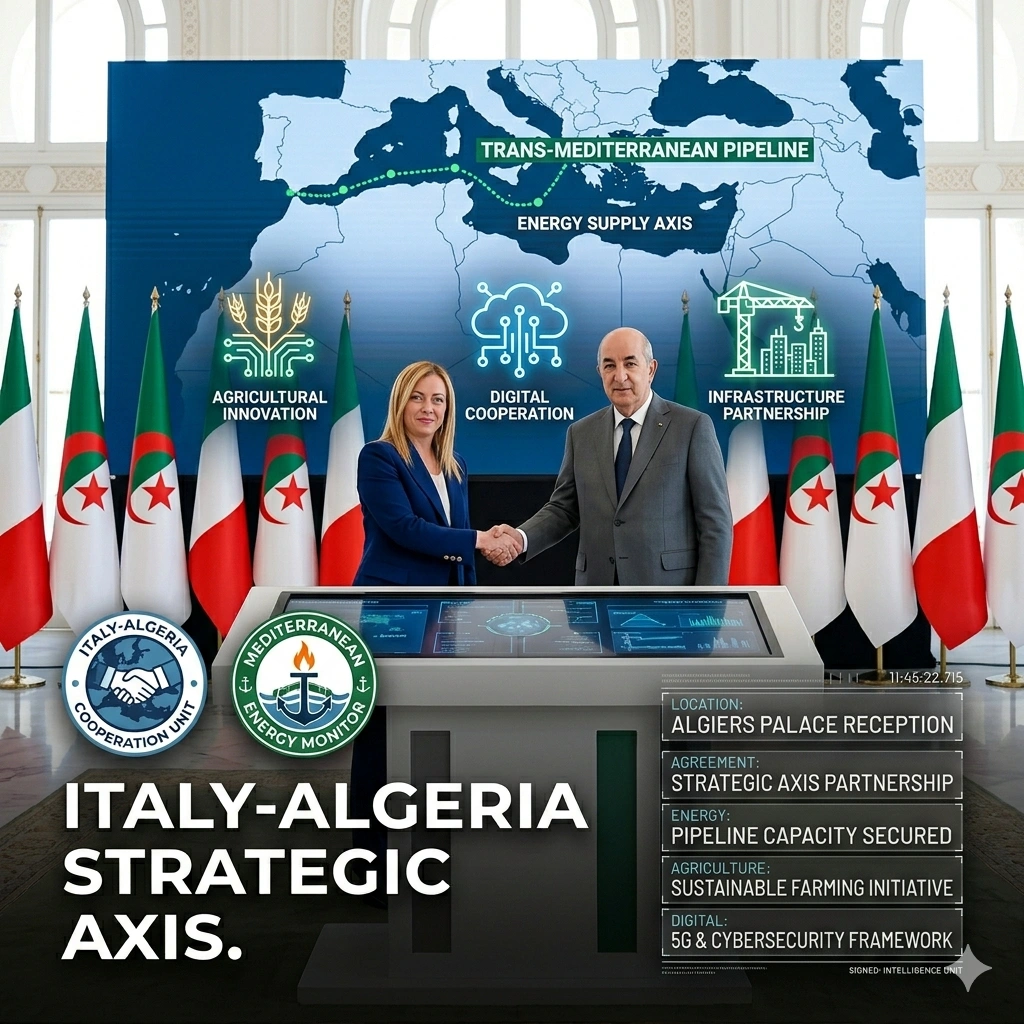
Italy-Algeria strategic partnership and the Mattei Plan
The Italy-Algeria strategic partnership is now the centerpiece of the “Mattei Plan,” Meloni’s flagship foreign policy initiative aimed at creating a new cooperation model with Africa. During her second official visit to Algiers, the Prime Minister emphasized that Italy no longer views Algeria merely as a fuel station but as a strategic peer. This shift is manifest in the diversification of bilateral projects that span across several economic sectors. By investing in Algerian infrastructure, Italy is securing its own future while fostering development across the Mediterranean. This multidimensional approach is designed to create long-term stability in a region often plagued by economic migration and energy insecurity.
A primary component of the expanded Italy-Algeria strategic partnership involves a massive desert agriculture project intended to bolster food security. The initiative includes the establishment of an advanced agricultural training hub in Sidi Bel Abbès, where Italian technology will be used to cultivate arid lands. These projects are not just about farming; they represent a transfer of high-tech knowledge that binds the two economies together. For President Abdelmadjid Tebboune, this partnership offers a path toward diversifying the Algerian economy away from its heavy reliance on raw hydrocarbon exports.
The diplomatic push for the Italy-Algeria strategic partnership comes at a sensitive time for Meloni, who is facing domestic pressure following a recent referendum defeat. Surging energy prices, fueled by the direct strikes on Iran’s energy sector and the subsequent regional war, have created significant economic anxiety in Rome. By solidifying ties with Algiers, Meloni is attempting to shield the Italian public from the worst effects of global supply shocks. The success of the Mattei Plan is now inextricably linked to the Prime Minister’s political survival and Italy’s standing within the European Union.
Securing energy flows amid global LNG shocks
The urgency of the Italy-Algeria strategic partnership was magnified this week when Qatar invoked force majeure on a third of Italy’s LNG imports. This supply disruption followed devastating strikes on the Ras Laffan complex, a critical node in the global gas network. With Italy generating approximately 44% of its electricity from natural gas, the loss of Qatari supplies threatened to cause widespread blackouts and industrial paralysis. Algeria, connected to Italy via the Trans-Mediterranean Pipeline, has stepped in to fill this vacuum, proving its reliability as a primary energy partner.
Securing these flows through the Italy-Algeria strategic partnership is now classified as a matter of national security by the Italian Ministry of Environment and Energy Security. The Trans-Med pipeline provides a stable, land-based alternative to the increasingly dangerous maritime routes in the Persian Gulf and the Red Sea. Meloni and Tebboune discussed increasing the daily throughput of the pipeline to its maximum capacity to compensate for the missing LNG shipments. This physical connection makes Algeria the most important external actor in Italy’s current economic landscape.
- Qatar’s 33% reduction in LNG forced an immediate pivot to Algiers.
- Italy’s dependence on gas for 44% of power makes pipeline stability vital.
- The Trans-Med pipeline offers a “safe” route compared to Gulf shipping lanes.
- Joint investment in new extraction technology will further boost Algerian output.
Beyond the immediate crisis, the Italy-Algeria strategic partnership is looking toward the future of green energy. Discussions in Algiers touched upon the potential for green hydrogen production, leveraging Algeria’s vast solar potential and Italy’s industrial expertise. This forward-looking approach ensures that the energy alliance remains relevant even as Europe moves toward its 2050 decarbonization goals. By integrating hydrogen into the existing pipeline infrastructure, Italy and Algeria are future-proofing their strategic bond against the inevitable decline of fossil fuels.
Industrial cooperation and digital infrastructure
The Italy-Algeria strategic partnership has expanded into the digital realm, with plans to lay new undersea fiber-optic cables connecting the two nations. This digital bridge will facilitate faster data transfer and support the growth of a burgeoning tech sector in North Africa. Italian telecommunications firms are expected to lead the construction, providing Algeria with the high-speed connectivity needed for modern industrial operations. This infrastructure is a key pillar of the Mattei Plan, which seeks to turn Italy into a “hub” for energy and data between Europe and Africa.
In the industrial sector, the Italy-Algeria strategic partnership is facilitating the creation of joint ventures in automotive and heavy machinery manufacturing. Several Italian firms have already expressed interest in setting up assembly plants in Algerian industrial zones to serve the African Continental Free Trade Area. This move allows Italian brands to expand their market reach while creating thousands of jobs for Algerian youth. The “win-win” nature of these agreements is a major departure from the exploitative colonial-era models of the past.
- Subsea fiber-optic cables to enhance Mediterranean data sovereignty.
- Joint automotive manufacturing plants to target the African market.
- Development of industrial zones with Italian management expertise.
- Collaboration on desalination technology to combat regional water scarcity.
The Italy-Algeria strategic partnership also includes a strong focus on maritime security and the protection of subsea infrastructure. With the increasing threat of sabotage to pipelines and cables in the Mediterranean, the two navies have agreed to conduct joint patrols and share intelligence. This security dimension is crucial for protecting the multi-billion dollar investments being made under the Mattei Plan. By working together to secure the “Middle Sea,” Italy and Algiers are asserting their roles as the dominant regional powers in the central Mediterranean.
Italy-Algeria strategic partnership
The Italy-Algeria strategic partnership is the most significant diplomatic achievement of the Meloni administration to date, providing a template for future North-South relations. By transforming a simple gas dependency into a broad-based alliance, Italy has secured its energy future while contributing to the stability of North Africa. The “Mattei Plan” is no longer just a theoretical framework; it is a living reality manifest in the fields of Sidi Bel Abbès and the pipelines of the Trans-Med. The visual of this partnership sends a strong message of unity to a world currently defined by fragmentation and conflict.
- Flagship desert agriculture project in the Sahara.
- New agricultural training hub in Sidi Bel Abbès.
- Expansion of the Trans-Mediterranean Pipeline capacity.
- Strategic cooperation on migration and Sahel security.
As the conflict between the U.S., Israel, and Iran continues to reshape global alliances, the Italy-Algeria strategic partnership stands as a beacon of pragmatic cooperation. For the Italian people, this means lower energy bills and a more secure economic outlook during a time of immense global uncertainty. For the Algerian people, it represents an opportunity for industrial modernization and a seat at the table of Mediterranean leadership. The road from Algiers to Rome has never been shorter or more vital for the peace and prosperity of both nations.
Migration management and Sahel security
A critical but often sensitive topic within the Italy-Algeria strategic partnership is the management of irregular migration flows. As instability grows in the Sahel region, Algeria has become a primary transit country for those seeking to reach European shores. Meloni has sought Algiers’ cooperation in tightening border controls and dismantling human smuggling networks that operate across the Sahara. In return, Italy is providing technical assistance and funding for Algerian border security forces as part of a comprehensive regional stability package.
The deteriorating security situation in the Sahel, characterized by military coups and the rise of extremist groups, is a shared concern for both leaders. The Italy-Algeria strategic partnership involves a deep exchange of intelligence regarding the movements of armed groups in the desert regions. Italy views Algeria as a “stabilizing force” in a chaotic neighborhood, and Algiers appreciates Rome’s advocacy for African interests within the G7 and the EU. This alignment of security interests is a major reason why the partnership has moved so quickly beyond energy.
- Joint intelligence sharing on Sahelian extremist movements.
- Funding for advanced radar and drone surveillance at border points.
- Programs to address the “root causes” of migration through local development.
- Diplomatic coordination to prevent further state collapses in West Africa.
By addressing migration through the lens of the Italy-Algeria strategic partnership, Meloni is fulfilling a key campaign promise to her domestic base. However, she is doing so in a way that respects Algerian sovereignty and emphasizes development over mere containment. This approach has earned her significant diplomatic capital in Algiers, where previous European leaders were often viewed with suspicion. The result is a more effective and humane migration policy that benefits both the European and African continents.
Domestic political implications for Giorgia Meloni
The success of the Italy-Algeria strategic partnership is of paramount importance for Giorgia Meloni’s domestic standing in 2026. Following her recent referendum defeat, which was widely seen as a protest against the rising cost of living, the Prime Minister needs a major win to stabilize her government. By securing a reliable gas supply and launching the Mattei Plan, she is demonstrating her ability to deliver results during a global crisis. The Italy-Algeria strategic partnership is her primary defense against the opposition’s claims of economic mismanagement.
Energy prices are the “silent killer” of Italian political stability, and the Italy-Algeria strategic partnership is the most effective tool Meloni has to keep them in check. If the Qatari LNG shock had not been mitigated by Algerian flows, the resulting price spikes could have triggered a total collapse of public support for the governing coalition. Instead, the Prime Minister has managed to turn a crisis into a diplomatic triumph. This narrative of “strength in the face of adversity” is now the central theme of her political communication.
- Offsetting the political damage from the 2026 referendum loss.
- Proving the viability of the “Mattei Plan” to skeptical EU partners.
- Stabilizing the national grid and preventing industrial energy rationing.
- Shoring up support in Italy’s industrial North, which relies on steady gas.
The Italy-Algeria strategic partnership also allows Meloni to project Italy as a leader on the international stage. By taking the lead on African relations, she is positioning Italy as the “bridge” between the Global North and the Global South. This enhanced international prestige helps to insulate her from domestic criticism and gives her more leverage in negotiations within the European Council. The 2026 Algiers summit will likely be remembered as the moment when Meloni’s foreign policy truly came of age.
Technical expansion of the Trans-Med Pipeline
To support the Italy-Algeria strategic partnership, engineers from Eni and Sonatrach are working to increase the efficiency of the Trans-Mediterranean Pipeline. This involves upgrading the compression stations in Tunisia and Sicily to handle higher pressures, effectively expanding the volume of gas that can be delivered each hour. These technical upgrades are essential for meeting the increased demand caused by the loss of Qatari LNG. The Italy-Algeria strategic partnership is therefore as much a triumph of engineering as it is of diplomacy.
The expansion also includes the installation of smart monitoring systems to detect leaks or attempted sabotage in real-time. This high-tech layer ensures that the Italy-Algeria strategic partnership remains resilient against the physical threats posed by the current regional conflict. As the “umbilical cord” of the Italian economy, the pipeline is now one of the most heavily protected pieces of infrastructure in the world. The cooperation between the two state-owned energy giants, Eni and Sonatrach, is the operational heart of the bilateral relationship.
- Compression station upgrades in Sidi El Itayem and Cap Bon.
- Real-time fiber-optic monitoring for subsea pipeline segments.
- Expansion of storage facilities at the Mazara del Vallo terminal.
- Joint R&D into blending hydrogen with existing methane flows.
These technical improvements are expected to be completed by late 2026, providing Italy with a permanent increase in its gas intake from Africa. This long-term thinking is a hallmark of the Italy-Algeria strategic partnership, moving beyond emergency fixes to create a durable energy corridor. The investment in these upgrades is being shared by both nations, reflecting the “peer-to-peer” nature of the Mattei Plan. This shared skin in the game ensures that both Rome and Algiers are fully committed to the pipeline’s continued success.
Regional impact: Algeria as a Mediterranean leader
The Italy-Algeria strategic partnership has elevated Algeria’s status as the most influential Arab nation in the Mediterranean basin. By becoming Italy’s primary energy anchor, Algiers has gained significant leverage over European policy. This newfound influence is being used by President Tebboune to advocate for a more balanced relationship between the EU and the African continent. The Italy-Algeria strategic partnership is thus a vehicle for Algeria’s own regional ambitions and its quest for “strategic autonomy.”
Other European nations, including Germany and Spain, are now looking at the Italy-Algeria strategic partnership as a model for their own energy transitions. The success of the Meloni-Tebboune alliance has proven that state-to-state agreements can provide more stability than relying on the spot market for LNG. This has led to a “diplomatic scramble” in Algiers, with multiple European delegations arriving to seek similar deals. However, Italy’s early investment and the broad scope of the Mattei Plan have given Rome a distinct “first-mover” advantage.
- Algeria is now a “must-visit” destination for European energy ministers.
- Increased diplomatic weight in the Union for the Mediterranean.
- Ability to negotiate better trade terms with the broader EU bloc.
- Role as a key mediator in North African and Sahelian conflicts.
The Italy-Algeria strategic partnership has also fostered a sense of competition between North African nations to attract Italian investment. Morocco and Egypt are closely watching the developments in Algiers, leading to a race for infrastructure modernization across the region. This competitive environment is exactly what the Mattei Plan intended to trigger, sparking a “virtuous cycle” of growth and stability across the Mediterranean. Algeria, however, remains the primary beneficiary of this new Italian focus, at least for the 2026-2027 cycle.
Conclusion and future outlook
The Italy-Algeria strategic partnership is a masterful response to a world in crisis, demonstrating that proactive diplomacy can overcome even the most daunting energy shocks. Prime Minister Giorgia Meloni has successfully transformed Italy’s greatest vulnerability—its gas dependency—into its greatest strategic strength. The alliance with Algeria is now the foundation of Italy’s national security and the engine of its Mediterranean leadership. As the conflict in the Middle East continues to rage, the peace and productivity of the Italy-Algeria axis provide a rare source of hope for regional stability.
The road ahead will involve the diligent implementation of the projects launched during this visit. The desert agriculture initiatives and the digital infrastructure deals must be seen through to completion to prove the long-term value of the Mattei Plan. However, the political and strategic commitment shown by both Meloni and Tebboune suggests that the Italy-Algeria strategic partnership is built to last. It is a partnership defined not just by the gas flowing through pipes, but by the shared vision of a prosperous and secure Mediterranean.
In finality, the 2026 Algiers summit has redefined the geopolitical map of the region. Italy has found a reliable partner in its time of need, and Algeria has found a committed ally in its quest for modernization. The Italy-Algeria strategic partnership is a testament to the power of mutual respect and shared interests in an increasingly divided world. As we move further into this decade of uncertainty, the bond between Rome and Algiers will remain a critical pillar of global energy security and Mediterranean peace.
For more details & sources visit: Decode39
Read more about Algeria news on 360 News Orbit – Algeria.