
The Iraq qualification crisis has reached a boiling point as the national team faces a race against time to secure their spot in the 2026 World Cup. With the intercontinental playoff scheduled for March 31 in Monterrey, Mexico, the squad finds itself trapped between regional warfare and impossible logistics. This crisis is not just about sports; it is a direct consequence of the geopolitical instability currently gripping the Middle East. Head coach Graham Arnold has officially petitioned FIFA for a postponement, citing that the safety and mobility of his players are at extreme risk. The dreams of millions of Iraqi fans hang in the balance while diplomats and sports officials scramble for a viable solution.
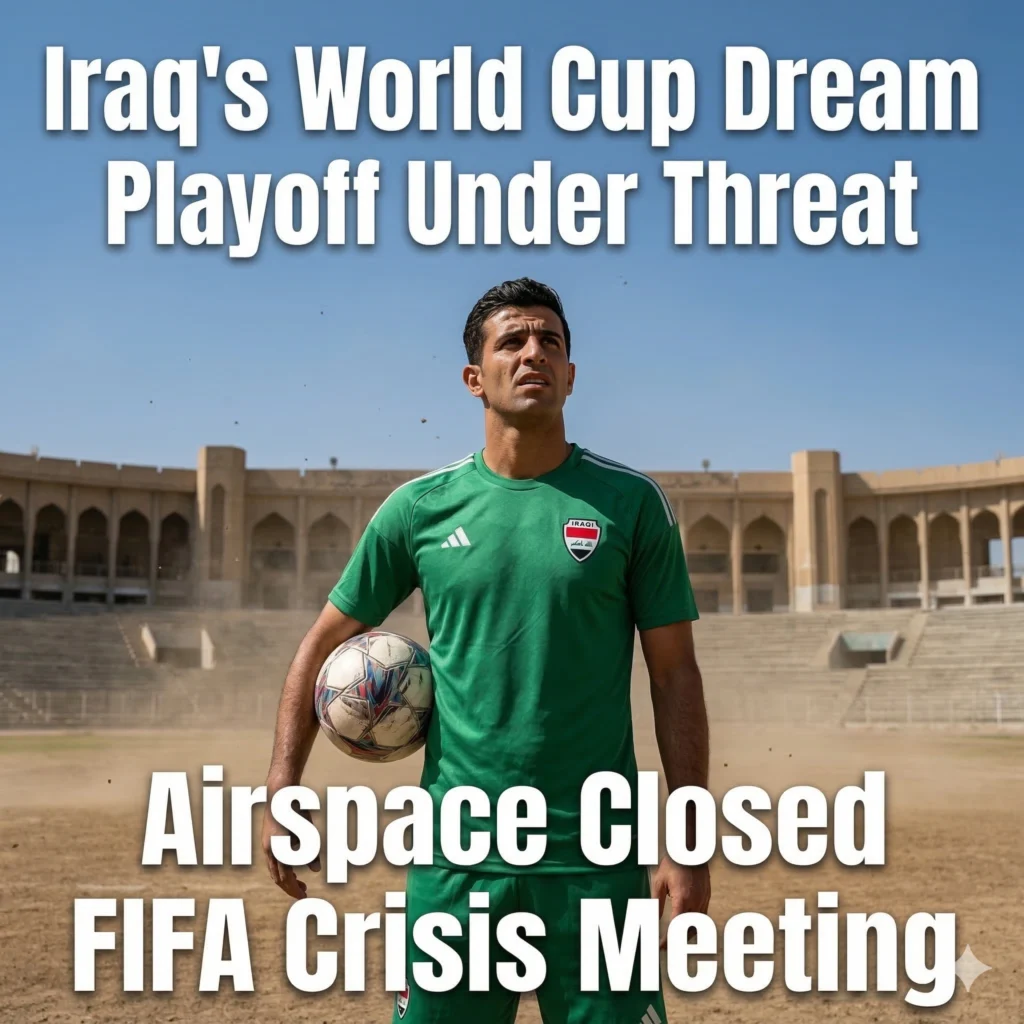
Regional Warfare and the Iraq Qualification Crisis
The ongoing conflict in the Middle East has created an environment where international sports participation becomes secondary to survival. The Iraq qualification crisis intensified when Iraqi airspace was strictly closed until at least April 1 due to the spillover effects of the US-Israel war on Iran. This closure has effectively grounded the majority of the national team, as many key players compete in the domestic Iraqi league. Without the ability to fly out of Baghdad, the team cannot even begin the long journey to North America for their playoff match. This blockade represents a physical barrier that no amount of training can overcome.
Furthermore, the regional instability has disrupted the team’s training camps and preparation schedules. The constant threat of escalation makes it difficult for players to focus on the high-stakes match against either Suriname or Bolivia. Coach Graham Arnold has emphasized that the psychological toll on the players is just as damaging as the physical travel restrictions. The team is essentially asking FIFA to recognize that these are extraordinary circumstances beyond the control of any football federation. Failure to delay the match could result in Iraq being forced to forfeit their most important game in a generation.
Diplomatic Hurdles and the Mexican Visa Struggle
Even if the airspace were to open tomorrow, the Iraq qualification crisis is further complicated by a lack of diplomatic infrastructure. Mexico does not maintain a permanent embassy in Iraq, which means players cannot apply for the necessary travel visas within their own borders. This creates a secondary layer of logistical misery for the Iraqi Football Association. Historically, players have had to travel to third countries just to attend visa interviews, a process that is currently impossible due to the aforementioned travel bans. The Mexican government has offered some assurances of assistance, but time is rapidly running out.
On March 8, a small group of players managed to secure visas at the Mexican embassy in Qatar, but the bulk of the squad remains undocumented. The Mexican authorities have promised to expedite the process for the remaining members, yet the logistical chain remains broken. Without a full squad, Iraq cannot hope to compete at the level required for a World Cup playoff. The diplomatic red tape serves as a reminder of how political isolation can directly impact the world of sports. The federation is now pushing for a neutral venue or a digital visa solution to bypass these physical barriers.
Iraq Qualification Crisis
The Iraq qualification crisis has become a central focus for FIFA as the organization weighs the integrity of the tournament against the realities of global conflict. The match in Monterrey is intended to be a celebration of international football, but it currently looks like a logistical nightmare. If the Iraqi team cannot travel, the playoff structure for the 2026 World Cup could be thrown into total disarray. FIFA must decide whether to move the match to a neutral location in the Middle East or Asia where travel might be more feasible for both teams. However, moving the venue would require the consent of the opposing team, adding another layer of negotiation.
The pressure on FIFA is immense, as the Iraq qualification crisis sets a precedent for how the governing body handles teams from active conflict zones. The Iraqi Football Association has been relentless in their pursuit of an urgent solution, documenting every barrier they face. They argue that the fairness of the competition is compromised if a team is eliminated not on the pitch, but in an airport terminal. The world is watching to see if the spirit of football can prevail over the mechanics of war. Until a formal ruling is issued, the Iraqi players remain in a state of professional limbo, training in a country they cannot currently leave.
Safety Concerns Amid Internal Instability in Mexico
Adding a new layer of complexity to the Iraq qualification crisis is the reported internal instability within Mexico itself. The Iraqi delegation has expressed significant concerns regarding player safety in Monterrey, citing recent spikes in local violence. For a team already dealing with the trauma of a regional war at home, the prospect of traveling to another volatile environment is deeply unsettling. These safety concerns are being used as part of the formal argument to move the match to a more stable, neutral venue. Player welfare is a non-negotiable aspect of FIFA’s hosting requirements, and Iraq is making it a primary talking point.
- The Iraqi delegation has requested specific security guarantees from the Mexican government.
- Concerns about travel between the airport, hotel, and stadium are paramount for the staff.
- FIFA security officials are currently assessing the situation in Monterrey to provide a report.
- The emotional burden of moving from one conflict zone to another is a major factor in team morale.
This dual-threat of home-grown warfare and foreign instability has left the Iraqi team feeling particularly vulnerable. The management team is working to ensure that if they do travel, the environment will be conducive to high-level athletic performance. However, with so many variables in flux, the focus remains primarily on the immediate hurdle of getting out of Iraq. The safety of the players remains the highest priority for the Iraqi Football Association as they navigate this unprecedented crisis.
Possible Neutral Venues and Rescheduling Scenarios
As the Iraq qualification crisis unfolds, several neutral venues have been proposed as potential alternatives to Monterrey. Cities in the United Arab Emirates or Qatar are being considered because of their proximity to Iraq and their existing, world-class football infrastructure. These locations would also simplify the visa process for the Iraqi squad, as many players already have travel history in the Gulf region. Rescheduling the match for later in April or early May is also a possibility, provided the opposing teams agree to the change. This would allow time for the airspace to potentially reopen and for the conflict to stabilize.
The logistical benefit of a neutral venue in Asia cannot be overstated for the Iraqi side. It would eliminate the need for long-haul travel to the Americas and the associated jet lag, which could be a decisive factor in a single-leg playoff. However, FIFA must balance this against the rights of the host nation and the travel requirements of the opponents. The negotiation process is currently behind closed doors, with the Iraqi Football Association presenting various scenarios to the FIFA executive committee. The goal is to find a middle ground that maintains the competitive integrity of the World Cup qualifiers while acknowledging the reality of the crisis.
Impact on the Domestic League and Local Players
The Iraq qualification crisis has hit the domestic league particularly hard, as the majority of the national team is composed of local talent. The closure of the airspace means these players are unable to fulfill their international duties, which is often a career-defining opportunity. The domestic season has been repeatedly interrupted by the conflict, making it difficult for players to maintain their match fitness. This lack of regular competition is a significant disadvantage when preparing for an intercontinental playoff against teams whose leagues are running normally. The local fans, who see the national team as a symbol of hope, are devastated by the possibility of a forfeit.
The reliance on local players was supposed to be a point of pride for the Iraqi national team under Graham Arnold. Instead, it has become a logistical Achilles’ heel during the Iraq qualification crisis. Players who were once seen as the future of Iraqi football are now wondering if they will ever get to showcase their skills on the world stage. The federation has tried to organize local friendlies to keep the squad active, but the security situation makes even this difficult. The local league is currently operating under a shadow of uncertainty, with many games played behind closed doors or postponed indefinitely.
The Role of the Iraqi Football Association (IFA)
The IFA has been the primary advocate for the players throughout the Iraq qualification crisis, working around the clock to find a diplomatic breakthrough. They have been in constant communication with the Mexican embassy in Qatar and the Mexican Ministry of Foreign Affairs. Their efforts have led to some small victories, such as the issuance of a handful of visas, but the task remains monumental. The association is also coordinating with other Middle Eastern football federations to build a coalition of support for their postponement request. They are framing the issue as a matter of universal sporting fairness that affects more than just one nation.
- The IFA has established a dedicated task force to manage the daily updates from FIFA.
- Regular briefings are held for the players to keep them informed of the legal progress.
- The association is exploring the possibility of chartering a private flight if a window of opportunity opens.
- Financial resources are being redirected from other projects to cover the rising costs of this crisis.
The leadership of the IFA has been praised for their transparency and dedication during this difficult period. They have made it clear that they will not accept a situation where the team is forced to play under unfair conditions. Their aggressive lobbying at FIFA headquarters in Zurich is intended to ensure that the Iraq qualification crisis is not ignored by the global football community. The association remains the last line of defense for a team that is currently isolated from the rest of the sporting world.
Future Outlook for Iraqi Football Beyond 2026
Regardless of the outcome of the current Iraq qualification crisis, the long-term future of football in the country is at a crossroads. The constant disruption caused by regional warfare makes it nearly impossible to build a sustainable national program. If Iraq is forced out of the 2026 World Cup due to these hurdles, it could lead to a significant decline in investment and interest in the sport. Conversely, if they manage to overcome these obstacles and qualify, it would be remembered as one of the greatest achievements in the history of international football. The stakes could not be higher for the development of the game in the region.
The resilience shown by the players during the Iraq qualification crisis will likely become a part of the team’s legend. However, resilience alone cannot fix a broken airspace or a lack of embassies. The international community may need to consider new protocols for teams playing in active conflict zones to prevent these situations from recurring. For now, the focus is entirely on the March 31 deadline and the hope that a compromise can be reached. The story of the Iraqi national team is currently a poignant reminder of how the world’s most popular sport is inextricably linked to the world’s most difficult political realities.
Conclusion and the Final Plea to FIFA
The Iraq qualification crisis is a complex tapestry of war, diplomacy, and athletic ambition that requires an extraordinary response from FIFA. As the March 31 match approaches, the silence from Zurich is becoming increasingly deafening for the people of Iraq. The plea for a postponement is not a request for special treatment, but a demand for the basic right to compete fairly. The players have done their part on the field; it is now up to the administrators and politicians to ensure they have a field to play on. The world hopes for a resolution that allows the beautiful game to shine through the clouds of conflict.
In the end, the Iraq qualification crisis serves as a test of the values that FIFA claims to uphold. If the tournament truly belongs to the world, then every nation must have a realistic path to participate, regardless of the geopolitical storms surrounding them. The Iraqi team stands ready to play, hammers in hand if necessary to break through the barriers, but they need the global community to open the door. The next few days will decide whether Iraq’s World Cup journey ends in a boardroom or on the lush grass of a stadium.
For more details & sources visit: Al Jazeera
Read more about Iraq news on 360 News Orbit – Iraq.