
Indian Protesters Oppose Modi’s Israel Visit is the focal point of a massive geopolitical shift as civil society groups across the nation rise in defiance of the government’s diplomatic trajectory. The planned visit of Prime Minister Narendra Modi to Israel has ignited a firestorm of controversy, leading to widespread demonstrations and a growing sense of domestic unrest regarding India’s foreign policy.
The Indian People in Solidarity with Palestine (IPSP) spearheaded these movements, mobilizing thousands of citizens who view the upcoming diplomatic mission as an endorsement of ongoing violence. From the crowded streets of New Delhi to the industrial hubs of Pune, the message from the streets is clear: the public demands a reassessment of the nation’s strategic alliances.
As tensions escalate in Gaza, the timing of this high-level visit has drawn intense international and domestic scrutiny. Protesters argue that India’s historical stance as a champion of decolonization and human rights is being compromised by deepening military and economic ties with Israel. This movement represents one of the most significant challenges to the ruling party’s foreign agenda in recent years.
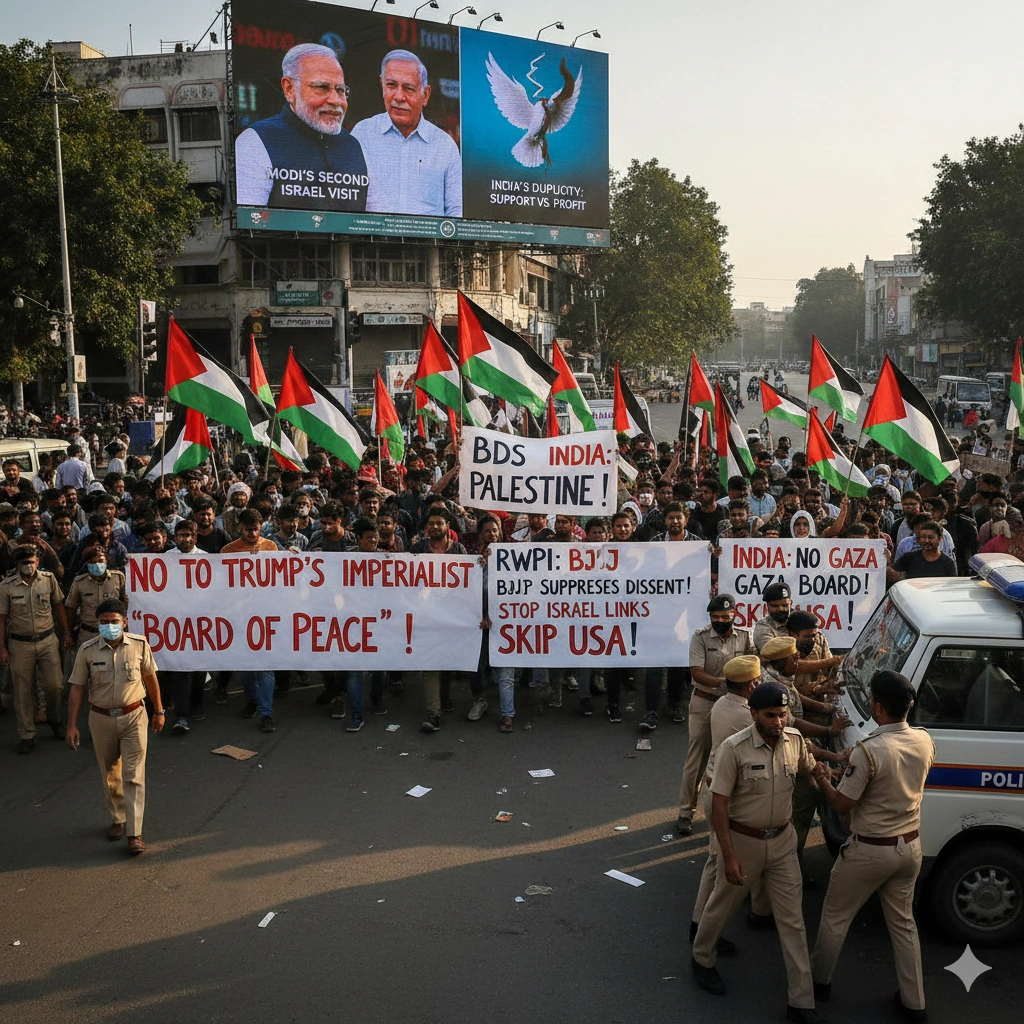
Indian Protesters Oppose Modi’s Israel Visit
The momentum behind the recent rallies suggests that Indian Protesters Oppose Modi’s Israel Visit not just as a symbolic gesture, but as a rejection of systemic military cooperation. In New Delhi, the atmosphere was electric as activists gathered to denounce what they describe as a “betrayal of the Palestinian cause” by the current administration.
Participants at these rallies highlighted the reported ceasefire violations in Gaza, which have resulted in the deaths of over 500 Palestinians according to recent humanitarian reports. The visual impact of the protests was undeniable, with Palestinian flags waving alongside banners calling for an immediate end to bilateral defense deals between India and the Israeli government.
Security forces have remained on high alert as the scale of the dissent grows, reflecting the high stakes of this diplomatic visit. For the protesters, the goal is to force a public conversation about the ethical implications of India’s procurement of military technology from a nation currently engaged in active, high-casualty conflict.
Civil Society Mobilization Against Diplomatic Trips
The organizational strength of groups like the IPSP, BDS India, and the Revolutionary Workers’ Party of India (RWPI) has been a defining feature of this unrest. These organizations have successfully coordinated events in multiple cities, ensuring that the message that Indian Protesters Oppose Modi’s Israel Visit reaches every corner of the country.
In Mumbai, the financial capital, the rhetoric focused on the economic ties that bind the two nations, particularly in the sectors of technology and agriculture. Activists argued that these “benefit-driven” relationships ignore the humanitarian crisis unfolding in the Middle East, prioritising corporate profits over human lives.
The mobilization has also seen a significant involvement from the youth and student populations, who are increasingly vocal about global justice issues. By utilizing social media and grassroots organizing, these groups have managed to sustain interest in the protests long after the initial announcements of the Prime Minister’s travel plans.
The Impact of Regional Tensions on Foreign Policy
Geopolitical dynamics are shifting rapidly, and the fact that Indian Protesters Oppose Modi’s Israel Visit indicates a deep divide in how Indian citizens view their country’s role on the global stage. Many participants pointed to the “Board of Peace on Gaza” initiated by international actors as a failed mechanism for justice.
Critics of the Indian government’s current path suggest that the state is engaging in a form of “strategic duplicity.” On one hand, India continues to offer official statements of support for a two-state solution, while on the other, it strengthens its intelligence-sharing and weapons-purchasing agreements with Tel Aviv.
This perceived inconsistency has fueled the anger of the protesters, who feel that India is losing its moral authority. The rallies serve as a reminder that foreign policy is no longer the exclusive domain of bureaucrats and diplomats; it is a matter of public conscience that can spark mass movements.
Security Crackdowns and the Right to Dissent
The response of the state to these protests has been a point of major contention, especially in cities like Pune where clashes between police and activists led to injuries. Reports indicate that Indian Protesters Oppose Modi’s Israel Visit faced significant hurdles, including the use of unlawful assembly charges to disperse peaceful gatherings.
In Pune specifically, twenty-four activists were arrested during a demonstration that turned chaotic after police intervened to prevent the burning of effigies. While these individuals were later released, the incident has raised questions about the shrinking space for democratic dissent within the country’s current political climate.
Legal experts and human rights defenders have expressed concern over the use of force against those who are simply exercising their constitutional right to protest. They argue that the crackdown only serves to validate the protesters’ claims that the government is suppressing voices that challenge its strategic narratives.
Economic and Military Ties Under the Scanner
One cannot ignore the underlying economic factors when discussing why Indian Protesters Oppose Modi’s Israel Visit during such a sensitive period. India has become one of the largest purchasers of Israeli military hardware, a relationship that has grown exponentially over the last decade under the “Make in India” initiative.
Protest leaders argue that these defense contracts are being signed at the expense of human rights considerations. They believe that the military-industrial complex is driving India’s foreign policy more than traditional diplomatic values or the pursuit of global peace and stability.
By bringing these financial ties into the spotlight, the protesters hope to create pressure on corporate entities involved in these trades. The boycott, divestment, and sanctions (BDS) movement in India has been particularly active in highlighting the specific companies that benefit from the occupation of Palestinian territories.
Global Solidarity and the Palestinian Cause
The international community is watching closely as Indian Protesters Oppose Modi’s Israel Visit, noting the alignment between Indian activists and global peace movements. The rhetoric used in the New Delhi and Mumbai rallies mirrors that of protests seen in London, New York, and Amman.
This global connectivity has empowered local activists, providing them with a platform that extends beyond national borders. They see themselves as part of a worldwide front against what they describe as “imperialist expansion” and “genocidal military tactics” being deployed in the Gaza Strip.
The use of international symbols of resistance, such as the Keffiyeh and specific protest chants, signifies a deep-seated solidarity. For many Indians, the Palestinian struggle for self-determination resonates with their own historical fight against colonial rule, making the current government’s pivot toward Israel particularly painful.
Political Opposition and Legislative Debates
The unrest on the streets has inevitably found its way into the halls of power, where opposition parties are using the protests to challenge the ruling BJP. Left-wing parties have been especially vocal, calling for the Prime Minister to skip the upcoming visit and reconsider India’s participation in US-led initiatives.
While the government maintains that the visit is essential for national security and technological advancement, the opposition argues that the timing is a “diplomatic blunder.” They suggest that Indian Protesters Oppose Modi’s Israel Visit because the public recognizes the ethical vacuum in the current administration’s Middle East strategy.
The debate in Parliament has become increasingly polarized, with supporters of the visit accusing the protesters of being “anti-national.” Conversely, the critics argue that true patriotism involves holding the government accountable to the humanitarian values that the Indian Republic was founded upon.
The Role of Media and Information Warfare
In the digital age, the narrative surrounding why Indian Protesters Oppose Modi’s Israel Visit is being shaped by competing media portrayals. State-aligned outlets often focus on the strategic benefits of the partnership, while independent and international media highlight the humanitarian concerns of the activists.
Social media has become a primary battlefield for these narratives, with hashtags related to the protests trending across various platforms. Activists use these digital tools to document police actions and share live updates from the protest sites, bypassing traditional media gatekeepers.
This information flow is crucial for maintaining the momentum of the movement. It allows the IPSP and other groups to counter government narratives and provide a direct channel of communication to the public, ensuring that the human cost of the conflict remains at the center of the discussion.
Future Implications for Indo-Israeli Relations
As the date of the visit approaches, the question remains whether the fact that Indian Protesters Oppose Modi’s Israel Visit will lead to any tangible change in policy. Historically, the Indian government has been resilient to street-level pressure regarding foreign affairs, yet the scale of this movement is unprecedented.
If the protests continue to grow, they could potentially complicate future bilateral agreements or lead to a “cooling-off” period in diplomatic relations. The government must balance its strategic needs with the growing domestic demand for a more ethically grounded foreign policy.
The long-term impact on the Indian electorate is also a factor to consider. With elections always on the horizon, the ruling party must gauge whether its close ties with Israel will alienate key demographics or if the strategic benefits will outweigh the domestic political costs.
Conclusion of the Anti-Visit Rallies
The current wave of dissent proves that the relationship between India and the Middle East is a matter of intense public interest. When Indian Protesters Oppose Modi’s Israel Visit, they are demanding a return to a foreign policy that prioritizes human rights and international law over short-term tactical gains.
The burning of effigies and the chanting of slogans are more than just expressions of anger; they are calls for a national soul-searching. As the world watches the tragedy in Gaza, the actions of the Indian public serve as a powerful reminder that the struggle for justice is universal and knows no borders.
Ultimately, the success of these protests will be measured by their ability to influence the national discourse and force a more transparent discussion on India’s role in global conflicts. The voice of the people has been raised, and it is a voice that the government can no longer afford to ignore in its diplomatic calculations.
Cultural Resistance and the Power of Art
Art and culture have played a vital role in how Indian Protesters Oppose Modi’s Israel Visit across different urban centers. Poets and street theater artists have joined the rallies, using their craft to convey the suffering of those in Gaza and the urgency of the Indian response.
In the lanes of Old Delhi, murals have appeared overnight, depicting the shared history of struggle between the people of India and Palestine. These visual reminders serve to educate the public and keep the emotional core of the protest movement alive amidst the dry rhetoric of political debate.
Music has also been a unifying force, with protest songs in various Indian languages being used to mobilize crowds. This cultural infusion makes the movement more accessible to a broader audience, ensuring that the message is not lost in translation or confined to intellectual circles.
Humanitarian Concerns at the Forefront
The central motivation for why Indian Protesters Oppose Modi’s Israel Visit remains the staggering loss of life in the Gaza Strip. Activists frequently cite the deaths of children and the destruction of civilian infrastructure as the primary reasons for their moral outrage.
Medical professionals and humanitarian workers have also lent their voices to the protests, sharing accounts of the dire conditions on the ground. They argue that India, as a rising global power, has a responsibility to use its influence to stop the violence rather than rewarding the perpetrators with high-level visits.
The focus on the humanitarian aspect helps to transcend political affiliations, appealing to a common sense of humanity. It is this ethical clarity that has allowed the movement to gain traction across diverse sections of Indian society, from religious leaders to secular activists.
The Geopolitical Chessboard and India’s Role
The fact that Indian Protesters Oppose Modi’s Israel Visit highlights the complexity of India’s position in a multi-polar world. As the government seeks to navigate its relationships with the US, Russia, and the Middle East, it faces the challenge of maintaining its “strategic autonomy.”
Protesters argue that by leaning too heavily toward Israel, India is effectively aligning itself with a specific Western-led geopolitical bloc. They believe this move undermines India’s traditional leadership in the Global South and its ability to act as a neutral mediator in international disputes.
The debate is essentially about the identity of the Indian state on the global stage. Is India a nation that seeks power through military and economic alliances, or is it a nation that leads through moral example and adherence to international justice? This is the fundamental question being asked on the streets today.
Summary of the National Sentiment
The widespread nature of the demonstrations confirms that Indian Protesters Oppose Modi’s Israel Visit with a level of intensity that cannot be easily dismissed. From Pune to New Delhi, the demand for a policy shift is echoing through the country’s most important political and social hubs.
The government’s response in the coming weeks will be a litmus test for the health of Indian democracy. Whether it chooses to engage with the concerns of its citizens or continues to suppress their voices will have lasting implications for the country’s internal stability and its international reputation.
In the end, the protests are a testament to the vibrancy of Indian civil society. Despite the risks of arrest and injury, thousands of people have chosen to stand up for what they believe is right, ensuring that the plight of the Palestinian people remains a central issue in the Indian political consciousness.
- Protesters demand an end to all military ties with the Israeli government immediately.
- Activists call for the Prime Minister to prioritize humanitarian aid to Gaza over defense deals.
- The IPSP continues to organize nationwide strikes to highlight the duplicity of official foreign policy.
- Student groups are pushing for universities to divest from companies supporting the occupation.
The movement shows no signs of slowing down as the official visit date approaches. Every rally and every arrested activist adds to the narrative of a nation divided over its moral obligations. As Indian Protesters Oppose Modi’s Israel Visit, they are writing a new chapter in the history of Indian political activism, one that looks toward a more just and equitable world order.
For more details & sources visit: Peoples Dispatch
For the latest updates from Palestine, visit our Palestine news page.