
The India GCC Free Trade Agreement represents a monumental shift in the economic landscape of Southern Asia and the Middle East. This strategic initiative, officially launched in New Delhi, aims to dismantle long-standing trade barriers between the six-nation Gulf bloc and the rapidly expanding Indian economy. By fostering a deeper level of integration, both regions are positioning themselves to lead the global market through enhanced cooperation and mutual growth.
As the world observes this historic alignment, the India GCC Free Trade Agreement stands as a testament to the power of bilateral diplomacy. The agreement is designed to streamline customs procedures and facilitate a smoother flow of goods, ensuring that businesses on both sides can operate with unprecedented efficiency. This partnership is not just about commerce; it is about building a sustainable future for millions of people across these two vital regions.
The launch of the India GCC Free Trade Agreement comes at a time when global supply chains are seeking stability and predictability. India and the Gulf nations have shared a rich history of trade, but this formal pact elevates the relationship to a professional and structured level. Analysts predict that the resulting economic synergy will accelerate development across multiple strategic sectors, from energy to technology.
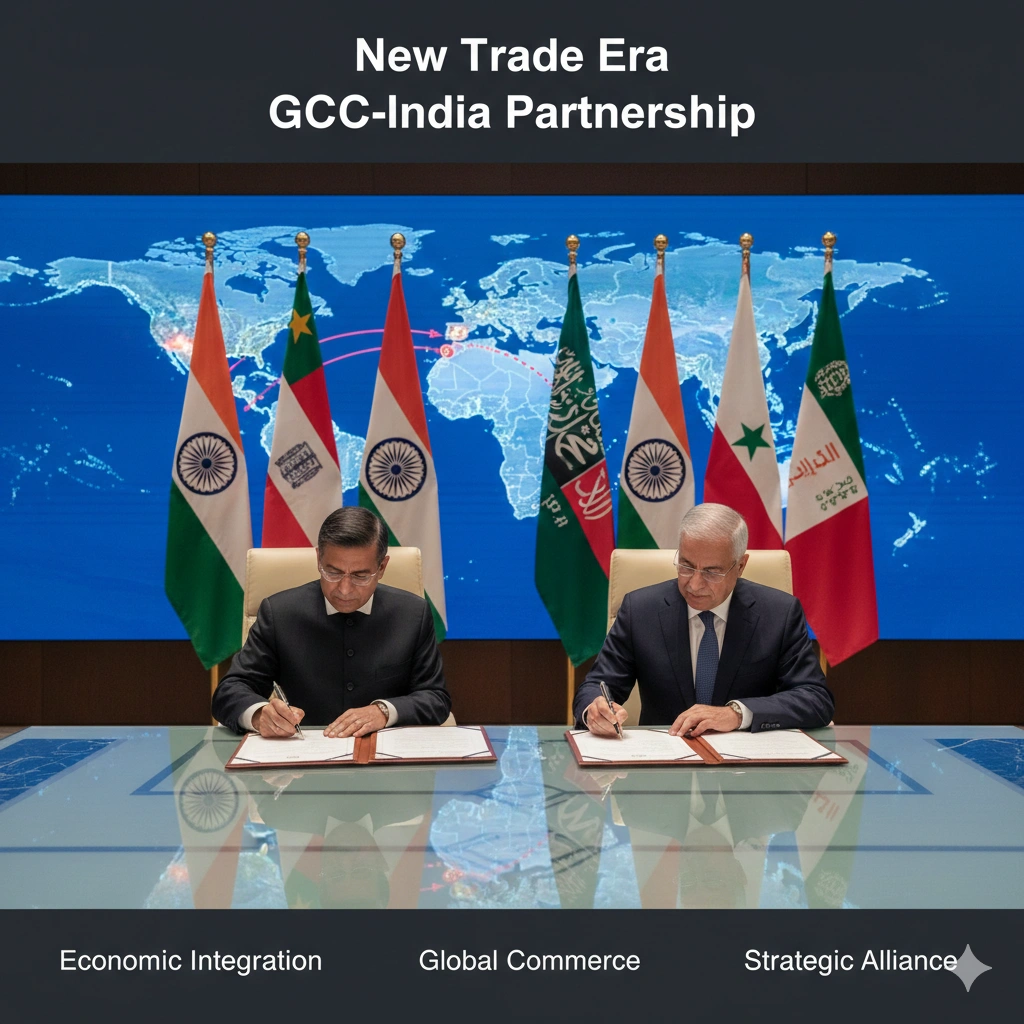
India GCC Free Trade Agreement
The formal signing of the joint statement for the India GCC Free Trade Agreement marks a pivotal moment for international diplomacy. GCC Secretary-General Jasem Mohamed Al-Budaiwi and Indian Commerce Minister Piyush Goyal have set a clear path forward for comprehensive economic unity. This framework ensures that the negotiations will cover a wide array of sectors, including services, investments, and digital trade.
With the India GCC Free Trade Agreement, both parties are committed to removing various customs and non-customs barriers that have previously hindered trade. This move is expected to unlock billions of dollars in untapped potential, providing a significant boost to the GDP of all involved nations. The agreement serves as a bridge, connecting the resource-rich Gulf states with India’s massive consumer market and manufacturing prowess.
The India GCC Free Trade Agreement also prioritizes the protection of intellectual property rights, which is essential for fostering innovation. By creating a secure legal environment, the pact encourages technology transfers and collaborative research projects. This focus on modern economic standards ensures that the agreement remains relevant in an increasingly digital and knowledge-based global economy.
Strategic Economic Integration for the Future
Economic integration under the India GCC Free Trade Agreement is expected to redefine the supply chain dynamics of the 21st century. The six-member nations of the GCC view India as a primary destination for their energy exports and a source of high-quality human capital. Conversely, India sees the Gulf as a critical partner for food security and a major source of foreign direct investment.
Through the India GCC Free Trade Agreement, these two powers are formalizing a symbiotic relationship that has existed informally for decades. The pact will provide a more predictable environment for long-term investments, reducing the risks associated with market volatility. This stability is crucial for large-scale infrastructure projects that require multi-year commitments from both government and private sectors.
The India GCC Free Trade Agreement also addresses the needs of micro, small, and medium-sized enterprises (MSMEs). These businesses are the backbone of both economies, and the agreement includes specific provisions to help them access international markets. By lowering entry barriers, the pact empowers smaller entrepreneurs to compete on a global stage, driving grassroots economic development.
Impact on Bilateral Trade and Investment
The volume of trade between India and the GCC is already staggering, reaching approximately 178 billion dollars in the last fiscal year. However, the India GCC Free Trade Agreement is designed to push these numbers even higher by eliminating redundant tariffs. This growth is anticipated to be particularly strong in the sectors of petrochemicals, gems, jewelry, and engineering goods.
Investors are keeping a close watch on the India GCC Free Trade Agreement as it promises to harmonize regulatory standards across the regions. This harmonization makes it easier for Indian firms to establish a presence in the Gulf and for GCC sovereign wealth funds to invest in Indian startups. The deal creates a “fast-track” mechanism for resolving trade disputes, further enhancing investor confidence.
- Reduction of import duties on essential raw materials and finished goods.
- Simplified visa and labor regulations for skilled professionals.
- Increased transparency in government procurement processes.
- Enhanced cooperation in the renewable energy and green hydrogen sectors.
The India GCC Free Trade Agreement is expected to stimulate a surge in service-sector exports, particularly in IT and healthcare. India’s prowess in software development complements the Gulf’s push toward digital transformation and smart city initiatives. This alignment of interests makes the agreement a win-win scenario for the professional workforces of both territories.
Strengthening Global Supply Chains
One of the primary goals of the India GCC Free Trade Agreement is to reinforce the resilience of global supply chains. Recent global disruptions have highlighted the need for diversified and reliable trade partners. By solidifying their economic ties, India and the GCC are creating a robust corridor that can withstand external shocks and maintain the flow of essential goods.
The India GCC Free Trade Agreement facilitates better logistics and maritime cooperation, ensuring that ports in the Arabian Sea operate as a unified network. This logistical efficiency reduces transit times and costs, making products from both regions more competitive in international markets. The pact essentially creates a powerful economic bloc that can negotiate more effectively with other global entities.
Furthermore, the India GCC Free Trade Agreement focuses on food security, a critical issue for the desert nations of the Gulf. India’s vast agricultural sector will have direct access to Gulf markets, while the GCC provides the fertilizers and energy needed for high-yield farming. This circular relationship is a cornerstone of the strategic partnership envisioned by the new trade agreement.
Focus on the Digital Economy and Innovation
The modern global economy is driven by data and digital services, and the India GCC Free Trade Agreement reflects this reality. The pact includes modern provisions for e-commerce, data protection, and cross-border digital payments. This ensures that the India GCC Free Trade Agreement is not just a traditional trade deal but a forward-looking roadmap for the digital age.
By aligning their digital regulations, India and the GCC are making it easier for tech startups to scale across borders. The India GCC Free Trade Agreement encourages the exchange of best practices in fintech and cybersecurity, protecting the financial systems of both regions. This collaborative approach to innovation is expected to yield new technological breakthroughs in the coming years.
- Development of common standards for digital signatures and electronic contracts.
- Cooperation in the field of Artificial Intelligence and machine learning.
- Joint ventures in satellite technology and space exploration.
The India GCC Free Trade Agreement provides a framework for joint research and development in the pharmaceutical sector as well. This is particularly important for producing affordable vaccines and medicines for the Global South. The partnership leverages India’s manufacturing capacity and the Gulf’s financial resources to address global health challenges.
Negotiating the Path to Riyadh
The GCC General Secretariat is scheduled to host the first formal round of negotiations for the India GCC Free Trade Agreement in Riyadh. This upcoming meeting will delve into the technical details of tariff lines and market access. While the launch has been successful, the path to the India GCC Free Trade Agreement requires careful deliberation to satisfy the interests of all six Gulf nations.
The negotiation process for the India GCC Free Trade Agreement is expected to be thorough, covering everything from environmental standards to labor rights. Both sides have expressed a desire for an “early harvest” deal to show immediate results while the more complex issues are resolved. This pragmatic approach demonstrates the high level of commitment to making the agreement a reality.
The leadership in New Delhi and the various Gulf capitals are aligned in their vision for a more integrated future. The India GCC Free Trade Agreement is a top priority for their respective diplomatic agendas, as it supports their ambitious domestic development plans. The spirit of cooperation displayed during the initial talks suggests that a final agreement could be reached sooner than many analysts initially expected.
Harmonizing Trade Standards and Customs
A significant portion of the India GCC Free Trade Agreement will focus on the technical barriers to trade. Harmonizing standards for products ensures that goods manufactured in India meet the quality requirements of the Gulf and vice versa. This reduces the need for repetitive testing and certification, which often acts as a hidden tax on international commerce.
Under the India GCC Free Trade Agreement, customs cooperation will be enhanced through the sharing of digital data and automated clearance systems. This modernization of the border process is essential for the timely delivery of perishable goods and time-sensitive industrial components. The agreement seeks to create a “frictionless” trade environment that benefits exporters and importers alike.
- Mutual recognition agreements for professional qualifications and standards.
- Joint committees to oversee the implementation of trade rules.
- Technical assistance programs for capacity building in customs administration.
The India GCC Free Trade Agreement also addresses the issue of non-tariff barriers, such as complex labeling requirements and sanitary regulations. By simplifying these rules, the pact makes it easier for small businesses to navigate the complexities of international trade. This focus on ease of doing business is a hallmark of the negotiations currently underway.
Strategic Energy Partnership and Sustainability
Energy remains a core component of the economic relationship, and the India GCC Free Trade Agreement will deepen this bond. While traditional oil and gas will continue to play a major role, the agreement also emphasizes a transition toward sustainable energy. The India GCC Free Trade Agreement provides a platform for joint investments in solar power, wind energy, and carbon capture technologies.
India’s goal of achieving net-zero emissions aligns with the Gulf nations’ efforts to diversify their economies away from fossil fuels. The India GCC Free Trade Agreement facilitates the exchange of green technology and provides incentives for companies investing in eco-friendly projects. This commitment to sustainability ensures that economic growth does not come at the expense of the environment.
The India GCC Free Trade Agreement also explores the potential for a regional power grid, allowing for the sharing of surplus electricity between the regions. This integration would enhance energy security and reduce the overall carbon footprint of the participating nations. Such ambitious projects are made possible by the high level of trust and cooperation fostered by the new trade framework.
Future Outlook and Global Significance
The India GCC Free Trade Agreement is more than just a regional trade pact; it is a signal to the rest of the world that the “Global South” is taking charge of its economic destiny. By forming this powerful alliance, India and the GCC are creating a new center of gravity in the global economy. The India GCC Free Trade Agreement will likely serve as a model for other emerging markets looking to build similar strategic partnerships.
As the negotiations progress, the world will be watching to see how the India GCC Free Trade Agreement balances the diverse interests of its participants. The success of this deal would be a major victory for multilateralism and open trade in an era of increasing protectionism. The India GCC Free Trade Agreement is a bold step toward a more interconnected and prosperous world.
In conclusion, the launch of the India GCC Free Trade Agreement marks the beginning of a transformative journey for two of the world’s most dynamic regions. Through dedication and dialogue, India and the Gulf nations are crafting an agreement that will benefit generations to come. The India GCC Free Trade Agreement is the key to unlocking a future of shared success and enduring partnership.
The road to the final India GCC Free Trade Agreement may be complex, but the foundation laid in New Delhi is solid. Both sides understand that the stakes are high and the rewards are even higher. By working together under the India GCC Free Trade Agreement, they are ensuring that their economies remain resilient, innovative, and globally competitive for the foreseeable future.
For more details & sources visit: Arab News
For the latest updates from India, visit our India news page.