
India is being urged to adopt a formal India economic security doctrine to guide its decisions on trade, technology, and investment amid an increasingly volatile global environment. A new policy analysis argues that such a doctrine—supported by a dedicated institutional council—would help New Delhi manage external risks while safeguarding strategic autonomy.
The proposal comes at a time when global economic relations are being reshaped by strategic curbs on trade, investment, and technology flows, exposing vulnerabilities for both advanced and developing economies. For India, the absence of a clearly articulated economic security framework risks leaving policymakers and businesses uncertain during periods of geopolitical and market disruption.
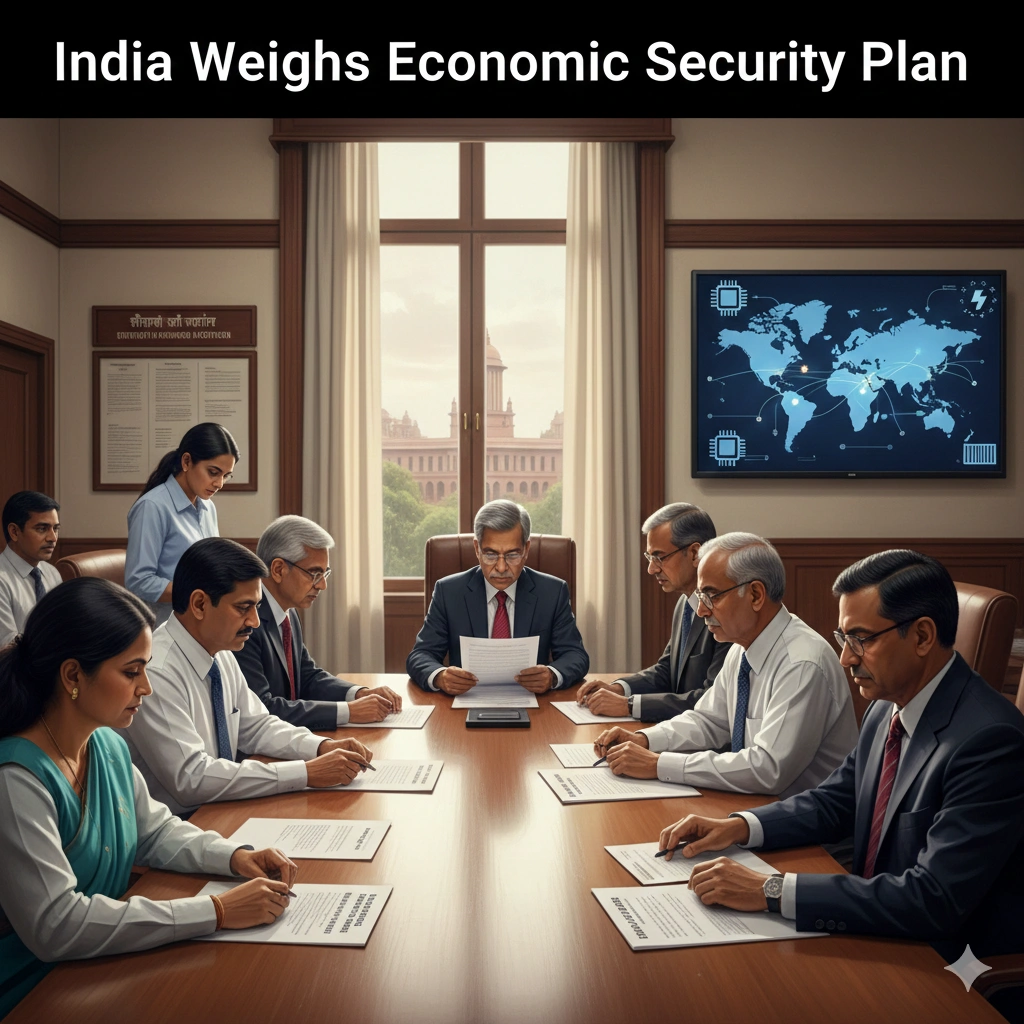
Strategic Curbs Expose Fragility of Global Economic Links
According to the analysis published by NatStrat, recent restrictions imposed by major powers have revealed how fragile international economic systems have become. Export controls, investment screening, tariffs, and supply-chain realignments have increasingly been driven by political and security considerations rather than purely economic logic.
Developing economies like India are particularly exposed to such shifts, as policy shocks from larger powers can disrupt access to markets, capital, and critical technologies. The article argues that without a structured India economic security doctrine, responses risk becoming reactive rather than strategic.
Proposal for an Institutional Economic Security Council
At the core of the proposal is the creation of a dedicated, institutionalised council tasked with drafting evidence-based strategies for India’s economic engagement. This body would assess risks and opportunities across bilateral, plurilateral, and multilateral frameworks, providing clearer policy signals to businesses and investors.
Such a council could help ensure consistency across ministries and reduce uncertainty during crises, allowing India to align its economic decisions more closely with long-term strategic objectives rather than short-term pressures.
Learning From Global Economic Security Frameworks
The analysis notes that India would not be acting in isolation. Several major actors have already introduced economic security frameworks to address similar challenges. The European Union, for instance, has issued a Joint Communication on strengthening economic security, while the OECD has released assessments highlighting risks related to supply chains, energy security, foreign investment, and cyber threats.
These frameworks reflect a growing recognition that economic policy and national security are increasingly intertwined. The article suggests India should draw lessons from these approaches while tailoring its doctrine to national priorities and development goals.
Managing Politics and Commerce in a Multipolar World
A key challenge identified in the proposed India economic security doctrine is defining how political disputes intersect with economic engagement. The analysis argues that India needs clearer parameters for determining when to separate politics from economics and when to use economic tools as instruments of influence.
This balancing act is particularly evident in India’s complex relationships with both the United States and China. Tariffs, export controls, investment scrutiny, and supply-chain dependencies have made it harder to maintain purely transactional economic ties with either partner.
Reducing Exposure While Preserving Market Access
The article emphasizes that an effective doctrine should not promote economic isolation. Instead, it should focus on reducing exposure in critical sectors and sensitive technologies while preserving access to global markets, capital flows, and innovation networks.
Diversification of supply chains, selective decoupling in strategic areas, and deeper engagement with trusted partners are cited as tools India could deploy more systematically under a coherent framework.
Building Influence Through Economic Tools
Beyond risk management, the proposed doctrine would also clarify how India can use economic instruments to build international influence. Trade agreements, investment partnerships, and technology collaboration could be leveraged more strategically to support diplomatic and security objectives.
By articulating clear priorities, the India economic security doctrine could strengthen India’s position in global negotiations and enhance predictability for domestic and foreign stakeholders alike.
A Framework for Long-Term Strategic Autonomy
The analysis concludes that as geopolitical competition intensifies, India can no longer afford an ad hoc approach to economic decision-making. A formal doctrine, supported by institutional capacity, would provide a roadmap for navigating uncertainty while defending national interests.
In a world where economics and security are increasingly inseparable, the call for an India economic security doctrine reflects a broader shift in how nations seek to protect prosperity without sacrificing openness.
For more details & sources visit: NatStrat
For the latest updates from India, visit our India news page.