
A major scientific breakthrough beneath Pine Island Glacier is transforming how researchers understand ice movement across Antarctica. Scientists have identified a massive hidden granite formation buried deep below the glacier, offering critical insight into why this region is melting so quickly and how it may influence future global sea levels.
The discovery connects unusual pink granite boulders found in the Hudson Mountains to a vast underground rock body formed nearly 175 million years ago. The finding is already helping refine computer models used to predict long-term ice sheet behavior and climate impact.
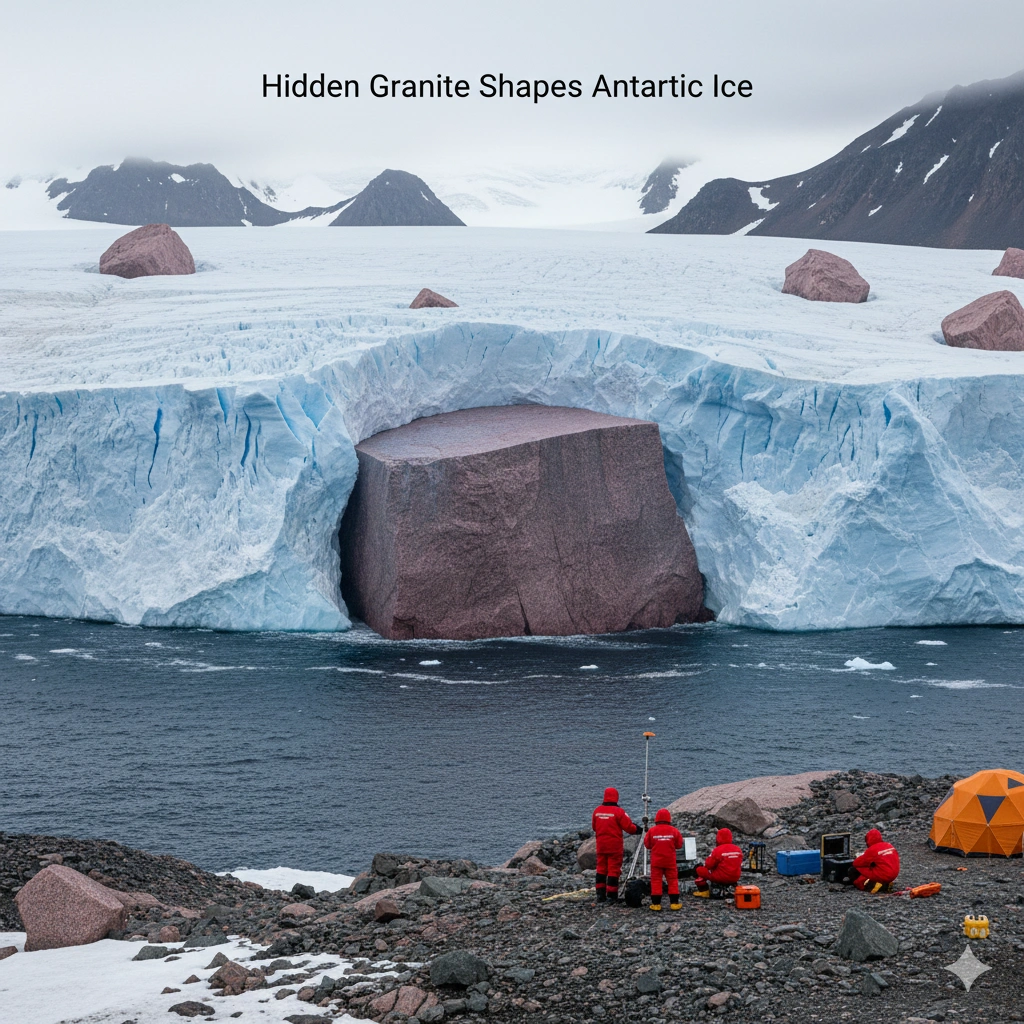
Hidden Granite Pine Island Glacier Structure: What Scientists Found
Researchers led by the British Antarctic Survey combined field geology, radioactive dating, and airborne gravity scanning to locate the hidden formation.
The buried granite body is estimated to be:
- Around 100 km wide
- Roughly 7 km thick
- Comparable to about half the size of Wales
These measurements came from gravity surveys that detected density differences beneath the ice surface. Scientists confirmed that the granite formed during the Jurassic period, about 175 million years ago.
Why Pink Granite Boulders Solved a Geological Mystery
For decades, unusual pink granite rocks sitting on volcanic peaks puzzled scientists studying regions around Pine Island Glacier. The rocks did not match the surrounding volcanic geology, raising questions about their origin.
The breakthrough came when researchers from the British Antarctic Survey traced those boulders back to a deep underground granite source beneath Pine Island Glacier. During the last ice age, a much thicker and more powerful glacier scraped granite blocks from the bedrock and transported them across vast distances.
As the ice later thinned, it deposited those rocks across mountain peaks, leaving behind geological markers that map past glacier size, strength, and movement patterns linked directly to Pine Island Glacier.
How Subglacial Geology Controls Ice Flow and Ice Loss
One of the most important findings is how bedrock type affects glacier stability.
Granite is extremely hard. When combined with meltwater channels beneath ice sheets, it creates a complex system where glaciers can be:
- Strongly anchored to bedrock
- But still vulnerable to warming ocean water
This helps explain why this glacier is both stable in some areas and rapidly losing ice in others. The region has already experienced some of the fastest ice loss on the continent in recent decades.
What This Means for Future Sea Level Rise
Understanding subglacial geology is essential for climate forecasting. Scientists say integrating this new geological data into ice sheet models will improve predictions of:
- Glacier retreat speed
- Ice sheet collapse risk
- Global sea level rise projections
The discovery also improves reconstruction of past ice sheet behavior, which helps scientists simulate future scenarios more accurately.
Why This Discovery Matters for Climate Science
This discovery is important because it shows how hidden geological structures shape global climate outcomes. Even features buried kilometers below ice can determine how fast glaciers move toward the ocean.
It also highlights how combining multiple scientific methods like geochemistry, airborne surveys, and geophysics can reveal hidden Earth systems that influence climate stability.
Scientists believe this approach could help uncover more hidden geological controls beneath other Antarctic glaciers in the future.
The Bigger Picture: Antarctica’s Hidden Landscape
Antarctica is not just ice. Beneath the surface lies a complex landscape of mountains, basins, and ancient rock formations. Discoveries like this highlight how little is still known about the continent’s deep structure.
As technology improves, researchers expect more breakthroughs that will reshape understanding of global climate systems and long-term sea level trends.
For more details & sources visit: Earth.com (with underlying study in Nature Communications Earth & Environment)
Read more on Antarctica news: 360 News Orbit – Antarctica