
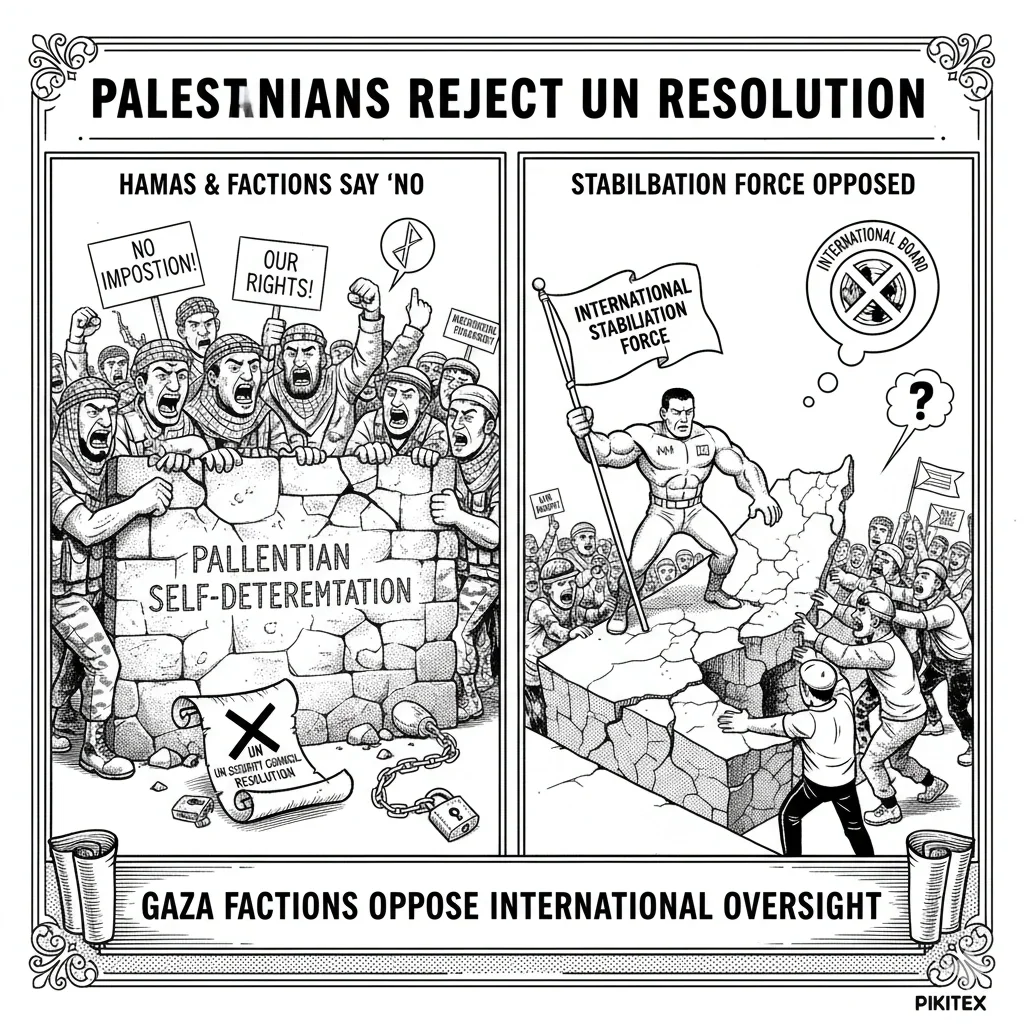
Palestinian factions, led by Hamas, have firmly rejected a Hamas Gaza UN resolution proposing the creation of an international board and stabilisation force in Gaza. The announcement on November 18 comes as part of a broader U.S.-led initiative following the October 10 ceasefire, aimed at restoring order and addressing humanitarian and governance challenges in the region.
Opposition to “Imposed Guardianship”
In a joint statement, Hamas and allied groups described the UN Security Council resolution as a form of “imposed guardianship” over Gaza. According to the statement, the plan would undermine Palestinians’ right to self-governance and disregard the fundamental principle of local decision-making. The factions argue that any externally imposed governance framework would erode the political authority of Gaza’s elected leaders and compromise Palestinian sovereignty.
The groups also criticised the resolution for failing to address Israeli attacks in the West Bank and for ignoring the structural issues underlying the ongoing conflict, including occupation, apartheid, and restrictions on Palestinian mobility and economic activity.
Mixed Reactions Among Gaza Residents
Reactions from Gaza’s population were mixed. Some residents expressed strong opposition to the UN proposal, emphasizing that Palestinians are capable of self-rule and that foreign intervention could exacerbate tensions. Others cautiously welcomed international engagement, noting that stabilisation efforts could assist in rebuilding infrastructure and improving security.
The debate highlights the delicate balance between international humanitarian efforts and the principle of local autonomy. Many observers warn that without broad Palestinian support, the resolution risks becoming symbolic rather than effective in addressing governance and humanitarian challenges.
U.S.-Led Initiative and Regional Support
The resolution is part of a U.S.-led initiative supported by several Arab states aiming to stabilise Gaza after a recent ceasefire. The plan seeks to create mechanisms for governance oversight, security coordination, and economic recovery. However, the backlash from Hamas and other factions illustrates the political sensitivities surrounding international intervention in Gaza, where local groups insist on managing internal affairs independently.
UN officials have stressed that the initiative aims to complement Palestinian efforts rather than replace them. Yet, the resistance from Hamas underscores the difficulty of implementing externally mediated governance reforms in contested territories, particularly where political legitimacy is disputed.
Broader Implications for Gaza Governance
The Hamas Gaza UN resolution rejection underscores longstanding tensions over sovereignty, international oversight, and Palestinian self-determination. Analysts note that while stabilisation and reconstruction are urgent, proposals perceived as limiting political autonomy risk heightening distrust between Palestinian factions and international actors.
The resolution also reflects broader geopolitical dynamics. U.S.-backed efforts to stabilise Gaza must navigate regional alliances, domestic Palestinian politics, and the complex realities of governance under occupation. Without buy-in from key stakeholders, including Hamas, these initiatives may struggle to achieve meaningful outcomes.
Looking Ahead
As international actors continue to engage on Gaza’s reconstruction and security, the rejection by Hamas signals that future proposals will need to carefully balance humanitarian assistance with respect for local authority. Achieving stability, governance reforms, and conflict resolution will require dialogue, compromise, and recognition of Palestinian self-determination.
The Hamas Gaza UN resolution episode highlights the challenges facing international organisations in conflict zones where local governance, sovereignty, and external intervention intersect. Moving forward, multilateral efforts will likely focus on building consensus and ensuring that initiatives are viewed as supportive rather than coercive.
Source: Al Jazeera