
Gulf Oil Production Cut has sent shockwaves through the international economy as Kuwait and its regional allies slash output by 6.7 million barrels per day. This unprecedented reduction is a direct response to the effective closure of the Strait of Hormuz, a vital artery for global energy transit. As maritime exports remain paralyzed, storage facilities in Kuwait, Saudi Arabia, and the UAE have rapidly hit their maximum capacity.
Without a clear exit route for crude oil, producers have been forced to preemptively scale back operations to prevent a total system collapse. This strategic withdrawal of supply comes at a time of extreme geopolitical volatility following retaliatory strikes on domestic infrastructure. The Gulf Oil Production Cut is now the primary factor driving concerns of a multi-year global energy crisis.
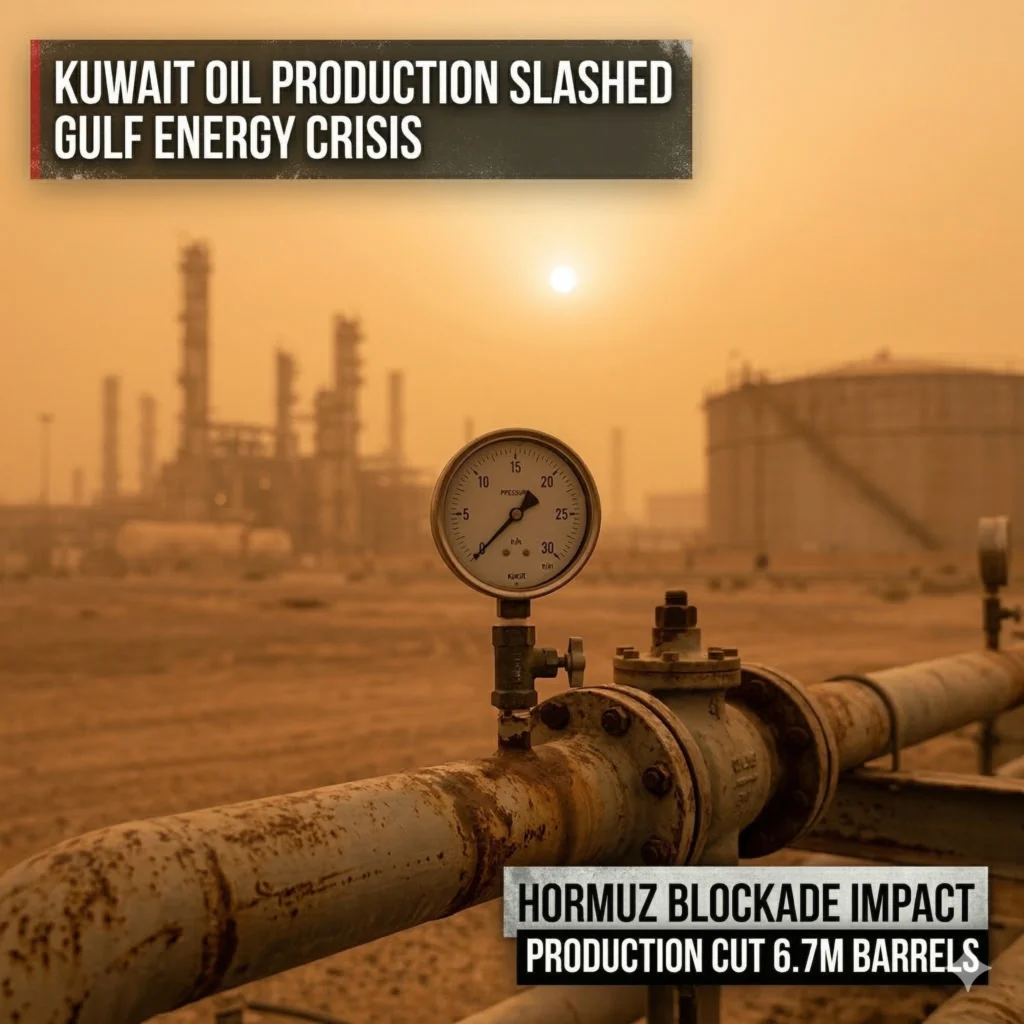
Analyzing the Impact of the Gulf Oil Production Cut
The Gulf Oil Production Cut was officially coordinated between Kuwaiti officials and neighboring producers to manage a storage crisis that reached a breaking point this week. As the conflict enters its eleventh day, the inability to move tankers through the Persian Gulf has created a massive backlog of unrefined crude. Local refineries have been forced to shut down as they can no longer process the surplus of oil that has no destination. This has led to a sharp spike in global fuel transportation costs as insurers and shippers reassess the risks of the region.
Kuwaiti infrastructure, including sites hosting United States military personnel, has faced direct pressure from aerial strikes, further complicating the Gulf Oil Production Cut. These security concerns have made it nearly impossible to maintain normal extraction rates while the safety of workers and facilities is at risk. Saudi Aramco CEO Amin Nasser has described this period as the most significant challenge the regional oil and gas industry has ever encountered. The scale of the reduction reflects the severity of the maritime blockade.
While some alternative export routes exist, they are currently insufficient to handle the volume required to replace the Strait of Hormuz. The logistics of the region are under extreme pressure, and the Gulf Oil Production Cut is the only remaining lever to prevent an environmental and operational catastrophe. Investors are bracing for prolonged disruptions that could permanently alter energy pricing models. The world is watching as the pillars of global energy security are tested.
Regional Storage Capacity and the Need for Preemptive Action
The decision behind the Gulf Oil Production Cut was largely driven by the physical limitations of regional storage tanks. In Kuwait and Iraq, storage facilities are reportedly reaching 95% capacity, leaving no room for new production to be housed. If production were to continue at normal levels, the industry would face a “gridlock” scenario where wells might be permanently damaged by forced, unplanned shutdowns. The current cut allows for a more controlled and reversible idling of assets.
This preemptive scaling back is essential for protecting the long-term integrity of the oil fields. By coordinating the Gulf Oil Production Cut, the allied nations are ensuring that they can ramp back up quickly once the waterway reopens. However, the immediate effect is a massive hole in the global daily supply that other producers like the US or Norway cannot fill on short notice. This supply-demand imbalance is the engine behind the current market panic.
Furthermore, the closure of liquefied natural gas (LNG) plants in nearby Qatar has added another layer of complexity to the Gulf Oil Production Cut. The energy market is now facing a dual shortage of both crude oil and natural gas, which powers much of the world’s industrial sector. Economists note that the synergy between these two shortages is creating a “perfect storm” for inflation. The resilience of the global economy is being pushed to its absolute limit.
Gulf Oil Production Cut
The Gulf Oil Production Cut is not just a regional adjustment but a global event that has prompted immediate political intervention. United States President Donald Trump announced a temporary lifting of certain oil-related sanctions this week in a desperate attempt to stabilize skyrocketing prices. This move aims to bring more barrels from other sources into the market to offset the 6.7 million lost in the Gulf. However, the psychological impact of the Gulf Oil Production Cut remains the dominant force in trading pits from London to Singapore.
Kuwaiti producers are working around the clock to ensure that the infrastructure remains in a state of “warm standby.” This means that while the Gulf Oil Production Cut is in effect, the machinery and pipelines are being maintained to avoid corrosion or mechanical failure. This maintenance is a costly but necessary part of the strategy to survive the current hostilities. The coordination between the Gulf allies has been remarkably tight, showing a unified front in the face of external aggression.
Despite the cuts, the threat to domestic infrastructure remains a high-priority concern for the Kuwaiti government. The recent strikes on bases within Kuwaiti borders have led to increased military patrols around oil installations. The Gulf Oil Production Cut is therefore as much a security measure as it is an economic one. Protecting the “black gold” that funds the nation is the highest priority for the Kuwaiti leadership during this eleven-day war.
Logistical Pressures on Alternative Export Routes
The Gulf Oil Production Cut has highlighted the dangerous level of dependence that the world has on a single maritime point of failure. While Saudi Arabia has pipelines that reach the Red Sea, Kuwait and Iraq are almost entirely dependent on the Persian Gulf. Efforts to find land-based alternatives are being fast-tracked, but these projects will take months, if not years, to provide significant relief. The Gulf Oil Production Cut is the only immediate solution to the current bottleneck.
- Maritime Gridlock: Over 20 million barrels of oil normally pass through the Strait daily; now, that volume is effectively zero.
- Refinery Closures: Local Kuwaiti refineries have stopped production to prevent a surplus of refined products with no shipping options.
- Insurance Spikes: War risk premiums for tankers in the region have increased by 500% in just ten days, making trade non-viable.
- Sanction Relief: The US move to lift sanctions is a temporary “band-aid” for a structural supply wound in the Middle East.
These logistical hurdles mean that even if the conflict ended tomorrow, the effects of the Gulf Oil Production Cut would be felt for months. Re-establishing the safe flow of tankers and clearing the backlog of stored oil will be a monumental task. The global supply chain has been shattered, and the cost of rebuilding it will likely be passed on to consumers at the pump. This is a definitive moment for the 21st-century energy landscape.
Impact of Iranian Retaliatory Strikes on Energy Sites
The Gulf Oil Production Cut was accelerated by the physical damage caused by Iranian retaliatory strikes late last month. Targets included not only military bases but also critical support infrastructure for the oil industry. These attacks forced many international contractors to evacuate their staff from Kuwaiti oil fields, further reducing the capacity to maintain high production levels. The Gulf Oil Production Cut is a pragmatic response to a shrinking workforce and damaged assets.
The use of drones and missiles in these strikes has proven that traditional air defenses must be augmented with more specialized technology. As Kuwaiti officials await a resolution to the hostilities, they are also investing in new security protocols to protect their assets from future “swarm” attacks. The Gulf Oil Production Cut provides a window of time to implement these upgrades without the pressure of active production. It is a period of forced evolution for the Kuwaiti energy sector.
Moreover, the psychological toll on the regional workforce cannot be ignored. The “sense of normalcy” has been replaced by a state of constant vigilance, which naturally slows down industrial output. The Gulf Oil Production Cut accounts for this human factor, acknowledging that peak efficiency is impossible under the threat of aerial bombardment. The resilience of the Kuwaiti people is being tested alongside their infrastructure.
Financial Consequences for Global Energy Investors
Investors worldwide are increasingly concerned that the Gulf Oil Production Cut could trigger a global recession similar to the shocks of the 1970s. The sudden removal of 6.7 million barrels per day has led to a dramatic increase in the “fear premium” on oil futures. Those who rely on stable energy prices for manufacturing and transportation are seeing their margins evaporate overnight. The Gulf Oil Production Cut has turned the energy market into a high-stakes gamble.
Financial analysts are closely monitoring the storage levels in the United States and Europe to see how long they can last without Middle Eastern imports. While strategic reserves are being tapped, they are a finite resource that cannot last forever. The Gulf Oil Production Cut has essentially started a countdown for global energy stocks. If the Strait of Hormuz does not open within the next thirty days, the economic fallout will be catastrophic for several major economies.
In Kuwait, the loss of daily oil revenue is placing an immense strain on the national budget. While the country has significant sovereign wealth, a prolonged Gulf Oil Production Cut will eventually force a re-evaluation of public spending. This economic pressure is a key component of the current conflict, as the warring parties use energy supply as a tool of geopolitical leverage. The oil market has become the primary battlefield of the 2026 war.
Strategic Responses from the United States and Allies
The response from Washington to the Gulf Oil Production Cut has been a mixture of military protection and economic relief. The temporary lifting of sanctions is intended to encourage countries like Venezuela or Iran’s rivals to increase their output. However, the technical reality is that few nations have the “spare capacity” to match the volume of the Gulf Oil Production Cut. This leaves the global market in a state of precarious imbalance.
Military efforts to clear the Strait of Hormuz are ongoing, but the threat of mines and shore-based missiles remains high. Until the waterway is declared safe for commercial traffic, the Gulf Oil Production Cut will remain the law of the land in the Middle East. The coordination between the US Navy and the Gulf states is critical for the eventual restoration of trade. For now, the focus is on containing the conflict and preventing further strikes on oil infrastructure.
As the Gulf Oil Production Cut persists, the move toward alternative energy sources in the West is likely to accelerate. This crisis has proven that dependency on a single geographical region for energy is a massive strategic liability. The 2026 oil shock may be the final push needed for a global transition away from fossil fuels. In this sense, the Gulf Oil Production Cut could have a lasting impact on the planet’s climate trajectory.
Future Outlook for Kuwaiti Energy Production
Looking ahead, the recovery from the Gulf Oil Production Cut will be a multi-phase process. First, the security situation must be stabilized to allow for the return of international technical teams. Second, the maritime routes must be de-mined and secured for tankers. Only then can Kuwait and its allies begin the slow process of drawing down their storage and ramping up their wells. The Gulf Oil Production Cut is a deep wound that will take time to heal.
Kuwait continues to coordinate with allied nations to ensure that the eventual return to market is orderly. A sudden flood of oil could crash prices, creating a different kind of economic disaster. Therefore, the “thawing” of the Gulf Oil Production Cut will be just as carefully managed as the freeze was. The goal is to reach a stable equilibrium that protects both the producers’ income and the global economy’s health.
In the meantime, the world must learn to live with significantly less oil from the Persian Gulf. This “new normal” will involve higher costs, energy rationing in some regions, and a constant eye on the news from Kuwait. The Gulf Oil Production Cut has reminded the world that energy is not just a commodity—it is the lifeblood of civilization, and it is currently under threat. The coming months will determine the shape of the global economy for the next decade.
Conclusion: Navigating the Most Significant Energy Crisis
The Gulf Oil Production Cut of 2026 will be remembered as a turning point in the history of the oil industry. By reducing output by 6.7 million barrels per day, Kuwait and its neighbors have taken a stand to protect their infrastructure and the global market from a chaotic collapse. While the move is painful for consumers and investors, it is a necessary response to the closure of the world’s most important waterway. The resilience of the Gulf allies in coordinating this cut is a testament to their strategic depth.
As we navigate this crisis, the importance of international cooperation cannot be overstated. From the halls of the UN to the trading floors of Wall Street, the resolution of the Gulf Oil Production Cut is the top priority. The world is waiting for the day when the tankers can once again sail through the Strait of Hormuz, ending the most significant energy crisis in decades. Until then, the Gulf Oil Production Cut remains the defining feature of the global energy landscape.
For more details & sources visit: Ukrinform
Read more about Kuwait news on 360 News Orbit – Kuwait.