
Global terrorism deaths fall by 28% according to the 2026 Global Terrorism Index, marking a significant milestone in international security efforts. This substantial reduction brings the total number of fatalities down to 5,582, with 81 countries reporting marked improvements in their domestic safety environments. However, experts from the Institute for Economics & Peace (IEP) warn that these statistical gains are overshadowed by a volatile outlook and a dramatic geographic shift in extremist activity. While the overall numbers are down, the nature of the threat is evolving into more localized and unpredictable forms across different continents.
The data reveals that global terrorism deaths fall during a period when Western nations are simultaneously experiencing a 280% surge in casualties. This paradox suggests that while large-scale organized groups are losing ground in traditional conflict zones, “lone-wolf” and politically motivated attacks are rising in developed economies. Sub-Saharan Africa has officially emerged as the new global epicenter for extremist activity, accounting for over half of all worldwide fatalities. The Islamic State remains the deadliest group globally, repositioning its footprint to exploit governance vacuums in African regions where local security forces are stretched thin.
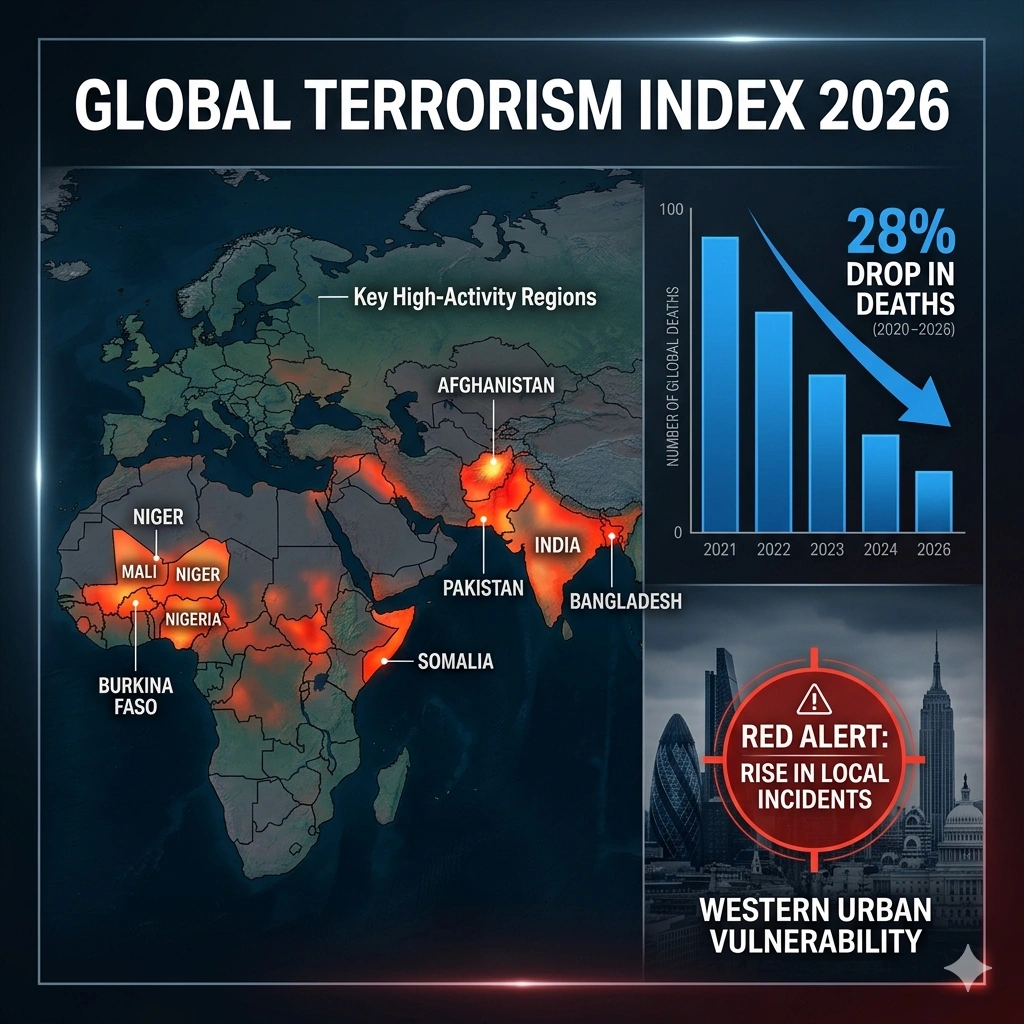
Sub-Saharan Africa Becomes the New Epicenter
As global terrorism deaths fall in the Middle East, the Sahel and sub-Saharan Africa have become the primary theaters for radical insurgencies. Groups affiliated with both the Islamic State and Al-Qaeda have intensified their operations across borders, targeting civilian populations and critical infrastructure. The lack of coordinated regional defense strategies has allowed these groups to establish “proto-states” in remote areas. This shift represents a significant challenge for international peacekeeping missions, which must now adapt to a vast and difficult terrain far removed from previous operational centers.
The transition of the epicenter means that global terrorism deaths fall less rapidly in regions with high poverty and low institutional trust. In these areas, extremist groups often provide basic services or protection to marginalized communities, complicating military efforts to dislodge them. The 2026 report highlights that the focus of global counter-terrorism must move toward developmental aid and local governance support. Without addressing the root causes of instability in Africa, the current decline in total deaths may be short-lived. The international community is being urged to redirect resources to prevent the permanent entrenchment of these networks.
Global Terrorism Deaths Fall
The 2026 report confirms that global terrorism deaths fall to 5,582, the lowest level recorded in over a decade. This decline is attributed to the successful dismantling of several major terror networks and the increased effectiveness of cross-border intelligence sharing. Many nations that were previously hotspots, such as Iraq and Syria, have seen a steady stabilization of their internal security. However, this progress is described as a “fragile reprieve” by security analysts. The underlying ideologies that drive these groups remain potent and continue to find new audiences through digital recruitment.
While global terrorism deaths fall, the complexity of the attacks being carried out is actually increasing. Perpetrators are moving away from large-scale bombings toward targeted assassinations and cyber-terrorism. These “low-cost, high-impact” tactics are harder for traditional security services to detect and prevent. The rise of sophisticated encryption and decentralized funding through cryptocurrency has allowed smaller cells to operate independently of central command structures. Consequently, the decrease in total fatalities does not necessarily equate to a decrease in the total threat level facing the global population.
Pakistan Becomes the Most Impacted Nation
Despite the fact that global terrorism deaths fall elsewhere, Pakistan has overtaken all other nations to become the most impacted country for the first time. This rise is primarily driven by the resurgence of the Tehrik-i-Taliban Pakistan (TTP) and heightened regional instability along the western borders. The recent outbreak of open conflict between Pakistan and Afghanistan has exacerbated the security situation, leading to a spike in cross-border raids. The TTP has utilized safe havens to launch increasingly bold attacks against both military and civilian targets within the country.
The situation in Pakistan demonstrates how global terrorism deaths fall in some areas only to resurface in others due to geopolitical shifts. The 2026 Index points out that the withdrawal of international oversight in neighboring regions has left a vacuum that militant groups are eager to fill. Pakistan’s security forces have intensified their operations, but the fluid nature of the border makes total containment nearly impossible. The impact on the national economy and social fabric has been profound, as the country seeks to balance internal defense with regional diplomatic pressures.
Rising Threats and Radicalization in Western Nations
Even as global terrorism deaths fall on a worldwide scale, Western countries have faced a worrying 280% surge in terror-related casualties. Most of these incidents are linked to “lone-wolf” actors who have been radicalized online, often driven by far-right or far-left political motivations. The tripling of youth radicalization cases in Europe and North America has alarmed policymakers and social scientists alike. These individuals often lack direct ties to established groups, making them nearly invisible to standard surveillance until the moment they strike.
- Youth radicalization has become a primary concern for interior ministries.
- Social media platforms are under pressure to improve their automated detection of extremist content.
- Community-based deradicalization programs are being expanded in major urban centers.
- Mental health support is increasingly viewed as a tool for preventing domestic terrorism.
The trend in the West shows that global terrorism deaths fall in traditional battlefields but can manifest as domestic crises in stable democracies. The rise of “politically motivated” violence suggests that social polarization is becoming a significant security risk. Authorities are now focusing on the intersection of misinformation and extremist recruitment. Preventing the next generation from falling into these echo chambers is considered the most effective long-term defense strategy. The 2026 data serves as a wake-up call that no region is truly immune to the evolving nature of extremist violence.
The Role of IS Detention Camp Escapes
A major factor threatening the trend where global terrorism deaths fall is the mass escape of prisoners from IS detention camps in Syria. Over the past year, several high-profile breaches have allowed thousands of battle-hardened militants to disappear back into the regional shadows. These individuals possess the tactical knowledge and leadership experience needed to revitalize dormant cells. Experts warn that these “ghost operatives” are already making their way to new conflict zones, particularly in sub-Saharan Africa and South Asia.
The failure to secure these camps is cited in the Global Terrorism Index as a significant strategic oversight. As global terrorism deaths fall, the potential for a sudden “surge” remains high as long as these veteran fighters remain at large. International efforts to repatriate or prosecute these detainees have moved at a glacial pace, leaving local militias to guard them with insufficient resources. The 2026 report suggests that the “regrouping” phase of the Islamic State is currently underway, fueled by the influx of escaped personnel. This creates a high risk of a new wave of global instability in the coming 24 months.
Youth Radicalization and Digital Recruitment Tactics
While global terrorism deaths fall, the rate of digital recruitment among younger populations has reached record levels. Extremist groups have adapted their messaging to appeal to the grievances of the Gen Z and Alpha generations, using gaming platforms and encrypted apps. These “soft” recruitment tactics focus on building a sense of community and purpose before introducing more radical ideologies. The IEP report highlights that the average age of arrested terror suspects has dropped significantly in 2025 compared to previous years.
- Gaming servers are being monitored more closely for extremist recruitment activity.
- Influencer-style videos are being used to “glamorize” life within militant groups.
- Decentralized autonomous organizations (DAOs) are being explored by groups for funding.
The battle for the minds of the youth is where the future of global security will be decided. Even if global terrorism deaths fall today, the “radicalization pipeline” ensures a steady supply of potential attackers for the future. Governments are responding by integrating media literacy into school curricula to help students identify propaganda. However, the speed of digital innovation often outpaces the ability of regulators to respond. A coordinated global effort involving tech giants and civil society is needed to protect the digital ecosystem from being weaponized by extremists.
Future Outlook and the “Temporary Reprieve” Warning
The 2026 Global Terrorism Index concludes that while global terrorism deaths fall, the world may be in a state of “temporary reprieve.” The combination of open conflicts in South Asia, mass escapes in the Middle East, and rising domestic tensions in the West creates a volatile mix. Security experts suggest that the current decline in deaths may be a statistical anomaly caused by the reorganization of major groups. As these organizations finish their regional shifts, they are likely to launch a new series of coordinated attacks to prove their continued relevance.
Maintaining the trend where global terrorism deaths fall will require a level of international cooperation that is currently under strain. The shift toward multipolarity in global politics has made it more difficult for nations to agree on shared security priorities. However, the report emphasizes that terrorism is a borderless threat that requires a borderless response. Investing in the stability of “failed states” and the resilience of civil institutions remains the most effective way to ensure that the current decline becomes a permanent trend. The world must remain vigilant even as the numbers move in a positive direction.
The Impact of Geopolitical Shifts on Security
Global terrorism deaths fall when major powers are aligned in their counter-terrorism goals, but recent geopolitical shifts have fractured this unity. The competition between the West and emerging powers has sometimes led to a “blind eye” being turned toward proxy groups. This lack of a unified front allows extremist organizations to exploit diplomatic rifts and find support in unexpected places. The 2026 report notes that regional security alliances are becoming more important than global ones in the current climate.
- Regional alliances in Africa are taking the lead in local counter-insurgency.
- Intelligence sharing is being restricted due to concerns over cyber-espionage.
- The “weaponization” of migration flows is being linked to extremist transit routes.
As global terrorism deaths fall, the strategic focus is shifting toward preventing the use of new technologies in attacks. This includes the proliferation of low-cost drones and the potential use of artificial intelligence to plan complex operations. The 2026 Index calls for a new international treaty to govern the use of AI in security and to prevent its misuse by non-state actors. The future of warfare is becoming increasingly technological, and counter-terrorism must evolve at the same pace to be effective.
Economic Costs of Terrorism and Recovery Efforts
Despite the news that global terrorism deaths fall, the economic impact of extremist activity remains staggering. The 2026 report estimates the global economic impact of terrorism at over $80 billion, including property damage and lost productivity. Nations like Pakistan and Nigeria face a significant “security tax” that diverts funds away from health and education. Recovery in these regions is slow, as the constant threat of violence deters foreign direct investment and hinders the growth of local markets.
- GDP growth in impacted nations is estimated to be 2% lower than it could be.
- Security spending often accounts for over 20% of national budgets in hotspots.
- Tourism sectors in sub-Saharan Africa are struggling to recover post-conflict.
When global terrorism deaths fall, there is a “peace dividend” that can be reinvested in the community. However, this dividend is only realized if the security gains are perceived as permanent by the private sector. The IEP highlights that sustainable development is the best counter-terrorism tool available. By creating economic opportunities, nations can reduce the appeal of extremist groups that offer financial incentives to their recruits. The economic and security spheres are inextricably linked in the quest for global stability.
The Islamic State’s Persistent Threat and Footprint
The 2026 Index makes it clear that while global terrorism deaths fall, the Islamic State has not been defeated. Instead, it has transformed into a decentralized global franchise. The group’s ability to inspire attacks thousands of miles from its original heartland is a testament to the power of its digital brand. In 2025, IS was responsible for more deaths than any other group, with its most active branches located in the Sahel and Central Africa. This “franchise model” allows the group to survive even as its central leadership is targeted.
The persistence of this threat is a major reason why global terrorism deaths fall at an uneven rate. The Islamic State’s shift to Africa has allowed it to tap into local ethnic and land-use conflicts, giving its global jihad a local flavor. This makes the group harder to fight with purely military means, as it becomes embedded in the local social fabric. Addressing the IS threat in 2026 requires a nuanced approach that separates the group’s global ideology from the local grievances it exploits. Only then can the international community hope to see a permanent reduction in its lethality.
Political Polarization as a Catalyst for Violence
In the West, the fact that global terrorism deaths fall globally is overshadowed by the rise of domestic extremism fueled by political polarization. The 2026 report highlights that the majority of attacks in North America and Europe are now “politically motivated” rather than “religiously motivated.” This shift reflects a breakdown in social cohesion and the rise of “us versus them” narratives in mainstream discourse. When political disagreement turns into existential hatred, the risk of violence increases exponentially.
- Social media algorithms are being blamed for creating “echo chambers” of hate.
- Violent rhetoric by public figures is being linked to a rise in “copycat” attacks.
- The line between activism and extremism is becoming increasingly blurred.
Countering this trend requires a renewed focus on civic education and the promotion of democratic values. As global terrorism deaths fall in traditional conflict zones, the home front is becoming the new priority for security agencies. Ensuring that political grievances are addressed through peaceful institutions is the best way to prevent the rise of domestic terror. The 2026 Index suggests that the health of a democracy is directly correlated to its level of domestic security.
Success Stories: Countries with Improving Security
The 2026 Global Terrorism Index isn’t just a list of warnings; it also celebrates the success stories where global terrorism deaths fall. Countries like Iraq and the Philippines have seen massive improvements in their security rankings thanks to successful local reintegration programs. In these nations, former combatants are being brought back into society through vocational training and psychological support. These programs show that it is possible to break the cycle of violence through persistent and compassionate state action.
- Iraq has seen a 65% reduction in terror attacks over the last three years.
- The Philippines has successfully neutralized major insurgent leaders in Mindanao.
- National reconciliation commissions are being used to resolve historical grievances.
These success stories provide a roadmap for other nations struggling with similar issues. They demonstrate that while military action is sometimes necessary, the long-term solution lies in social and political reform. When global terrorism deaths fall in these areas, it opens up new possibilities for regional cooperation and economic growth. The 2026 report encourages the global community to study these examples and apply their lessons to emerging hotspots in Africa and South Asia.
The Role of International Bodies in Sustaining Gains
Sustaining the current trend where global terrorism deaths fall will depend heavily on the effectiveness of international bodies like the UN and INTERPOL. These organizations provide the platform for nations to share data and coordinate their legal responses. The 2026 report calls for more robust international laws to handle the prosecution of foreign fighters and the regulation of extremist content online. Without a unified legal framework, groups will continue to exploit the “cracks” between different national jurisdictions.
- INTERPOL has expanded its database of known terror associates to include over 100,000 names.
- The UN’s Office of Counter-Terrorism is focusing on the “prevention of violent extremism” (PVE).
- International banking regulations are being tightened to prevent terror financing.
The global terrorism deaths fall when the international community acts as a single, coordinated entity. The challenges of 2026 require a level of commitment that goes beyond traditional security. It involves building a global culture of peace and a legal system that can adapt to the speed of modern threats. The 2026 Global Terrorism Index serves as both a scorecard and a call to action for the year ahead. The work of securing the world is far from over, but the current data shows that progress is possible.
Media Responsibility and Information Warfare
The way the media reports on the news that global terrorism deaths fall can have a significant impact on public perception and group recruitment. Sensationalist reporting can inadvertently provide the “theater” that terrorists crave, while accurate and balanced coverage can inform the public without spreading fear. The 2026 report includes a section on the responsibility of journalists to avoid becoming a megaphone for extremist propaganda. Information warfare is a key component of modern terrorism, and the media is on the front lines.
- Newsrooms are adopting new ethical guidelines for reporting on terror incidents.
- Fact-checking organizations are playing a vital role in debunking extremist myths.
- The use of “live-streamed” violence by perpetrators is being blocked by tech platforms.
When global terrorism deaths fall, it is important for the media to report on the underlying causes and the success of counter-measures. This helps to build public trust in security institutions and reduces the psychological impact of individual attacks. The 2026 Index reminds us that the goal of terrorism is to provoke a reaction, and by refusing to be intimidated, society can deny the attackers their primary objective. Accurate information is a powerful weapon against the spread of radicalization and fear.
Conclusion: A Year of Progress and Vigilance
The news that global terrorism deaths fall by 28% in 2026 is a rare piece of positive news in a complex global landscape. It represents the hard work of thousands of security personnel, diplomats, and community leaders around the world. However, the report is clear that this is not the time for complacency. The regional shifts, the rise of domestic threats in the West, and the evolution of digital tactics all suggest that the threat remains very real. The world is at a crossroads, and the decisions made in the next year will determine if the current decline is a lasting trend.
As global terrorism deaths fall, we must remain vigilant and committed to the long-term goal of a world free from fear. The 2026 Global Terrorism Index provides the data and the insights needed to navigate this changing environment. By focusing on the root causes of extremism and strengthening international cooperation, we can ensure that the numbers continue to move in the right direction. The journey toward global peace is long and difficult, but the progress seen this year gives us reason to be hopeful for the future.
For more details & sources visit: Institute for Economics & Peace (IEP)
Read more on global developments: 360 News Orbit – Extended Orbit