
Global de-escalation strategy is now the primary focus of Prime Minister Mark Carney as he navigates a complex diplomatic landscape during his official visit to Sydney. While standing before international media at the Lowy Institute, the Prime Minister emphasized that the current trajectory of Middle Eastern conflict requires an immediate shift toward stability. This visit marks a pivotal moment for Canadian foreign policy, as Carney seeks to balance traditional alliances with the urgent need for a rules-based international order.
The Prime Minister expressed his profound regret over the escalating violence involving the United States, Israel, and Iran, noting that such kinetic actions represent a failure of global diplomacy. By advocating for a global de-escalation strategy, Carney is positioning Canada as a leading middle power capable of mediating between superpowers and regional antagonists. His remarks underscore a commitment to preventing a wider regional war that could destabilize global energy markets and international security frameworks for decades to come.
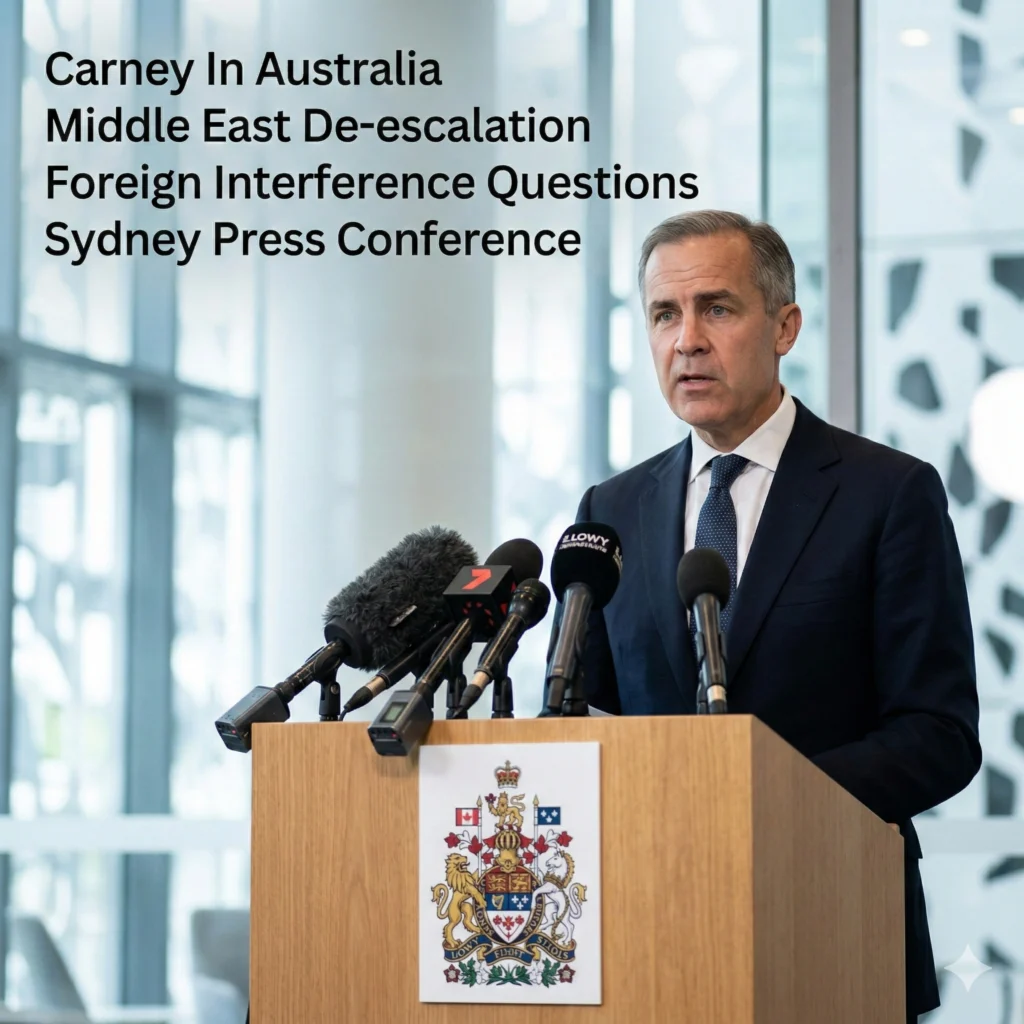
The Foundations of a Global De-escalation Strategy
The current geopolitical climate demands a sophisticated global de-escalation strategy that moves beyond simple rhetoric and into the realm of actionable diplomacy. Mark Carney highlighted that the recent strikes against Iranian targets, while characterized as defensive, signal a dangerous breakdown in communication between major powers. He argued that without a concerted effort to return to the negotiating table, the risk of miscalculation grows exponentially every day.
Canada’s role in this strategy involves leveraging its reputation as a fair broker to encourage dialogue among conflicting parties. The Prime Minister noted that the international community must prioritize humanitarian concerns and the protection of sovereign borders above short-term military objectives. This approach requires a unified front from middle powers who often bear the brunt of global instability without having a direct hand in the initial provocations.
Furthermore, the strategy involves a critical reassessment of how intelligence is shared among allies regarding military operations in the Middle East. Carney revealed that Canada was not briefed in advance of the latest strikes, highlighting a gap in the consultative process that must be closed. To ensure a global de-escalation strategy is effective, there must be a transparent framework where all stakeholders are informed of actions that could trigger broader conflict.
Strengthening the Rules-Based International Order
A robust global de-escalation strategy is inherently tied to the preservation and strengthening of the rules-based international order which has governed state relations since the mid-20th century. During his Sydney address, Carney lamented the erosion of these norms, suggesting that the “law of the jungle” must not be allowed to replace international law. He called for a renewed commitment to multilateral institutions that can provide a platform for peaceful dispute resolution.
The Prime Minister emphasized that when countries bypass international bodies to engage in unilateral military action, the entire foundation of global peace is weakened. He suggested that Canada and Australia are uniquely positioned to lead a revival of these institutions through increased funding and diplomatic engagement. By reinforcing the rules, middle powers can create a buffer against the impulsive actions of larger, more aggressive nations.
This commitment to order also extends to the realm of maritime security and the protection of international trade routes. Carney discussed how the conflict in the Middle East directly impacts the security of the Indo-Pacific region, making a global de-escalation strategy a matter of economic survival for many nations. The goal is to create a predictable environment where commerce can flourish without the constant threat of military interruption.
Global De-escalation Strategy
The implementation of a global de-escalation strategy requires a careful balance of military readiness and diplomatic overtures to ensure lasting regional peace. Mark Carney believes that de-escalation is not a sign of weakness but a strategic necessity in a world where nuclear-armed states are increasingly at odds. He urged the United States and Iran to seek a “diplomatic off-ramp” before the situation reaches a point of no return.
Central to this strategy is the involvement of regional players who have a vested interest in maintaining the status quo. Carney suggested that nations like Jordan, Egypt, and the Gulf states must be integral parts of any peace framework. By decentralizing the peace process, the global de-escalation strategy becomes more inclusive and more likely to result in a durable agreement that addresses the root causes of the friction.
Moreover, the Prime Minister pointed out that economic sanctions and incentives should be used more precisely to drive parties toward the bargaining table. Instead of broad measures that harm civilian populations, targeted pressure can be more effective in altering the calculus of leadership. This nuanced approach is a hallmark of the Canadian vision for a safer, more predictable international environment.
Navigating Complex Diplomatic Resets
Implementing a global de-escalation strategy also means navigating the treacherous waters of foreign interference and bilateral tensions with emerging powers. Carney’s recent trip to India served as a backdrop for his Sydney visit, as he addressed the ongoing challenges of stabilizing relations with New Delhi. He noted that while trade is essential, it cannot come at the expense of national security or democratic integrity.
The Prime Minister was notably cautious when asked about India’s current activities regarding foreign interference, choosing to focus on the future of the partnership. This tactical shift suggests that a global de-escalation strategy must sometimes involve quiet diplomacy and “regretful” silences to protect broader strategic goals. By de-emphasizing past grievances, Canada hopes to conclude a new comprehensive economic partnership that benefits both nations.
These diplomatic resets are essential for building the coalitions needed to support a global de-escalation strategy. If Canada can successfully manage its relationship with a major power like India, it provides a blueprint for how other middle powers might handle similar friction. The objective is to create a web of stable relationships that collectively resist the pull toward global fragmentation and conflict.
Economic Integration as a Peace Building Tool
A key component of the global de-escalation strategy is the use of economic integration to create a shared interest in peace. The landmark agreement signed between Canadian and Australian pension funds during this visit is a prime example of this philosophy in action. By co-investing in global infrastructure, these nations are physically building the links that make war more costly and less attractive.
Carney argued that when nations are financially intertwined, they are naturally more inclined to support a global de-escalation strategy. Shared prosperity creates a powerful incentive for stability, as any disruption to the global order results in immediate financial losses for all parties. These infrastructure projects also provide tangible benefits to local populations, reducing the social unrest that often leads to radicalization and conflict.
The Prime Minister, joined by Finance Minister François-Philippe Champagne, highlighted that these investments are part of a broader “friend-shoring” strategy. This involves moving supply chains to stable, democratic allies to reduce dependency on volatile or hostile regimes. This economic shift is a proactive measure within the global de-escalation strategy designed to insulate the Canadian economy from future geopolitical shocks.
The Role of Middle Powers in Modern Diplomacy
In the absence of clear leadership from the world’s largest powers, a global de-escalation strategy must be championed by middle powers like Canada and Australia. Mark Carney’s visit to Sydney is a testament to the growing influence of these nations on the world stage. He noted that while middle powers may not have the largest militaries, they possess significant moral and diplomatic weight.
By coordinating their efforts, these countries can act as a “stabilizing middle” that prevents the world from splitting into two opposing blocs. The global de-escalation strategy relies on this group of nations to uphold international standards and speak truth to power when necessary. This collective action is more effective than any single nation acting alone, providing a much-needed check on the ambitions of superpowers.
Carney’s scheduled address to the Australian Parliament later this week will likely expand on this theme of collective responsibility. He intends to propose a formal framework for middle-power cooperation that addresses both security and environmental concerns. This visionary approach to a global de-escalation strategy acknowledges that today’s threats are interconnected and require a unified, global response.
Security Diversification and Pacific Ties
Strengthening Pacific ties is a vital pillar of the global de-escalation strategy as Canada looks to diversify its partnerships. Defence Minister David McGuinty’s presence in the delegation underscores the security dimension of this shift toward the Indo-Pacific. By participating in joint exercises and intelligence sharing with Australia, Canada is enhancing its ability to contribute to regional stability.
The Prime Minister emphasized that a global de-escalation strategy in the Middle East is linked to the security of the Pacific. Conflict in one region often emboldens aggressors in another, making it essential to have a presence in both. Canada’s increased focus on the Pacific is a clear signal that it intends to play a more active role in global security matters, rather than relying solely on its North American neighbors.
This diversification also involves building deeper cultural and educational links between the two nations. Carney spoke about the importance of people-to-people exchanges in fostering the mutual understanding necessary for a global de-escalation strategy to succeed. By building a foundation of shared values and common goals, Canada and Australia can ensure that their alliance remains strong in the face of an uncertain future.
Humanitarian Impacts and Ethical Diplomacy
No global de-escalation strategy can be successful without a deep consideration of the humanitarian impacts of conflict. Carney’s remarks in Sydney were infused with a sense of urgency regarding the plight of civilians caught in the crossfire of the Middle East conflict. He argued that the ethical dimension of diplomacy is just as important as the strategic dimension, and that Canada will always prioritize human life.
The Prime Minister called for increased international aid to regions affected by the recent military operations, suggesting that reconstruction and relief are essential for long-term peace. A global de-escalation strategy must include a plan for what happens after the missiles stop flying, ensuring that displaced populations have a path home. This focus on the human element of security is what distinguishes the Canadian approach to international relations.
By championing ethical diplomacy, Carney is appealing to the better nature of the international community. He believes that a global de-escalation strategy rooted in compassion and justice is more likely to win the hearts and minds of people around the world. This approach not only builds goodwill but also creates a more stable world where grievances are addressed through dialogue rather than violence.
Challenges to Implementation and Future Outlook
Despite the strong rhetoric, the path to a successful global de-escalation strategy is fraught with significant challenges. The Prime Minister acknowledged that the deep-seated animosities in the Middle East will not be resolved overnight. He noted that the lack of direct communication between the U.S. and Iran remains a primary obstacle to any meaningful breakthrough.
However, Carney remained optimistic that the persistent efforts of middle powers can eventually break the deadlock. He views his visit to Australia as a crucial step in building the international consensus needed to support a global de-escalation strategy. The goal is to create a constant diplomatic pressure that makes escalation an unattractive option for all parties involved.
As the world looks toward 2026, the success of this strategy will be measured by the absence of major conflict and the restoration of international norms. The Prime Minister’s tour of the Pacific is a bold attempt to redefine Canada’s place in the world and lead the charge toward a more peaceful era. Whether the global de-escalation strategy takes hold remains to be seen, but the groundwork is being laid in the halls of Sydney and beyond.
Summary of Strategic Goals in Sydney
- Establishment of a coordinated middle-power response to Middle East tensions.
- Strengthening of the rules-based international order through multilateral engagement.
- Diversification of trade and security partnerships to enhance national resilience.
The journey toward a peaceful global order is long, but through the global de-escalation strategy, Mark Carney is showing that Canada is ready to take the first steps. By fostering deep alliances with like-minded nations like Australia, the Prime Minister is creating a coalition for peace that can withstand the pressures of modern geopolitics. This visit to Sydney will be remembered as a turning point where diplomacy was prioritized over division.
The Prime Minister’s emphasis on transparency and communication serves as a reminder that the global de-escalation strategy is a collaborative effort. It requires the courage to speak up when allies act unilaterally and the wisdom to seek common ground with adversaries. As Carney prepares for his address to the Australian Parliament, the world is watching to see if this new era of Canadian diplomacy can truly deliver on its promise of peace.
Ultimately, the global de-escalation strategy is about more than just avoiding war; it is about building a world where peace is the default state. Through economic integration, ethical diplomacy, and security diversification, Canada is helping to construct that world. The official visit to Australia is a clear manifestation of this vision, providing a roadmap for how middle powers can lead in a time of crisis.
For more details & sources visit: CPAC
For more Australia-related updates, visit our Australia News page.