
The economic partnership between Berlin and Bucharest has reached an unprecedented milestone, signaling a new era of European industrial synergy. According to the latest figures from the Romanian-German Chamber of Commerce and Industry (AHK Romania), bilateral goods trade surged to a historic 42.6 billion euros in the 2025 fiscal year. This 5.7% increase comes at a time when traditional global markets are facing significant volatility, positioning the Germany-Romania trade growth as a beacon of regional stability.
As global supply chains undergo a radical transformation, European nations are increasingly looking inward to secure their production lines. Romania has successfully maintained its status as Germany’s 17th largest trading partner, proving that its industrial capacity and strategic location are more valuable than ever. This shift is not merely about numbers; it represents a fundamental change in how European economies interact to mitigate the risks posed by external economic shocks and fluctuating trade policies in the West.
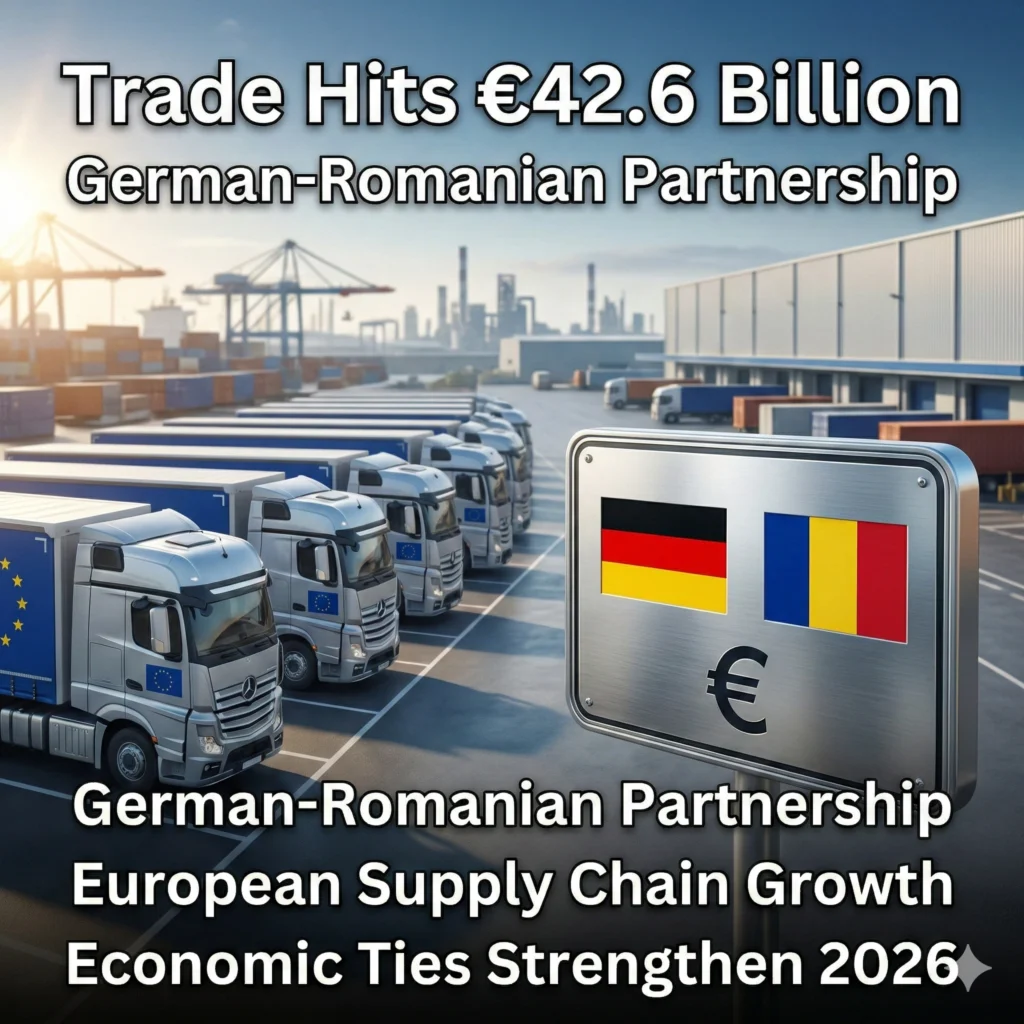
Germany-Romania Trade Growth
The internal dynamics of the Germany-Romania trade growth reveal a deepening integration of manufacturing and consumer markets. Data from Germany’s Federal Statistical Office shows that German imports from Romania grew by a remarkable 9.2%, totaling 19.8 billion euros. This surge indicates that Romanian-made components and finished goods are increasingly vital to German industrial output. Meanwhile, German exports to Romania grew by 2.8%, reaching 22.8 billion euros, as Romanian businesses continue to invest in German machinery and high-tech equipment.
The balance of trade reflects a healthy exchange where both nations benefit from specialized production. While Germany remains a major exporter of capital goods, Romania’s growing export volume highlights its evolution from a low-cost manufacturing hub to a sophisticated industrial partner. This Germany-Romania trade growth is particularly evident in the automotive and electronics sectors, where integrated supply chains require constant cross-border movement of parts and expertise to maintain peak efficiency in a competitive market.
- Imports from Romania to Germany increased by 9.2% to 19.8 billion euros.
- Exports from Germany to Romania rose by 2.8% to 22.8 billion euros.
- Bilateral services trade added a substantial 6.8 billion euros to the total.
- Total combined economic volume exceeds 49 billion euros when including services.
This sustained Germany-Romania trade growth acts as a stabilizer for the broader EU economy. By focusing on proximate supply chain partners, both nations reduce the logistical costs and carbon footprints associated with long-distance trade. Analysts point out that this “near-shoring” trend is a direct response to the unpredictability of global shipping and the desire for more resilient European production locations that can withstand geopolitical shifts without disrupting the flow of essential goods.
Services Sector Expansion
Beyond physical goods, the services sector has become a powerhouse within the framework of Germany-Romania trade growth. In 2025, trade in services contributed an additional 6.8 billion euros to the bilateral relationship. German services exports to Romania saw a double-digit jump of 10%, reaching 2.7 billion euros. This growth is largely driven by consulting, engineering, and digital services that support the modernization of Romanian infrastructure and the expansion of German-owned manufacturing plants within the country.
While German exports thrived, Romanian service imports to Germany reached 4.1 billion euros, showing a slight decrease of 1.9%. This marginal dip does not overshadow the fact that Romania remains a primary provider of IT and logistics services for the German market. The interplay between these service-based industries provides a stable foundation for the Germany-Romania trade growth, ensuring that the economic relationship is multifaceted and not solely dependent on the manufacturing of heavy industrial goods.
The integration of digital services is particularly important for future Germany-Romania trade growth. As German companies implement Industry 4.0 standards, they rely heavily on Romanian software developers and technical support teams. This collaborative environment fosters innovation and allows both nations to stay at the forefront of the digital transformation. The services sector’s resilience proves that the partnership is evolving to meet the demands of a high-tech, knowledge-based economy.
Resilience Amid Global Turbulence
The current surge in Germany-Romania trade growth is occurring against a backdrop of significant global economic turbulence. With traditional export markets in the United States and Asia experiencing various pressures, European leaders are prioritizing “strategic autonomy.” Romania’s role as a critical hub for German companies seeking reliable supply chain partners has never been more prominent. This strategy allows the European core to maintain its industrial strength even when external markets are under pressure.
Economic analysts suggest that the deep integration between Berlin and Bucharest serves as a hedge against global shocks. When global trade routes are disrupted, the land-based corridors connecting Germany and Romania remain open and efficient. This geographic proximity is a cornerstone of the Germany-Romania trade growth, providing a level of security that transcontinental trade simply cannot match. Consequently, more German firms are shifting their primary production focus to these resilient European locations.
- Mitigation of risks from external global economic shocks.
- Reduction of dependency on volatile transcontinental trade routes.
- Strengthening of intra-European trade as a primary economic strategy.
- Enhanced reliability of supply chain partners within the EU framework.
The focus on Romania is part of a broader trend where German industry seeks to “de-risk” its operations. By fostering Germany-Romania trade growth, Berlin ensures that its manufacturing base has access to a skilled workforce and stable energy costs within the European Union’s regulatory environment. This alignment of economic and political interests creates a powerful incentive for continued investment and cooperation between the two nations for years to come.
Strategic Importance of Supply Chains
In the modern economy, the efficiency of supply chains is the ultimate competitive advantage, and Germany-Romania trade growth is a testament to this reality. Romania has positioned itself as a vital link in the European automotive and machinery sectors. German companies are not just trading with Romania; they are building complex ecosystems where research, development, and production are shared across borders. This integration makes the supply chain more flexible and responsive to changes in consumer demand.
The strategic importance of these links is highlighted by the continued Germany-Romania trade growth in the face of rising energy costs elsewhere. Romania’s diverse energy mix and ongoing investments in renewable sources provide a stable environment for energy-intensive German industries. This synergy allows for a more sustainable production model, which is increasingly required by EU environmental regulations and corporate ESG goals. The partnership is thus evolving into a “green” industrial alliance.
- Romania serves as a critical hub for German automotive part manufacturing.
- Joint investments in renewable energy support sustainable trade growth.
- Technological exchange improves manufacturing precision and efficiency.
- Proximity reduces lead times and inventory costs for German distributors.
The AHK Romania has emphasized that these record-breaking figures are not an accident but the result of decades of institutional cooperation. The legal and economic frameworks provided by the EU facilitate the Germany-Romania trade growth by removing barriers and ensuring a level playing field. As more German SMEs (Small and Medium Enterprises) look to expand their footprint, Romania’s business-friendly environment and established German-speaking technical communities make it an ideal destination for long-term industrial projects.
Romania as Germany’s 17th Partner
Maintaining the rank of the 17th largest trading partner is a significant achievement for Romania, considering the size and maturity of the German economy. This stable position within the hierarchy of German trade reflects the consistency of the Germany-Romania trade growth over several years. While other partners may fluctuate based on commodity prices or geopolitical events, the relationship between Germany and Romania is built on a diversified portfolio of goods and services that provides long-term stability.
The growth trajectory suggests that Romania could potentially climb even higher in the rankings in the coming decade. As infrastructure projects in Romania—such as the expansion of highways and port facilities—come to fruition, the capacity for Germany-Romania trade growth will only increase. This infrastructure serves as the physical backbone for the movement of goods, ensuring that the 42.6 billion euro figure is just a starting point for even greater economic volumes in the future.
German officials believe that the strength of this partnership is a model for other EU member states. By focusing on mutual industrial benefits and shared regulatory standards, Germany and Romania have created a template for successful intra-European cooperation. The Germany-Romania trade growth proves that regional integration is the most effective way to maintain prosperity in an increasingly fragmented world. The focus on reliable, proximate partners is the new gold standard for economic planning.
Future Industrial Cooperation
The positive trade trajectory provides a stable foundation for further industrial cooperation and investment between Berlin and Bucharest. Experts predict that the next phase of Germany-Romania trade growth will be defined by joint ventures in high-tech sectors like aerospace and green hydrogen. These industries require the kind of deep integration and trust that has been built through decades of successful trade in more traditional sectors. The record 42.6 billion euros is a clear signal of confidence in the future.
Investment from Germany into Romania is expected to continue rising as companies seek to capitalize on the country’s growing middle class and technical expertise. This investment cycle fuels further Germany-Romania trade growth, as new factories require German capital goods to start operations and then export finished products back to the German market. It is a virtuous cycle of economic development that benefits both the German consumer and the Romanian worker, creating a shared stake in continued stability.
- Expansion into high-tech sectors including aerospace and green energy.
- Increased focus on R&D collaboration between German and Romanian firms.
- Development of “smart” logistics corridors to speed up trade.
- Strengthening of vocational training programs to support industrial needs.
The commitment to strengthening intra-European trade remains the primary strategy for mitigating risks from external global economic shocks. By doubling down on the Germany-Romania trade growth, both nations are sending a message that the European market is resilient and capable of self-sustained growth. As the fiscal year 2026 progresses, all eyes will be on whether this partnership can break even more records, further cementing the industrial bond between these two pivotal EU members.
Conclusion
The achievement of a record 42.6 billion euros in bilateral trade is a landmark moment for the economic relationship between Germany and Romania. This significant Germany-Romania trade growth demonstrates that even during periods of global economic turbulence, integrated and proximate partnerships can thrive. By focusing on both goods and services, and by prioritizing supply chain resilience, these two nations have built a model for European industrial success that is well-equipped for the challenges of the future.
As we look ahead, the deepening cooperation in technology and sustainable energy promises to keep the momentum of Germany-Romania trade growth alive. The strategic shift toward intra-European trade is not just a temporary reaction to market shifts but a long-term evolution of the European economy. With a foundation of trust, shared goals, and record-breaking performance, the partnership between Berlin and Bucharest remains a cornerstone of continental stability and prosperity.
For more details & sources visit: Business Review
For the latest news from Germany, visit our Germany news page.