
Gaza sports infrastructure shattered remains a heartbreaking reality as the Palestinian Olympic Committee reveals the staggering human and physical cost of the ongoing conflict. On February 17, 2026, Vice President Asaad Al-Majdalawi confirmed that over 1,000 Palestinian sports personnel have lost their lives since October 2023. This devastating milestone highlights a systematic erasure of the region’s athletic potential, leaving a void that may take generations to fill. Amidst reports of ceasefire violations, the international community is now facing a grim tally of destroyed dreams and leveled stadiums across the Gaza Strip.
The scale of the tragedy is unprecedented in modern sporting history, affecting every level of competition from local clubs to Olympic hopefuls. Al-Majdalawi reported that 1,007 athletes and sports workers, including 45 women, have been killed during the military campaign. This loss of life is compounded by the fact that Gaza sports infrastructure shattered under the weight of relentless bombardment, with 265 facilities either damaged or completely leveled. For the survivors, the path to recovery is obstructed by ongoing insecurity and the psychological trauma of losing teammates, coaches, and training grounds.
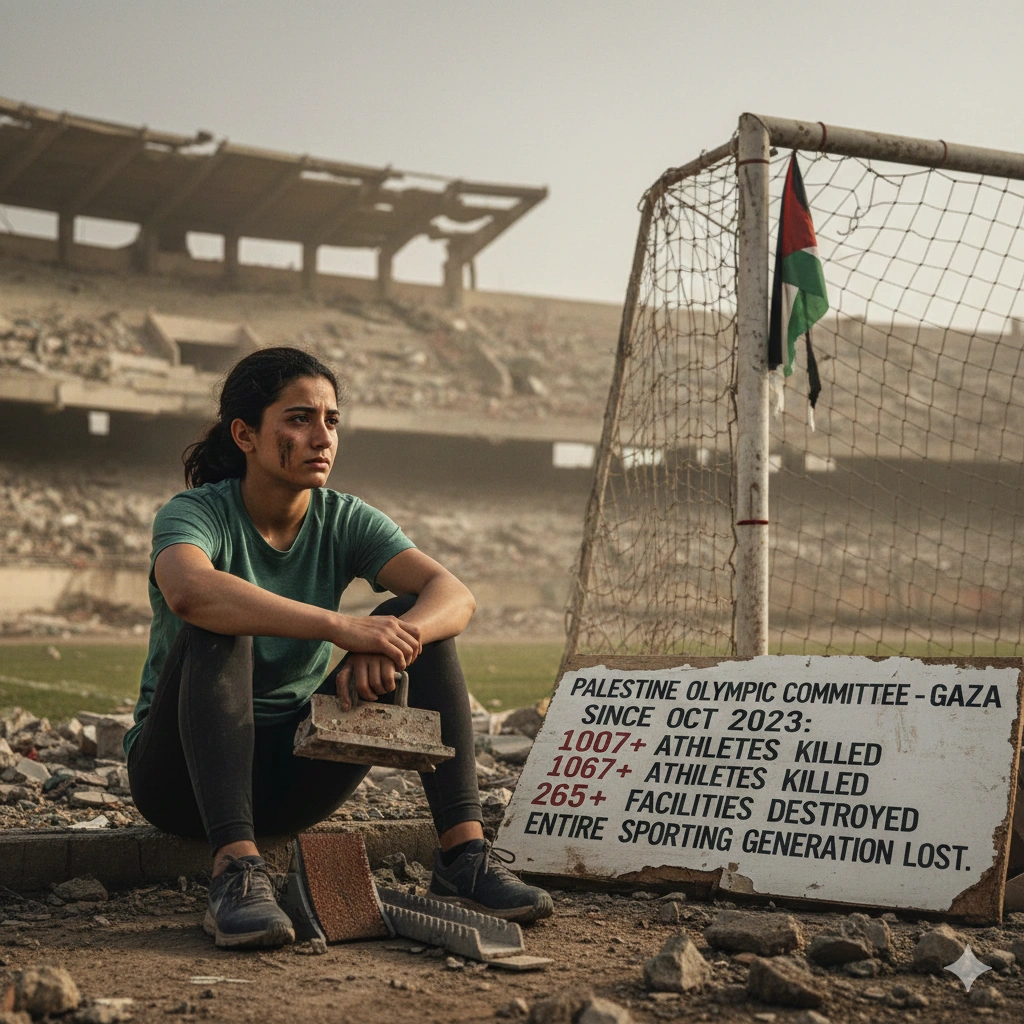
Gaza sports infrastructure shattered
Gaza sports infrastructure shattered is not merely a logistical hurdle but a total collapse of the foundation of Palestinian athletics. The committee’s data shows that 184 facilities have been completely destroyed, while another 81 have suffered partial damage, rendering them unusable for safe competition. These sites once served as community hubs where thousands of youths found refuge and purpose through football, basketball, and track events. Without these stadiums and halls, the “Men in Green” and other local teams have no place to nurture the next generation of talent.
The destruction of these venues represents a multi-million dollar loss that the local economy cannot currently sustain. Beyond the physical bricks and mortar, the collapse of these clubs has led to a widespread loss of income for coaches, administrative staff, and maintenance workers. As Gaza sports infrastructure shattered, the professional prospects for many young athletes evaporated overnight. This systematic damage ensures that even if a lasting peace is achieved, the physical means to produce world-class athletes will be missing for years to come.
The Human Cost of Conflict
The human toll of the war has been catastrophic, with over 72,000 people killed in total according to Gaza health authorities. Among these are the 1,007 sports professionals whose contributions to Palestinian culture were immense and varied. These individuals were not just players; they were mentors who provided structure and hope in an environment often defined by hardship. The loss of 45 female athletes is particularly poignant, as women’s sports had been seeing a record growth in participation and international representation before the conflict escalated.
While a US-backed ceasefire was implemented on October 10, the violence has not fully subsided, leading to more casualties among the sporting community. Reports indicate that over 600 Palestinians have been killed by gunfire and shelling since the ceasefire began, maintaining a climate of fear. This constant threat makes it impossible for surviving athletes to return to any form of regular training. The Gaza sports infrastructure shattered under such conditions means that even basic physical activity carries a significant risk to life and limb.
Psychological Trauma and Lost Generations
The impact of the war goes far beyond the visible ruins of stadiums and the counting of casualties. Surviving athletes are grappling with deep psychological trauma that hinders their ability to focus on competition or personal development. Many have witnessed the death of family members or the total destruction of their homes, leaving sports as a distant priority. Experts warn that we are witnessing the death of an entire sporting generation, as the transition from youth to professional levels has been completely severed.
- Development programs for children aged 6 to 12 have been non-existent for over two years.
- Elite training cycles for regional competitions have been permanently disrupted.
- Scholarships and international scouting opportunities have been lost due to travel restrictions.
- The lack of competitive play has led to a sharp decline in physical conditioning among surviving players.
These factors combined ensure that the Gaza sports infrastructure shattered will have a long-term ripple effect. It is not just about rebuilding walls; it is about rebuilding the shattered spirits of young people who once saw sports as a ticket to a better life. The collapse of these social structures removes a vital outlet for stress and community building in a region that desperately needs both.
Ceasefire Violations and Ongoing Risks
Despite the formal pause in major military operations, the reality on the ground remains volatile for the sporting sector. The 265 damaged facilities are often located in areas that remain high-risk zones due to unexploded ordnance or proximity to active military corridors. Gaza sports infrastructure shattered remains in a state of ruin because reconstruction efforts are frequently halted by renewed skirmishes. This instability prevents international aid organizations from delivering the necessary materials to begin the long process of clearing debris and laying new foundations.
The Palestinian Olympic Committee has voiced strong concerns that the daily insecurity is undermining any hope of recovery. When stadiums are used as temporary shelters for displaced families, they cease to function as athletic venues, further complicating the restoration of sports life. The Gaza sports infrastructure shattered narrative is thus one of double tragedy: the loss of the original buildings and the inability to build anything new in their place. This cycle of destruction and stalled progress keeps the Palestinian sports world in a state of perpetual mourning.
Economic Impact on the Sports Sector
The financial devastation following the conflict is staggering, with the sports sector being one of the hardest hit. Professional clubs that once generated revenue through ticket sales and local sponsorships have seen their assets liquified or destroyed. Gaza sports infrastructure shattered meant the end of livelihoods for thousands of people who depended on the sports economy. Coaches who spent decades building their reputations now find themselves without a field to stand on or a team to lead.
- Loss of equipment including jerseys, balls, and medical supplies worth millions.
- Total cessation of league play leading to zero revenue for major football clubs.
- Defaulting on contracts with players who can no longer be paid.
- The destruction of administrative offices containing vital historical records and registrations.
Rebuilding from this point will require a massive influx of international capital and a stable environment that currently does not exist. The Gaza sports infrastructure shattered remains a symbol of an economy that has been forced into a total standstill. For the workers in this sector, the future is a crisis of uncertainty where their specialized skills have no outlet for application.
The Role of International Sporting Bodies
There is growing pressure on international organizations like FIFA and the International Olympic Committee to address the crisis in Gaza. The Palestinian Olympic Committee has called for a stronger stance against the violations that led to the Gaza sports infrastructure shattered. Many believe that the global sporting community has a moral obligation to protect athletes and the facilities they use, regardless of the political climate. The death of over 1,000 sports people is a shock to the system of global fair play and human rights.
While some aid has been promised, the logistical challenges of getting supplies into the Strip remain a significant barrier. The Gaza sports infrastructure shattered requires more than just money; it requires a political guarantee that new facilities will not meet the same fate as the old ones. Until such guarantees are in place, any rebuilding effort is seen as a high-risk gamble. The Palestinian representatives continue to push for an international investigation into the targeting of sports facilities during the conflict.
A Generation Without a Playground
For the children of Gaza, the loss of sports facilities is a loss of childhood itself. In a densely populated area, these clubs and stadiums were the few places where they could play freely and safely. Now that the Gaza sports infrastructure shattered, these children are left with rubble as their only playground. This lack of physical activity has long-term health implications, including increased rates of obesity and chronic stress-related illnesses.
The absence of structured sports also leaves a vacuum that can be filled by less constructive activities. Sports have historically been a tool for peace and social cohesion in the region, providing a neutral ground for interaction. With the Gaza sports infrastructure shattered, this tool has been taken away from the hands of community leaders. The social fabric of the neighborhood is weakened when the local club—the heart of the community—no longer exists to bring people together.
Future Outlook for Palestinian Athletics
Looking toward the end of 2026, the outlook for Palestinian athletics remains grim but resilient. Despite the Gaza sports infrastructure shattered, some athletes continue to train in makeshift spaces or even in the ruins of their former clubs. This defiance is a testament to the spirit of the Palestinian people, but it is not a sustainable way to produce elite competitors. The Olympic Committee is working on plans to relocate some athletes abroad for training, but this is only a temporary solution for a lucky few.
The ultimate goal is the complete reconstruction of the 265 facilities and the establishment of a safe zone for sports. However, with ceasefire violations still occurring, this remains a distant dream. The Gaza sports infrastructure shattered will serve as a permanent reminder of the high cost of war and the fragility of the structures we take for granted. The path to the next Olympic Games will be paved with the memories of those 1,007 individuals who should have been there to represent their nation.
Documentation and Accountability
The Palestinian Olympic Committee is meticulously documenting every instance of damage to ensure that a record exists for future generations. By detailing how the Gaza sports infrastructure shattered, they aim to hold those responsible accountable under international law. This documentation includes satellite imagery, witness testimonies, and architectural assessments of the 184 totally destroyed sites. Such efforts are crucial for any future claims for reparations or reconstruction grants from the international community.
- Digital archives of all lost facilities are being created to preserve their history.
- Biographies of the 1,007 killed athletes are being compiled for a national memorial.
- Legal teams are reviewing the classification of sports facilities under protected status.
This work ensures that the story of how the Gaza sports infrastructure shattered is never forgotten. It provides a voice for the dead and a roadmap for the living to eventually reclaim their place on the world stage. While the buildings may be gone, the data and the memories remain as the foundation for a future rebirth of Palestinian sports.
Challenges in Rebuilding Efforts
Even if the war concludes tomorrow, the challenges in rebuilding are immense due to the blockade and the lack of raw materials. The Gaza sports infrastructure shattered during a time when the import of cement, steel, and high-tech turf is strictly controlled. International donors are often hesitant to fund projects that could be destroyed in a future round of escalation. This creates a “deficit of hope” where the ruins remain untouched for years, serving as a constant visual reminder of the tragedy.
Furthermore, the loss of 1,007 professionals means there is a shortage of qualified personnel to manage the rebuilding of the sports culture. Training new coaches and administrators takes time and resources that are currently being diverted to basic survival. The Gaza sports infrastructure shattered is thus a multi-layered problem involving physics, finance, and human capital. Overcoming these hurdles will require a global effort that transcends simple humanitarian aid and enters the realm of long-term developmental partnership.
Summary of the Crisis in Gaza
The events of the last two years have fundamentally altered the landscape of Palestinian athletics. The Gaza sports infrastructure shattered is a phrase that encompasses the loss of life, the leveling of buildings, and the crushing of spirits. From the 1,007 lives lost to the 265 facilities hit, the numbers paint a picture of a sector in total crisis. As the ceasefire remains fragile and violations continue to claim lives, the priority remains the safety of the survivors and the preservation of what little remains of the sporting tradition.
The world must recognize that the destruction of sports facilities is an attack on the future of a society. When the Gaza sports infrastructure shattered, a vital avenue for peace and personal growth was closed off. The recovery will be long, painful, and expensive, but the resilience of the Palestinian athletes suggests that they will eventually return to the field. Until then, the ruins of the stadiums stand as silent witnesses to a generation that was forced to trade their jerseys for mourning clothes.
For more details & sources visit: Anadolu Agency
For the latest updates from Palestine, visit our Palestine news page.