
The Gaza border blockade crisis reached a critical breaking point on Monday as Israeli authorities closed all major crossing points following massive joint military strikes in Iran. This sudden tightening of movement, which includes the strategic Rafah route and the Kerem Abu Salem crossing, has effectively paralyzed the flow of essential humanitarian aid into the territory. As regional tensions escalate due to the reported deaths of over one thousand people in recent Iranian engagements, the civilian population in Gaza faces an immediate survival challenge. Humanitarian organizations, including World Central Kitchen, have been forced to pause their vital meal distributions as local food security collapses and market prices skyrocket beyond the reach of displaced families.
The closure of these vital corridors marks a significant shift in the regional security landscape after the intensified military activity across multiple Middle Eastern fronts. Consequently, the Gaza border blockade crisis has led to overcrowded shops where basic goods are now sold at triple their original value, creating a sense of panic among residents. While a fragile ceasefire has been technically in place since last October, Israeli operations within the Gaza Strip have continued with strikes targeting neighborhoods like Tuffah and Shujayea. International observers are now monitoring how this expanding conflict in Iran will impact the long-term stability of the Mediterranean enclave as the humanitarian situation deteriorates.
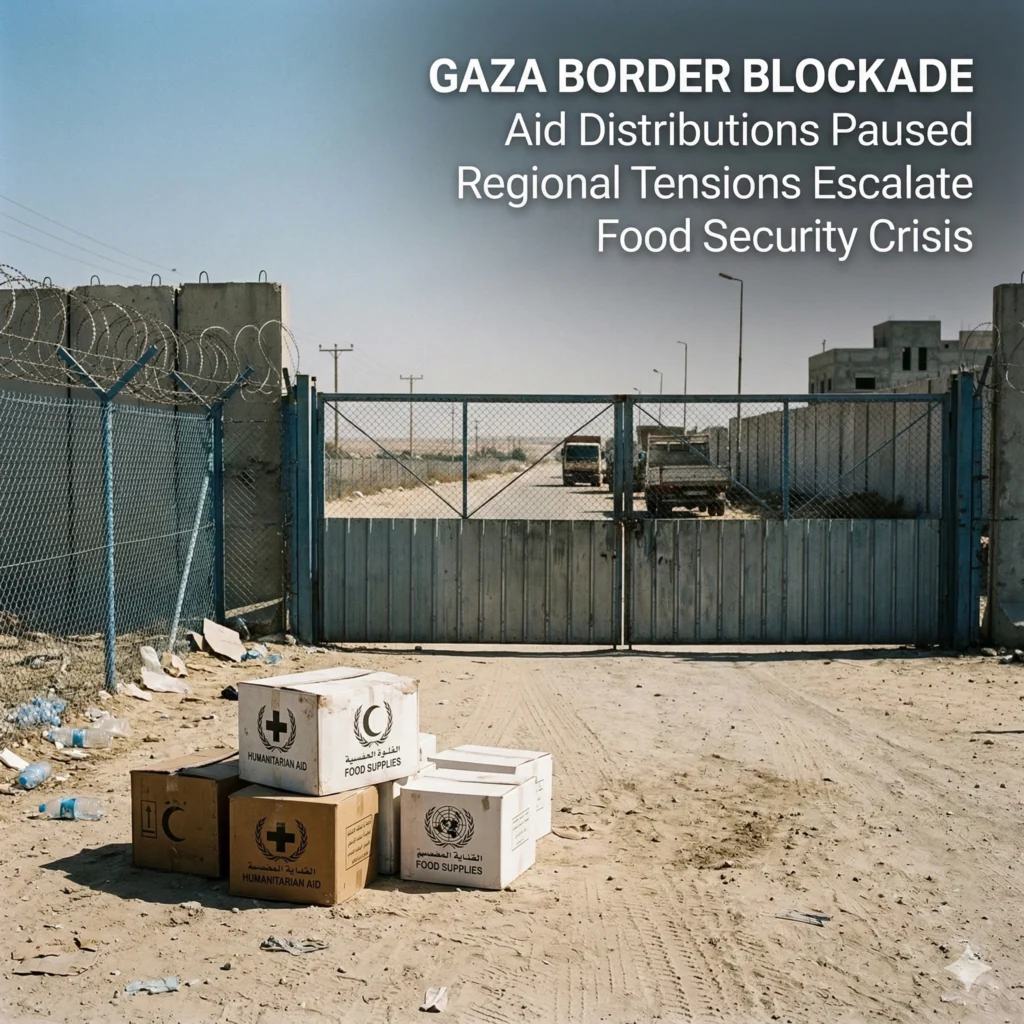
Gaza Border Blockade Crisis
The Gaza border blockade crisis is currently being driven by a high-stakes military strategy aimed at securing the frontier during a period of unprecedented regional volatility. Following the strikes in Iran, the Israeli defense establishment has prioritized strict border controls to prevent any potential spillover of violence into domestic territories. The Rafah crossing, which serves as a primary link to Egypt, remained completely shut while other crossings saw only highly supervised and partial reopenings on March 3. This restriction has created a logistical nightmare for aid agencies that rely on daily deliveries of oil, flour, and medical supplies to sustain hundreds of thousands of displaced civilians.
Local residents expressed deep concerns regarding a return to famine conditions as aid campaigns face indefinite postponements and severe logistical delays. Many families are reportedly stockpiling whatever essentials they can find in anticipation of prolonged closures and further market instability. The Gaza border blockade crisis is not just a military maneuver; it is a socio-economic shock that has left the most vulnerable populations without a safety net. Students in the region have also voiced their fears that the expanding conflict will permanently disrupt their education and lead to a never-ending cycle of displacement and poverty.
Humanitarian Collapse in Gaza City
The suspension of World Central Kitchen’s food programs serves as a grim indicator of the severity of the current Gaza border blockade crisis. Without the ability to receive daily shipments, the organization cannot maintain the kitchens that provide hundreds of thousands of hot meals to those living in makeshift shelters. This vacuum in food provision has immediately impacted the nutritional intake of children and the elderly, who are already weakened by months of restricted access to clean water. In neighborhoods like Shujayea, the lack of incoming aid is compounded by the ongoing threat of aerial strikes, making it nearly impossible for civilians to forage for alternatives.
Furthermore, the psychological toll of the blockade is becoming increasingly evident as the “Iran factor” adds a layer of global uncertainty to an already dire local situation. The reported casualty figures from March 9 indicate that at least seven Palestinians were killed and seventeen others wounded within a single twenty-four-hour period. These incidents occur while the borders remain sealed, preventing the injured from seeking advanced medical treatment in neighboring countries. The Gaza border blockade crisis has effectively created a pressure cooker environment where the lack of resources and the threat of violence coexist in a dangerous synergy.
Economic Shockwaves and Market Prices
The immediate economic impact of the border closures has been a sharp spike in the price of staple goods such as bread, oil, and sugar. With no new inventory arriving, local merchants have been forced to ration their existing stock, leading to long queues outside the few remaining functional shops. The Gaza border blockade crisis has essentially wiped out the purchasing power of the average citizen, who was already struggling with high unemployment rates. International humanitarian workers report that the shutdown has led to a speculative market where the price of essential items fluctuates wildly based on the latest news from the Iranian front.
- The price of a liter of cooking oil has increased by 150% in just forty-eight hours following the Rafah closure.
- Flour supplies in the southern refugee camps are estimated to last for only another six days at current consumption rates.
- Local bakeries are struggling to maintain production due to fuel shortages caused by the suspension of Kerem Abu Salem operations.
- Informal trade networks have emerged, but they often charge exorbitant fees that are unaffordable for the vast majority of the population.
This economic strangulation is a direct byproduct of the Gaza border blockade crisis, which uses resource control as a primary lever of security management. For many families, the choice is now between spending their entire life savings on a week’s worth of food or waiting for aid that may never arrive. The instability is also affecting the local currency’s value in the informal market, making it even harder for residents to plan for their long-term survival. As the blockade continues, the risk of a complete market collapse grows higher with each passing day.
Impact of Joint Military Strikes in Iran
The escalation of the conflict in Iran has fundamentally changed the calculus for border management in the Gaza Strip. The joint military strikes, which targeted key infrastructure and led to high casualty rates, have put the entire region on a high-alert status. This atmosphere of “total war” is what triggered the Gaza border blockade crisis, as Israeli authorities fear that proxy groups might use the chaos to smuggle weapons or personnel across the borders. The military posture in the Levant has shifted from local containment to regional deterrence, with the Gaza population caught in the middle of these larger geopolitical movements.
Military analysts suggest that the strikes in Iran have created a vacuum of power that various factions are now attempting to fill. This makes the Gaza border blockade crisis a tool for preventing any opportunistic attacks that could destabilize the current ceasefire agreement. However, the cost of this security measure is being paid by the civilians who have no involvement in the regional power struggle. The interconnectedness of the Gaza front and the Iranian theater means that as long as there is no resolution in the Persian Gulf, the borders of Gaza are likely to remain under intense pressure.
Displacement and Refugee Camp Tensions
In the southern region of the Gaza Strip, refugee camps are becoming increasingly overcrowded as people flee from northern areas targeted by recent strikes. The Gaza border blockade crisis makes the management of these camps nearly impossible, as the infrastructure was never designed to hold such a massive influx of people without external support. Tensions within the camps are rising as resources become scarce and the hope for a swift reopening of the borders fades. Displaced families are living in cramped conditions where disease can spread quickly, especially without adequate sanitation supplies.
- Sanitation services in the Khan Younis area have been reduced by 40% due to lack of spare parts and cleaning agents.
- Water desalination plants are operating at half capacity to conserve the remaining fuel stocks.
- Emergency medical clinics are reporting a surge in cases related to malnutrition and water-borne illnesses.
- Schools that have been converted into shelters are now housing three times their intended capacity.
The Gaza border blockade crisis has effectively turned these camps into permanent holding areas with no clear exit strategy. The lack of a humanitarian corridor means that even those with international travel permits are stuck, further increasing the sense of desperation. The social fabric of these communities is being tested as the competition for basic needs intensifies. Without a diplomatic breakthrough that addresses both the Iranian conflict and the Gaza situation, the humanitarian catastrophe in the south will continue to worsen.
Educational Disruption and Student Fears
The youth of Gaza are perhaps the most affected by the long-term implications of the Gaza border blockade crisis. Schools, which were already struggling to function, have now become primary shelters for those displaced by the recent strikes in Gaza City. This has led to a total cessation of formal education for thousands of students who fear that their future is being stolen by a conflict they cannot control. The psychological impact of being trapped behind a blockade while hearing reports of a regional war in Iran is profound, leading to a generation that feels abandoned by the international community.
University students who were hoping to travel abroad for their studies are now facing the reality that their visas may expire before the Rafah crossing reopens. This loss of opportunity is a significant blow to the intellectual capital of the region, which is essential for any future reconstruction efforts. The Gaza border blockade crisis is creating a “lost generation” whose only experience is one of conflict, deprivation, and restricted movement. Educational leaders in Gaza have called for a “safe zone” for schools, but such requests have been overshadowed by the broader military objectives currently being pursued by regional powers.
The Role of International Observers
International observers and UN agencies have been vocal in their condemnation of the total closure of the borders during the Gaza border blockade crisis. They argue that while security concerns are legitimate, the collective punishment of a civilian population is a violation of international humanitarian law. These organizations are working behind the scenes to negotiate a “humanitarian pause” that would allow for the delivery of life-saving supplies without compromising the security of the border. However, these negotiations are often hampered by the shifting dynamics of the war in Iran and the multiple fronts that the Israeli military is currently managing.
The focus of the international community remains on finding a way to decouple the Gaza border blockade crisis from the larger regional conflict. If the borders remain closed until the Iranian situation is fully resolved, the human cost in Gaza will be catastrophic. Diplomats are pushing for a monitoring system at the Kerem Abu Salem crossing that would allow for the inspection of goods while ensuring a steady flow of aid. This proposal is currently being debated, but the implementation remains stalled due to the high level of distrust between the parties involved.
Fragile Ceasefire and Ongoing Operations
Despite the “ceasefire” that has been in place since October, the reality on the ground in Gaza is one of constant military friction. The Gaza border blockade crisis is exacerbated by the fact that localized operations have never truly stopped, particularly in neighborhoods like Tuffah. This environment makes it difficult for aid agencies to plan their movements even if the borders were to reopen for a few hours. The lack of a clear distinction between a state of war and a state of ceasefire has created a “gray zone” that hostile actors often exploit to their advantage.
Israeli officials maintain that their operations are targeted and necessary to dismantle militant infrastructure that threatens their citizens. However, from the perspective of the residents in Gaza City, the combination of the blockade and the strikes feels like a total siege. The Gaza border blockade crisis is the most visible manifestation of this strategy, intended to isolate the territory from its regional allies. As the war in Iran continues to draw the world’s attention, the internal dynamics of Gaza are being shaped by a military logic that prioritizes security over humanitarian outcomes.
World Central Kitchen’s Impossible Mission
The decision by World Central Kitchen to suspend operations was not taken lightly and followed several close calls where their convoys were nearly caught in crossfire. The Gaza border blockade crisis made the risk-to-reward ratio for their staff unmanageable, as the lack of predictable border openings prevented them from securing their supply chains. Their departure from the field has left a massive hole in the daily caloric intake of tens of thousands of people who relied on their kitchens for their only meal of the day. The organization has stated that they are ready to return as soon as a “guaranteed safe passage” is established.
The suspension of such a high-profile NGO also sends a signal to other organizations that the current environment is too dangerous for large-scale operations. This cascading effect of withdrawals is exactly what local residents fear most, as it leaves them entirely dependent on a local market that is failing. The Gaza border blockade crisis has effectively neutralized the most efficient aid delivery mechanisms in the region, replacing them with a fragmented and insufficient black market. Until the international community can guarantee the safety and supply lines of groups like WCK, the food security of Gaza will remain in a state of freefall.
Strategic Implications of the Iranian Theater
The Iranian theater has become the “center of gravity” for Middle Eastern politics, and the Gaza border blockade crisis is a direct consequence of this shift. By striking targets in Iran, the coalition forces have signaled that they are willing to engage the source of regional instability directly. This has forced groups within Gaza to rethink their own strategies, leading to a period of tactical silence that is often more dangerous than open conflict. The blockade is designed to maintain this silence by cutting off the material support that these groups might receive from their foreign patrons.
However, the unintended consequence of this strategy is the rapid deterioration of the civilian infrastructure that will be needed for any long-term peace. The Gaza border blockade crisis is destroying the small and medium-sized businesses that form the backbone of the local economy. When the conflict eventually ends, the cost of rebuilding will be significantly higher because of the systemic damage currently being done. The strategic focus on Iran is necessary from a military perspective, but it must be balanced with a humanitarian strategy that prevents a total collapse in Gaza.
Future Outlook and Reconstruction Challenges
Looking ahead, the resolution of the Gaza border blockade crisis will depend entirely on the trajectory of the broader Middle East war. If the conflict in Iran de-escalates, there may be a window of opportunity to reopen the Rafah and Kerem Abu Salem crossings for humanitarian traffic. However, if the war expands, the blockade is likely to be tightened even further, potentially leading to a permanent state of isolation for the Gaza Strip. The reconstruction challenges that will follow this period are immense, as the blockade has prevented the entry of basic building materials for months.
- Any future reconstruction plan will require a stable border regime that allows for the mass entry of cement, steel, and heavy machinery.
- The local workforce will need to be retrained and reintegrated into a functional economy after years of stagnation and blockade.
- International donors will need to be convinced that their investments will not be destroyed in the next round of regional escalation.
- The environmental damage caused by the lack of waste management and sanitation during the blockade must be addressed to prevent a public health crisis.
The Gaza border blockade crisis is a dark chapter in the history of the region, highlighting the vulnerability of civilians in the face of modern geopolitical warfare. As the world watches the high-altitude strikes in Iran, it is essential not to lose sight of the people on the ground in Gaza who are fighting for their daily survival. The Paphos summit and other diplomatic gatherings must include the blockade on their agendas to ensure that a humanitarian path forward is found. The path to stability in the Mediterranean begins with a humane solution to the crisis currently unfolding at the border crossings.
For more details & sources visit: Prism Reports
For the latest updates from Palestine, visit our Palestine news page.