
Friedrich Merz EU deregulation agenda has taken center stage in Brussels as the German chancellor called for sweeping reforms to reverse what he described as 25 years of European industrial decline. Speaking at a high-level competitiveness summit in Antwerp, Merz urged European Union leaders to act “swiftly and decisively” to strengthen the bloc’s economic foundations and global standing.
His remarks come at a pivotal moment for the EU, as leaders prepare for a strategic retreat in Belgium aimed at redefining Europe’s economic direction amid rising competition from the United States and China.
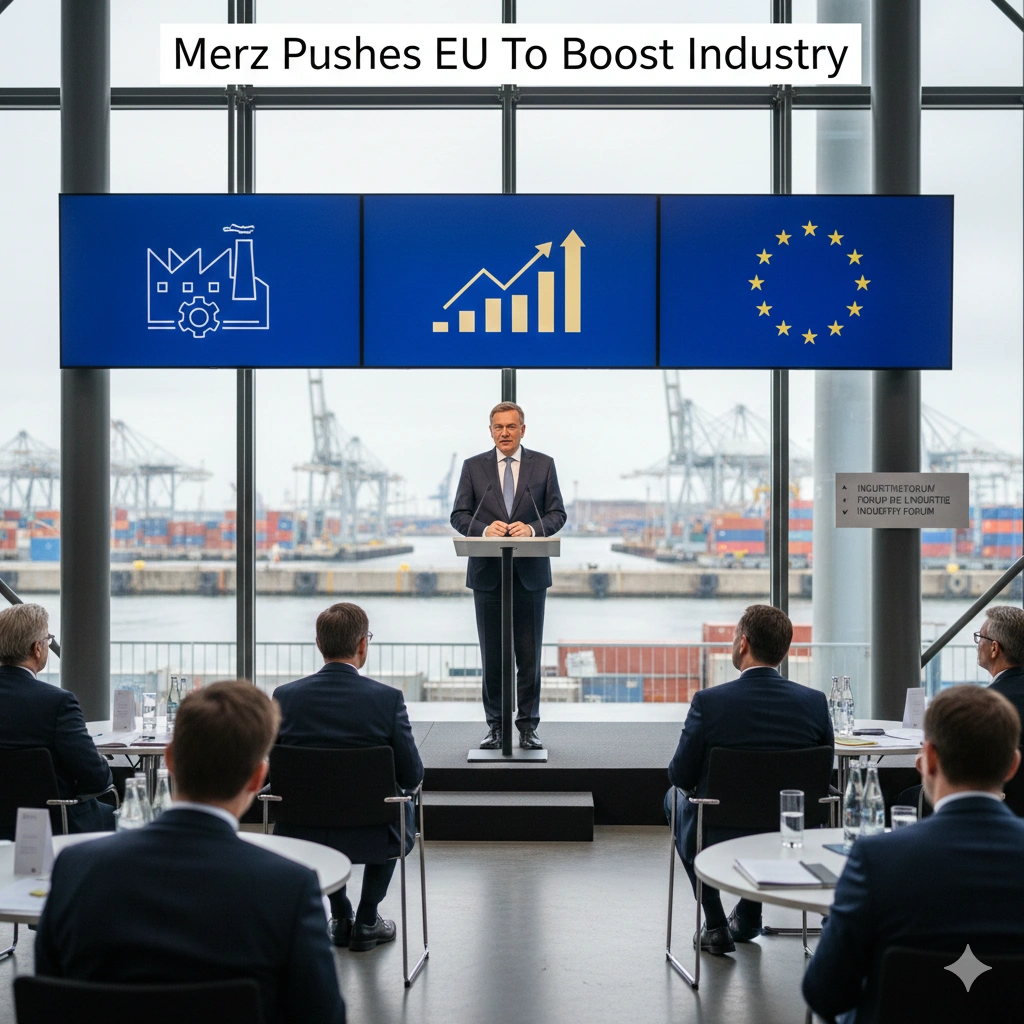
Friedrich Merz EU Deregulation Push Targets Industrial Revival
At the summit in Antwerp’s port district, Chancellor Friedrich Merz delivered a clear message: Europe must embrace comprehensive deregulation across all sectors if it hopes to regain competitiveness.
Merz argued that economic power is inseparable from political sovereignty, stating that “only an economically powerful Europe will be a sovereign Europe.” He stressed that complex regulatory frameworks and slow-moving reforms have undermined productivity and discouraged industrial investment over the past two decades.
The Friedrich Merz EU deregulation proposal focuses on revitalizing the single market, reducing bureaucratic burdens, and accelerating innovation. According to Merz, without structural reform, Europe risks falling further behind global rivals.
Rethinking the EU Carbon Market
A significant component of the Friedrich Merz EU deregulation strategy involves reconsidering the EU’s carbon pricing mechanism, formally known as the Emissions Trading System (ETS). Merz signaled openness to revising or even postponing aspects of the carbon market if it fails to support industrial transition.
The ETS was designed to reduce CO2 emissions while encouraging companies to shift toward climate-neutral production. However, Merz cautioned that excessively high carbon prices or regulatory rigidity could unintentionally weaken European heavy industry.
He emphasized that climate ambition must remain intact but warned that policy instruments should not “hinder companies’ shift to CO2-free production.” If the system proves counterproductive, he said, the EU must remain “very open” to recalibration.
Balancing Green Goals and Competitiveness
Merz’s comments reflect broader debates within the EU about how to balance environmental commitments with economic resilience. Leaders such as Emmanuel Macron and Ursula von der Leyen have stressed that green transformation and strategic autonomy must go hand in hand.
The challenge lies in maintaining Europe’s climate leadership while preventing industrial relocation to regions with lower regulatory costs. Many heavy industry representatives argue that high carbon prices and complex compliance requirements are eroding the bloc’s global competitiveness.
The Friedrich Merz EU deregulation proposal aims to address these concerns without abandoning long-term climate objectives.
EU Leaders Convene for Strategic Reform Talks
Merz’s intervention precedes a two-day gathering of all 27 EU leaders at Alden Biesen castle in eastern Belgium. The retreat will evaluate reform proposals put forward by leading European policymakers, including former Italian prime ministers Mario Draghi and Enrico Letta.
Their expert recommendations focus on strengthening the single market, deepening capital markets integration, and boosting innovation capacity across member states.
The Friedrich Merz EU deregulation push aligns with calls for enhanced economic coordination but introduces sharper urgency regarding regulatory overhaul. By framing competitiveness as a matter of sovereignty, Merz has elevated the debate beyond technical policy adjustments to a broader strategic imperative.
Industrial Decline and Global Competition
Europe’s industrial slowdown has become increasingly visible amid shifting global supply chains and aggressive industrial policies from Washington and Beijing. Subsidies under U.S. legislation and China’s state-backed manufacturing expansion have intensified pressure on European producers.
Merz’s argument is that without decisive deregulation, Europe risks becoming overly dependent on foreign technologies and imports. A streamlined regulatory framework, he contends, would empower European firms to innovate, invest, and compete globally.
The Friedrich Merz EU deregulation proposal thus represents both an economic and geopolitical strategy. By strengthening industry at home, Europe can enhance resilience and maintain influence in a rapidly evolving global order.
Political and Economic Implications
While Merz’s proposals have resonated with segments of the industrial sector, they may face resistance from environmental advocates and some EU member states wary of weakening climate commitments.
The coming months will determine whether the bloc opts for targeted adjustments or embarks on a broader regulatory transformation. Any revision to the carbon market would require careful negotiation among member states and EU institutions.
What remains clear is that the Friedrich Merz EU deregulation agenda has injected new momentum into discussions about Europe’s economic future. As global competition intensifies, EU leaders must reconcile growth ambitions with sustainability goals.
The outcome of these debates will shape the trajectory of European industry and the bloc’s role in the global economy for years to come.
For more details & sources visit: DW (Deutsche Welle)
For the latest news from Germany, visit our Germany news page.