
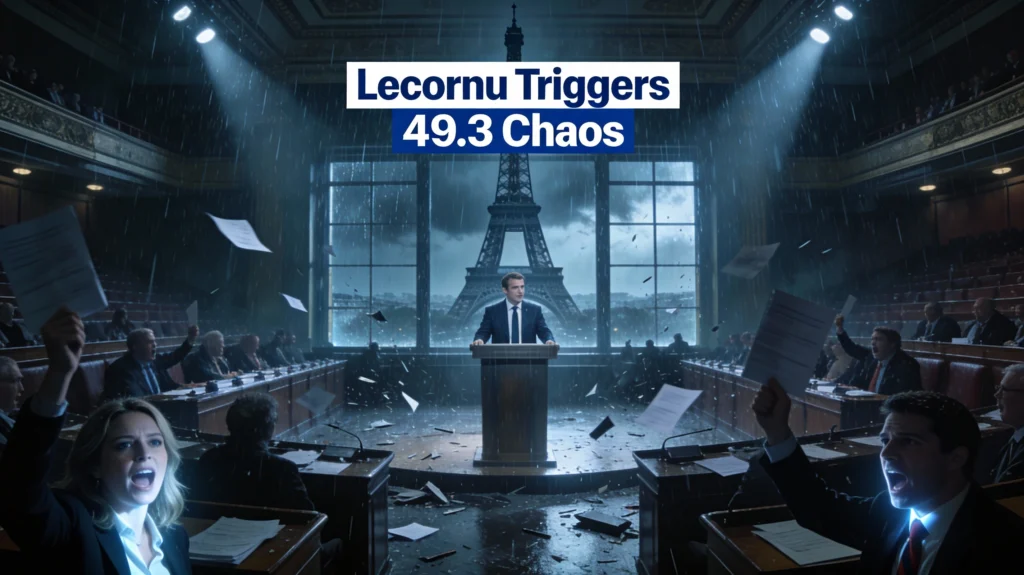
The French PM Lecornu budget power play has pushed France into one of its most politically volatile moments in recent years. On January 19, 2026, Prime Minister Sébastien Lecornu confirmed plans to invoke Article 49.3 of the French Constitution to force through the government’s 2026 tax revenue budget, bypassing a deeply divided National Assembly.
This dramatic move marks a sharp reversal of Lecornu’s earlier promise not to use the controversial constitutional tool and places his minority government directly in the line of multiple no-confidence motions from both the far left and far right.
Why the French PM Lecornu Budget Power Play Matters
Article 49.3 allows the French government to pass legislation without a parliamentary vote unless a motion of no confidence succeeds. While legal, it is politically explosive—especially in a hung parliament where alliances are fragile and public frustration over austerity is growing.
Lecornu acknowledged his “bitter regret” over breaking his pledge, arguing that prolonged parliamentary deadlock had turned budget debates into a political “spectacle” rather than a solution to France’s worsening fiscal crisis.
A Paralyzed Parliament and a Budget Deadlock
France’s National Assembly has been effectively frozen for months, unable to agree on a long-term financial roadmap. Since 2025, the government has relied on emergency budget rollovers, a temporary fix that fails to address structural deficits.
The French PM Lecornu budget power play focuses specifically on tax revenues, rather than spending, as a first step to stabilize state finances. However, critics argue this sequencing exposes the government to maximum political risk with minimal immediate relief for citizens facing inflation and rising living costs.
No-Confidence Threats From Both Political Extremes
The announcement immediately triggered backlash across the political spectrum:
- France Unbowed (LFI) leader Mathilde Panot began drafting a no-confidence motion, accusing Lecornu of undermining democratic norms.
- National Rally president Jordan Bardella demanded the dissolution of parliament, framing the move as proof of executive overreach.
- Marine Le Pen, though sidelined due to an ongoing appeal over an embezzlement conviction, continues to influence strategy from the background.
These reactions highlight how the French PM Lecornu budget power play could bring down the government—just as previous minority cabinets have fallen under similar pressure.
Socialists Hold the Balance of Power
The key to Lecornu’s survival may lie with the Socialist Party, which has not committed to backing a no-confidence motion. Parliamentary leader Boris Vallaud signaled possible abstention in exchange for targeted concessions, including:
- Subsidized student meals
- Expanded housing funds
- Social protections for low-income households
This tactical positioning underscores how fiscal policy, social welfare, and political survival are now tightly intertwined.
Deficit Reduction and Economic Stakes
At the heart of the crisis is France’s ballooning deficit. The government aims to reduce it to 5% of GDP, a target closely watched by EU institutions and financial markets.
If Lecornu survives the no-confidence vote, the budget will move next to the French Senate for review—a body traditionally more favorable to fiscal restraint. Success there could restore a degree of economic credibility, at least in the short term.
What Happens Next?
The coming days will determine whether the French PM Lecornu budget power play becomes a turning point or a political obituary reminder. A successful no-confidence vote would topple the government and potentially trigger snap elections, deepening uncertainty.
For broader European political context, readers can explore related coverage on EU fiscal governance and constitutional crisis mechanisms on trusted platforms such as Politico Europe and institutional explainers from the European Commission.
Conclusion: High-Risk Governance in a Divided France
The French PM Lecornu budget power play reflects the growing tension between governance efficiency and democratic legitimacy in modern France. While Article 49.3 offers a legal escape from paralysis, its repeated use risks eroding public trust and empowering extremist narratives.
Whether Lecornu’s gamble stabilizes France’s finances—or accelerates political collapse—will shape the country’s economic and democratic trajectory well beyond 2026.
For more details & sources visit: Politico
For the latest updates from France, visit our France news page.