
The Qatar AA Rating remains a pillar of stability in the Middle East as Fitch Ratings officially affirmed the nation’s credit status despite the ongoing regional war. Even with the total closure of the Strait of Hormuz halting the majority of energy exports, the sovereign’s massive external assets have provided a critical buffer. Fitch analysts noted that Qatar’s flexible public finances and high income levels allow it to absorb the shock of a temporary trade cessation. This stable outlook reflects a deep-seated confidence in the state’s ability to manage its debt obligations while navigating a volatile military environment that has disrupted global energy supplies.
While the conflict has physically halted shipments, the long-term economic narrative for the nation remains tied to its immense liquefied natural gas (LNG) reserves. Fitch’s affirmation highlights that the current disruption is viewed as a temporary liquidity hurdle rather than a structural solvency issue. The government’s ability to draw from its sovereign wealth fund ensures that the domestic banking sector remains liquid even as revenue from the North Field expansion project faces potential delays. This resilience is a key factor in why the Qatar AA Rating was maintained during one of the most significant regional escalations in recent history.
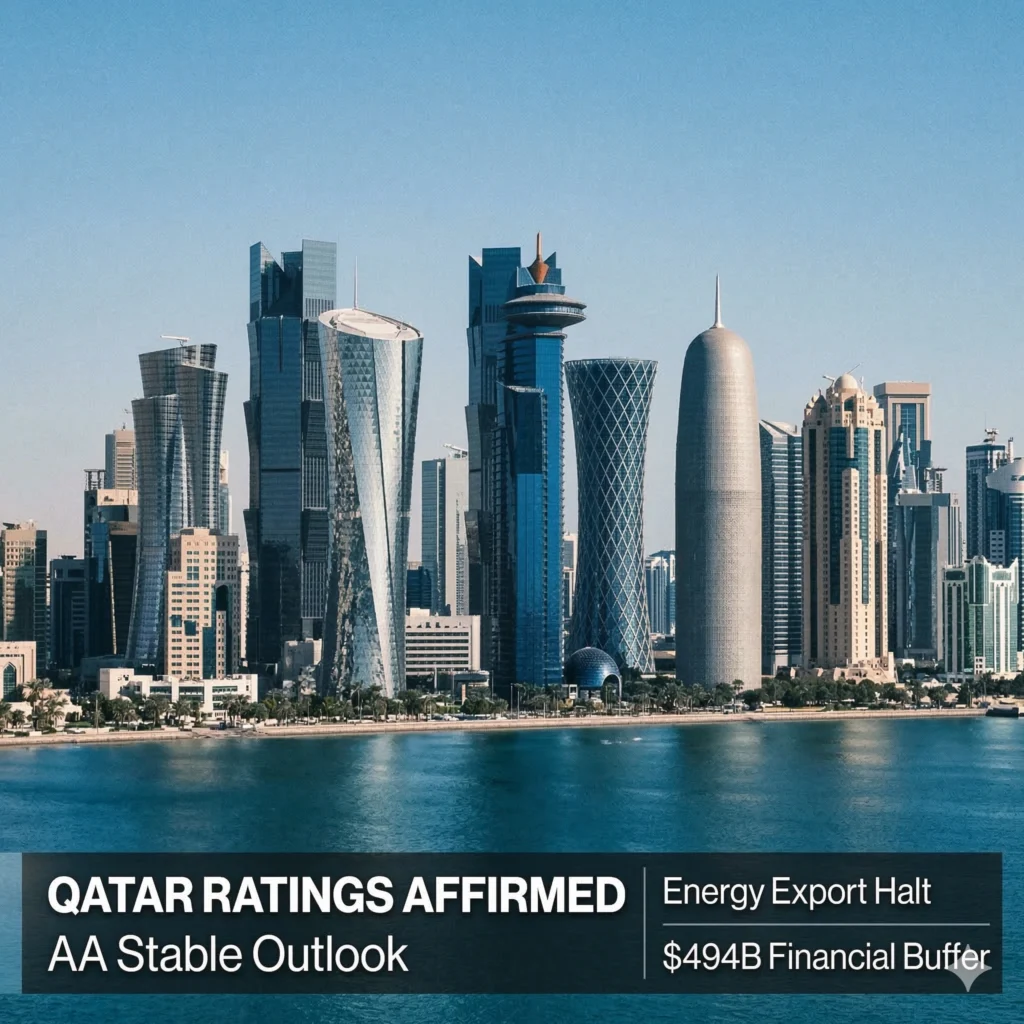
Sovereign Assets Protect the Qatar AA Rating
The most significant factor supporting the Qatar AA Rating is the nation’s staggering $494 billion in sovereign net foreign assets. These reserves, managed primarily through the Qatar Investment Authority, act as a primary defense mechanism against the economic fallout of the Iranian conflict. As energy exports through the Strait of Hormuz remain blocked, these assets allow the government to meet its fiscal requirements without increasing its debt-to-GDP ratio significantly. Fitch considers this “massive cushion” as the primary reason for maintaining a stable outlook during a period of zero export revenue.
Financial experts believe that Qatar can sustain its current spending levels for several months based on its liquid holdings alone. This financial independence is what differentiates the Qatari economy from its regional neighbors who may have higher debt burdens. The rating agency emphasized that while the budget surplus will narrow to just 0.3 percent of GDP in 2026, the absence of a deficit during a total export halt is a testament to the country’s fiscal health. This robust balance sheet remains the ultimate guarantor of the Qatar AA Rating.
Impact of the Strait of Hormuz Closure
The closure of the Strait of Hormuz has created a logistical nightmare for the energy sector, yet the Qatar AA Rating has not buckled under the pressure. This waterway is the transit point for nearly all of Qatar’s LNG and oil exports, and its blockage has effectively isolated the nation’s maritime trade. Fitch’s rating baseline assumes that the closure will be resolved in less than a month, allowing for a normalized return to global markets. If the maritime blockade extends beyond this timeframe, the downward pressure on the credit rating could increase.
Currently, the only active hydrocarbon export channel is the Dolphin pipeline, which transports gas to the United Arab Emirates. However, this only accounts for approximately 10 percent of the nation’s total output, leaving 90 percent of its revenue stream currently frozen. Despite this, the global demand for Qatari gas remains at an all-time high, ensuring that once the shipping lanes reopen, the recovery will be rapid. The Qatar AA Rating relies on this “v-shaped” recovery projection to maintain its current investment-grade status.
Qatar AA Rating
The Qatar AA Rating serves as a signal to international investors that the nation remains a safe haven for capital, even in a theater of war. The affirmation by Fitch is particularly notable given the targeted Iranian attacks on the Ras Laffan Industrial City infrastructure. While these strikes led to a temporary suspension of production, the damage is considered repairable within the context of the 2026 fiscal year. Fitch’s analysts believe that the structural integrity of Qatar’s energy sector remains a primary credit strength that outweighs short-term military risks.
- High income levels per capita remain among the highest in the world.
- Flexible public finances allow for rapid reallocation of state funds.
- A strong track record of debt repayment instills confidence in bondholders.
- Massive external assets provide a literal “war chest” for the economy.
Maintaining the Qatar AA Rating requires the government to demonstrate continued transparency and strategic planning. State-owned QatarEnergy has not wavered in its long-term goals, continuing to plan for a production increase to 142 million tonnes of LNG annually by 2030. This commitment to future growth provides the “long-term credit strength” that Fitch cited in its report. Even if the first phase of the North Field expansion is delayed until 2027, the underlying value of the resource remains unchanged.
Targeted Attacks on Ras Laffan Infrastructure
The suspension of operations at Ras Laffan Industrial City following an Iranian strike was a major point of concern for the Qatar AA Rating evaluation. Ras Laffan is the heart of the nation’s LNG production, and any permanent damage to its cooling systems or liquefaction trains could have catastrophic economic consequences. However, initial assessments suggest that the core energy lines remain functional. Fitch’s rating assumes that the facility will remain closed only for the duration of the “active” conflict phase, preventing long-term structural decay.
The military engagement has forced Qatar to pivot its security strategy, increasing its reliance on international defense partnerships. The stability of the Qatar AA Rating is inherently linked to the restoration of security at these key energy sites. If production remains offline for an extended period, the government may need to tap into its foreign reserves more aggressively than currently projected. Nevertheless, the current AA status reflects a belief that Qatar possesses the technical and financial resources to restore production quickly once the security environment stabilizes.
LNG Expansion and Long-Term Strategy
A core pillar supporting the Qatar AA Rating is the North Field expansion project, which aims to secure Qatar’s dominance in the global gas market for decades. While logistical challenges linked to the war may cause a temporary delay in the project’s timeline, the strategic importance of the expansion remains intact. State-owned QatarEnergy continues to sign long-term supply contracts with European and Asian partners, ensuring that the revenue stream will be robust once the conflict concludes. Fitch views these future cash flows as a stabilizing force for the nation’s credit profile.
- First phase of North Field expansion may be pushed to early 2027.
- Production goals of 142 million tonnes by 2030 remain the target.
- Global energy transition increases the value of Qatari gas as a “bridge fuel.”
- Strategic partnerships with international oil companies (IOCs) provide technical support.
The delay of the expansion is factored into the current Qatar AA Rating, with Fitch noting that the nation’s debt capacity can handle a prolonged development phase. The massive capital expenditure required for these projects is being funded through a mix of internal cash flow and targeted debt, which remains highly attractive to global investors thanks to the AA rating. As long as the physical infrastructure remains largely intact, the long-term wealth of the nation is considered secure by the rating agency.
Fiscal Resilience and Government Budget
The Qatari government budget is expected to show incredible resilience, even as energy revenues decline sharply due to the export halt. Fitch projects that the surplus will narrow to 0.3 percent of GDP in 2026, a figure that would be considered a victory for most nations under similar stress. This fiscal discipline is a major reason why the Qatar AA Rating remains unchanged. The government has the ability to scale back non-essential infrastructure spending to prioritize defense and social stability during the crisis.
Public finance management in Qatar is characterized by a high degree of flexibility. The state can quickly adjust its domestic spending to ensure that its sovereign net foreign assets are not depleted too rapidly. This proactive fiscal policy is a key metric for Fitch when assessing the Qatar AA Rating. By maintaining a surplus, even a marginal one, the government demonstrates that it is not reliant on constant debt issuance to function. This level of fiscal autonomy is a hallmark of “AA” rated sovereigns.
The Role of Global Energy Prices
Global oil and gas prices play a secondary but important role in the stability of the Qatar AA Rating. Fitch expects Brent crude prices to average around $70 per barrel in 2026, assuming that the regional energy infrastructure does not suffer permanent, widespread damage. Higher energy prices act as a double-edged sword: while they increase the potential value of Qatari exports, they also reflect a higher regional risk premium. For the Qatar AA Rating, the focus remains on the “volume” of exports rather than just the price, as the current halt makes the price irrelevant in the short term.
The agency’s baseline assumes that once the Strait of Hormuz reopens, Qatar will be able to sell its accumulated inventory at premium prices. This “catch-up” period is expected to significantly boost revenues in the latter half of 2026. The Qatar AA Rating accounts for this volatility, recognizing that the nation’s low cost of production makes it profitable even at much lower price points than $70 per barrel. This cost advantage is a permanent feature of the Qatari economy that provides long-term rating stability.
Regional War and Geopolitical Risk
The primary threat to the Qatar AA Rating remains the unpredictable nature of the regional war involving the United States, Israel, and Iran. Geopolitical risk is at an all-time high, and any expansion of the conflict that leads to the direct occupation or total destruction of Qatari energy assets would trigger a rating downgrade. However, Fitch’s current assessment is based on the conflict being contained to the Gulf maritime routes and specific military targets. The agency believes that the risk to Qatar’s “sovereign solvency” is currently manageable.
- The stable outlook assumes limited permanent damage to energy infrastructure.
- Security of the Dolphin pipeline is critical for the 10 percent output baseline.
- International diplomatic pressure is expected to lead to the reopening of the Strait.
- Qatar’s neutral diplomatic stance provides some protection against direct targeting.
The Qatar AA Rating reflects a “stable” outlook, meaning that Fitch does not expect to change the rating in the next 12 to 18 months. This is a powerful statement during a time of war, suggesting that the economic fundamentals of Qatar are strong enough to withstand even the most extreme regional shocks. The nation’s strategic importance to the global energy grid also ensures that international powers have a vested interest in protecting its infrastructure and maritime access.
Banking Sector Stability in Qatar
Despite the energy export halt, the domestic banking sector in Qatar remains robust, bolstered by the Qatar AA Rating. The central bank has sufficient foreign exchange reserves to provide liquidity to any banks facing short-term funding gaps. Furthermore, the high level of government assets ensures that the state can step in to support the banking system if necessary. Fitch notes that the “massive cushion” of sovereign assets is directly beneficial to the banking sector’s creditworthiness.
Investors in Qatari banks have remained relatively calm, as the AA rating provides a level of reassurance that is rare in a conflict zone. The banks themselves have limited exposure to the Iranian market, reducing the risk of direct financial contagion. As long as the Qatar AA Rating remains in place, the cost of funding for these banks will remain manageable, allowing them to continue supporting the domestic economy through the duration of the war.
Future Outlook for the Qatar AA Rating
Looking ahead to the remainder of 2026 and into 2027, the future of the Qatar AA Rating will depend on two main factors: the duration of the Strait of Hormuz closure and the extent of physical damage to Ras Laffan. If the maritime routes reopen within the one-month window assumed by Fitch, the rating will likely remain at AA with a stable outlook. However, a prolonged conflict that necessitates a significant drawdown of sovereign assets could lead to a reassessment of the nation’s “stable” status.
The long-term credit strength of Qatar is undeniably tied to its LNG expansion. As the world seeks to transition away from coal, Qatari gas is positioned as a critical resource for the global economy. This underlying demand provides a “floor” for the Qatar AA Rating, as the nation’s future earnings are almost guaranteed once the political situation stabilizes. For now, the affirmation by Fitch is a clear endorsement of Qatar’s economic resilience and its ability to weather the storm of the Iranian conflict.
Conclusion and Final Thoughts
In summary, the Qatar AA Rating stands firm as a testament to the country’s exceptional financial management and immense natural wealth. Despite the targeted attacks on its infrastructure and the total halt of energy exports through the Strait of Hormuz, the nation’s $494 billion in external assets provides an unbreakable safety net. Fitch Ratings has signaled to the world that Qatar is prepared for the economic consequences of war and possesses the fiscal flexibility to emerge from the crisis with its creditworthiness intact.
The stable outlook assigned to the Qatar AA Rating provides a much-needed sense of security in a region defined by uncertainty. While the short-term challenges are significant, the long-term growth trajectory remains positive, driven by the ambitious North Field expansion. As the conflict continues, the global community will look to Qatar as a model of economic resilience, proving that a well-managed sovereign wealth fund is the best defense against geopolitical instability.
For more details & sources visit: Doha News
Read more about Qatar news on 360 News Orbit – Qatar.