
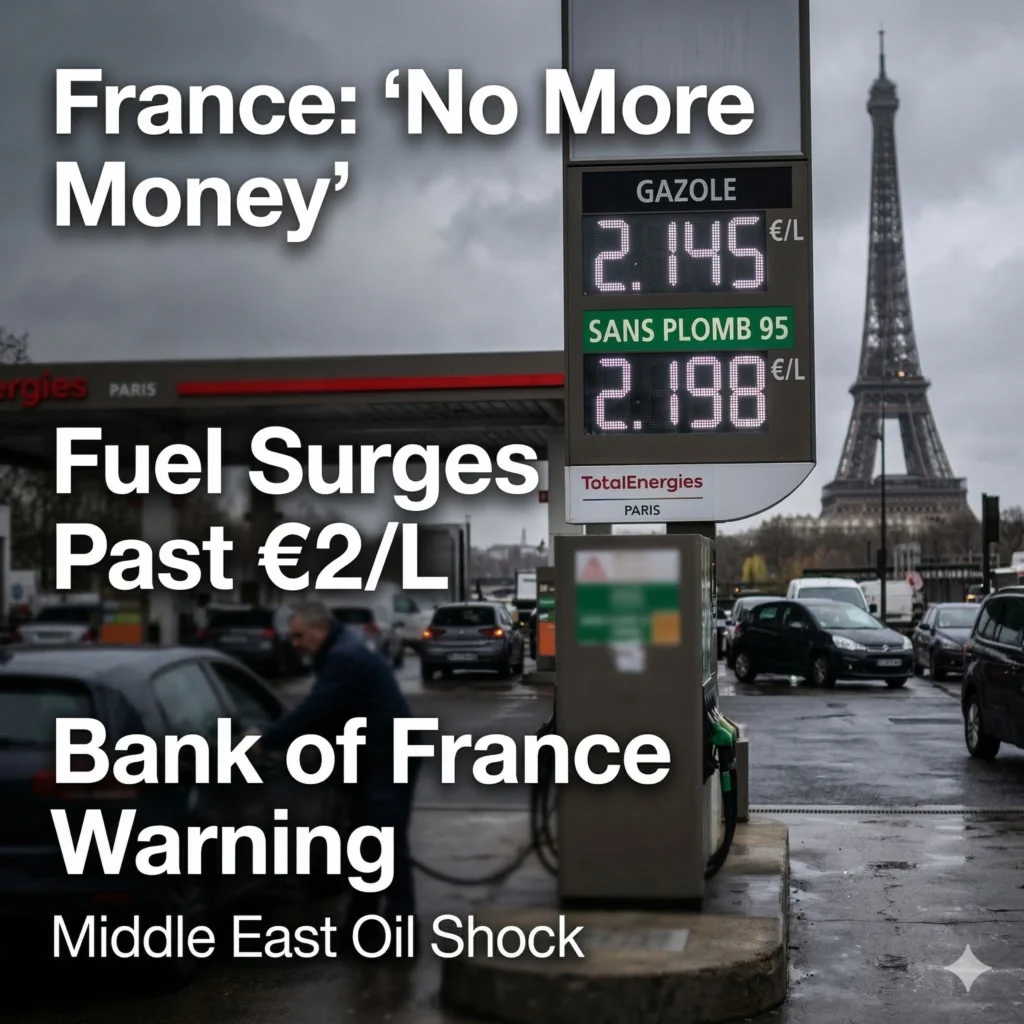
Fiscal constraints and regional conflict are the primary drivers behind the Bank of France’s decision to maintain a strict financial stance as global energy markets face unprecedented volatility. Governor François Villeroy de Galhau has confirmed that the state currently possesses no additional resources for new fuel subsidies, despite prices crossing the symbolic €2 threshold. This firm position is a direct response to a public deficit hovering around 5%, which leaves the government with little room for maneuver. As the Middle East crisis escalates, the French administration is pivoting toward a strategy of long-term energy independence rather than short-term financial relief measures.
The surge in energy costs follows the effective closure of the Strait of Hormuz, a strategic waterway that handles nearly 20% of the world’s liquefied natural gas trade. This disruption has sent shockwaves through the French economy, impacting everything from individual transport costs to the pricing structures of major international carriers. While the public is feeling the pressure of high fuel prices, the central bank warns that further borrowing to fund subsidies would only worsen the national deficit. This fiscal discipline is seen as essential for protecting interest rates on mortgages and business loans from rising further in a fragile economic climate.
Fiscal Constraints and Regional Conflict
The intersection of fiscal constraints and regional conflict has created a perfect storm for the French economy at the start of 2026. Governor Villeroy de Galhau emphasized that the nation cannot afford to ignore its structural deficit while attempting to buffer citizens from global oil price hikes. With joint US-Israel strikes on Iran earlier this year leading to extreme geopolitical instability, the supply chains for fossil fuels have been fundamentally compromised. France’s current debt level makes it impossible to implement the kind of tax cuts or fuel vouchers seen during previous energy crises without risking a sovereign credit downgrade.
Furthermore, the fiscal constraints and regional conflict have forced the Bank of France to adjust its growth projections for the first quarter. A modest target of 0.2% to 0.3% growth reflects the cooling effect that high energy costs have on consumer spending and industrial production. The Governor noted that the symbolic price of €2 per liter of fuel acts as a psychological barrier that can significantly dampen economic activity. By refusing to increase spending on subsidies, the bank aims to maintain a credible fiscal path that ensures long-term stability for the euro and the French financial system.
The Strait of Hormuz and Global Oil Markets
A major catalyst for the current tension between fiscal constraints and regional conflict is the closure of the Strait of Hormuz by Iranian forces. This blockade has disrupted the flow of approximately 20 million barrels of oil daily, leading to immediate shortages and price spikes at French petrol stations. Because France relies heavily on imported energy, the shutdown of this maritime corridor has direct consequences for the cost of living. The central bank is monitoring this situation closely, but officials reiterate that they cannot “print money” to solve a supply-side crisis caused by international warfare.
The impact of fiscal constraints and regional conflict is also visible in the maritime insurance and shipping sectors, which have seen premiums skyrocket. These added costs are passed down the supply chain, eventually landing on the shoulders of French consumers. Villeroy de Galhau argued that the only way to shield the nation from such vulnerabilities is to accelerate the transition to domestic renewable energy. Until that transition is complete, the country must endure the volatility of global markets while keeping its own house in order. This period of austerity is framed as a necessary sacrifice to avoid a more severe debt crisis.
Impact on the Aviation and Transport Industry
Major industrial players are already adjusting their operations to account for the twin pressures of fiscal constraints and regional conflict. Air France-KLM recently announced a significant increase in long-haul ticket prices to offset the rising cost of jet fuel. Passengers can expect to pay at least €50 more per ticket as the airline struggles to maintain profitability amid the supply crunch. This ripple effect demonstrates how energy inflation quickly spreads from the gas station to the broader services economy, complicating the central bank’s inflation-targeting efforts.
- Long-haul flight costs are increasing by approximately €50 ($58).
- Freight and logistics companies are adding fuel surcharges to deliveries.
- Public transport authorities are reviewing fare structures for the second half of 2026.
- Private car usage is declining as commuters seek more efficient alternatives.
These industry adjustments highlight the reality that fiscal constraints and regional conflict leave the government with few options to protect specific sectors. The Governor’s refusal to provide “fuel vouchers” means that businesses must find their own ways to adapt to the new price reality. For many, this involves passing the costs to the consumer or accelerating the electrification of their vehicle fleets. This market-driven adjustment is painful but, according to the Bank of France, the only sustainable way to manage the current economic transition without destroying the national budget.
National Deficit and Interest Rate Risks
One of the most significant risks posed by fiscal constraints and regional conflict is the potential for rising interest rates. If the government were to ignore its deficit and issue more debt for fuel subsidies, international investors might demand higher yields on French bonds. This would directly translate into higher mortgage rates for French families and more expensive loans for local entrepreneurs. Villeroy de Galhau’s warning is clear: subsidizing fuel today could lead to a housing and investment crisis tomorrow. This long-term perspective is a cornerstone of the central bank’s current monetary philosophy.
The national deficit, currently at 5%, is already well above the preferred European targets, making the fiscal constraints and regional conflict even more sensitive. Every billion euros spent on temporary fuel relief is a billion euros that cannot be used for the energy transition or healthcare. The Governor argues that the government must remain disciplined to maintain the confidence of the European Central Bank and global financial markets. This commitment to fiscal responsibility is designed to provide a stable foundation for the French economy once the current geopolitical storm eventually subsides.
Energy Independence as a Sustainable Solution
Villeroy de Galhau has repeatedly stated that the only permanent escape from the cycle of fiscal constraints and regional conflict is total energy independence. By investing in nuclear power and renewables, France aims to decouple its economy from the volatile politics of the Middle East. The current crisis is being used as a catalyst to speed up the “energy transition” projects that are already underway. While these investments are expensive, they are viewed as capital expenditures that will yield long-term savings and provide a shield against future geopolitical shocks.
- Expansion of next-generation nuclear reactors across French regions.
- Increased subsidies for domestic heat pump installations and insulation.
- Massive investment in offshore wind farms in the Atlantic and Mediterranean.
- Development of green hydrogen infrastructure for heavy industry.
The focus on energy independence is also a strategic move to manage future fiscal constraints and regional conflict scenarios. A nation that produces its own power is less susceptible to the closure of a distant strait or the results of foreign military strikes. This vision for the future requires a disciplined budget today so that the necessary capital remains available for the massive infrastructure projects required. The Governor believes that the current high prices at the pump, while difficult for families, serve as a stark reminder of why this transition is an absolute priority for the French Republic.
Economic Forecast and Growth Targets
Despite the challenges of fiscal constraints and regional conflict, the Bank of France maintains a cautiously optimistic growth target of approximately 1% for 2026. This forecast assumes that the global economy will gradually adapt to the new energy reality and that internal demand in France will remain resilient. However, the first-quarter performance will be a critical indicator of whether the high cost of energy will lead to a more significant slowdown. The central bank is prepared to adjust its policies if the data suggests a deeper recessionary trend, but subsidies remain off the table.
Managing the economic forecast requires a delicate balance between controlling inflation and encouraging investment. The fiscal constraints and regional conflict make it difficult to provide traditional stimulus, so the focus has shifted toward structural reforms that improve productivity. By making the French economy more efficient, the government hopes to offset the drag caused by high energy prices. This “supply-side” approach is intended to create a more robust economy that can thrive even when global oil markets are in turmoil.
Global Geopolitical Context and French Security
The fiscal constraints and regional conflict in France cannot be separated from the broader global security environment. The joint US-Israel strikes on Iran have shifted the balance of power in the Middle East, leading to a period of “harmful market involution” where uncertainty drives up prices regardless of actual supply levels. France’s role in the international community as a diplomatic mediator is also being tested by these events. The Governor’s economic warnings serve as a reminder that foreign policy decisions have immediate and tangible effects on the wallets of domestic taxpayers.
As France navigates this period, the cooperation with other European Union members becomes even more vital. Addressing the fiscal constraints and regional conflict through a unified European energy market could provide some relief, but the path forward remains difficult. The closure of the Strait of Hormuz is a global problem that requires a global solution, and France is actively participating in international efforts to reopen the waterway. Until then, the domestic policy remains focused on resilience, discipline, and a rapid pivot away from fossil fuel dependency to ensure the survival of the national economy.
Public Sentiment and the Cost of Living
The refusal to provide new subsidies in the face of fiscal constraints and regional conflict is a politically sensitive move for the current administration. Public sentiment is increasingly strained as the cost of basic goods and services rises alongside fuel prices. However, the Bank of France maintains that being honest about the “lack of money” is better than making empty promises that would lead to a financial crisis. Transparent communication about the national budget is viewed as a way to manage expectations and encourage community-level adaptations to the energy crisis.
Many citizens are turning to carpooling and public transport as a way to mitigate the impact of the €2 fuel price. This shift in behavior aligns with the long-term goals of the energy transition, even if the reason for the change is economic necessity rather than environmental idealism. The government is focusing its remaining resources on improving public transit infrastructure, which is a more sustainable use of funds than temporary fuel vouchers. In this way, the fiscal constraints and regional conflict are inadvertently accelerating social changes that were already in motion across the country.
Conclusion: Navigating a Perilous Economic Path
The decision to rule out new fuel subsidies marks a turning point in French economic policy, dictated by the harsh realities of fiscal constraints and regional conflict. Governor Villeroy de Galhau has placed the integrity of the national budget above the pressure for immediate populist relief. This strategy is built on the belief that fiscal discipline is the only way to protect the long-term prosperity of the French people. As the nation faces the challenges of 2026, the focus remains firmly on stability, energy independence, and the preservation of a healthy financial system.
While the immediate future looks challenging for many households, the roadmap provided by the Bank of France offers a clear direction. By enduring the current volatility without increasing the national debt, France is positioning itself as a resilient player in a fragmenting global economy. The lessons learned from the fiscal constraints and regional conflict of today will undoubtedly shape the energy and financial policies of tomorrow. The “no more money” warning is not just a statement of fact; it is a call to action for a nation to innovate and adapt its way out of an era defined by fossil fuel dependency.
For more details & sources visit: Anadolu Agency
For the latest updates from France, visit our France news page.