
The fatal drone strike targets a sensitive intelligence hub in the heart of Iraq’s capital, marking a dangerous escalation in regional hostilities. This morning, an explosive-laden aircraft successfully breached the perimeter of the Iraqi National Intelligence Service (INIS) headquarters located in Baghdad’s upscale Mansour district. The precision of the attack suggests a high level of technical capability among the “outlaw groups” currently operating within the city’s shadows. General Saad Maan confirmed that the blast resulted in the tragic death of a police officer stationed at the facility.
Local authorities have reported that the fatal drone strike targets specifically hit a building used for high-level communications and security coordination. This facility served as a vital link between Iraqi intelligence and international advisers, including those from the United States. By striking this particular structure, the perpetrators aimed to dismantle the operational synergy between Baghdad and its global security partners. The timing of the attack, occurring during a period of intense regional friction, indicates a calculated effort to isolate Iraqi security forces from their allies.
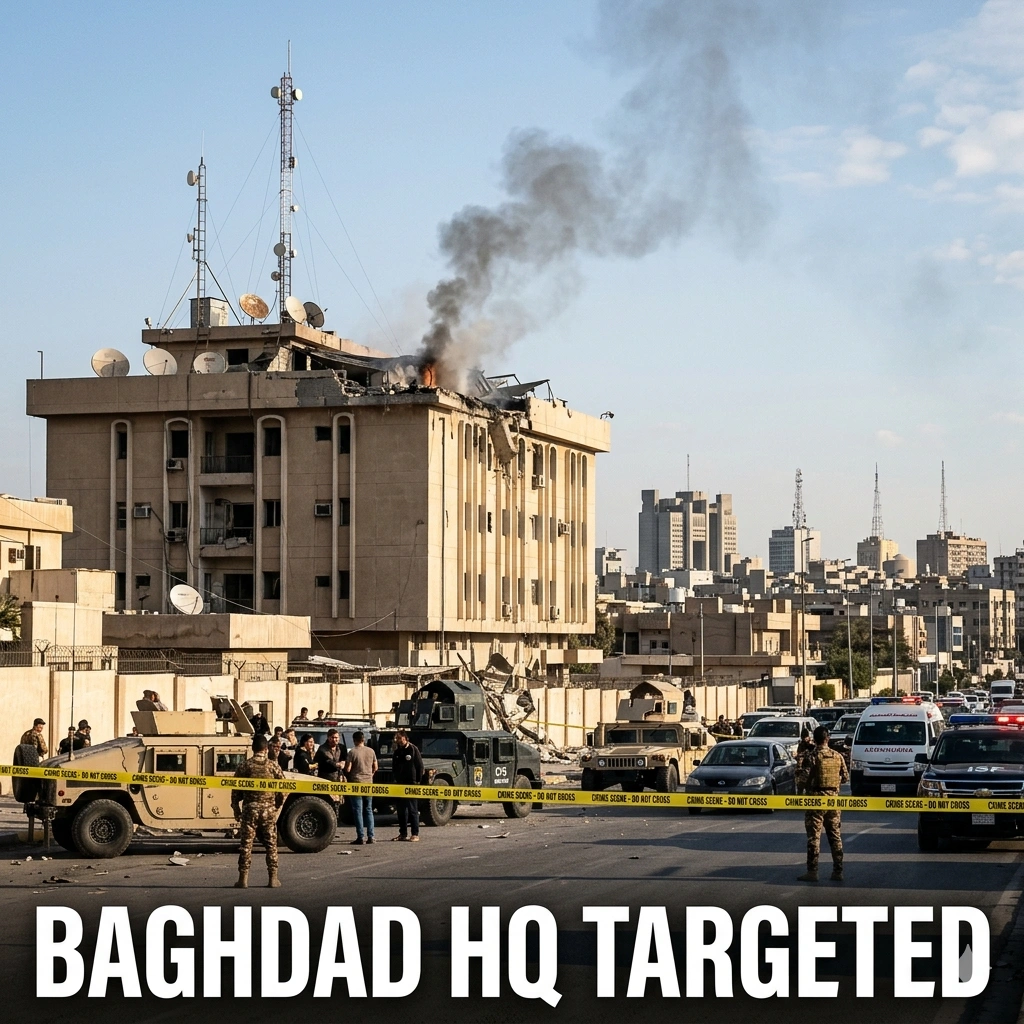
Baghdad Intelligence Hub Hit by Sophisticated Aerial Attack
The fatal drone strike targets the very center of Iraq’s security apparatus, causing significant damage to the INIS communications wing. This sector was responsible for managing sensitive data exchanges and real-time coordination with foreign military attaches. Following the explosion, thick plumes of smoke were seen rising over the Mansour district, a neighborhood known for hosting elite social clubs and diplomatic residences. Initial forensic reports suggest the drone used was a standardized military-grade loitering munition, commonly deployed by non-state actors in the Middle East.
Security analysts noted that the fatal drone strike targets a location that was previously considered one of the most secure zones in Baghdad. The breach has prompted an immediate review of the capital’s anti-drone defense systems, which apparently failed to intercept the incoming threat. Investigations are now focused on how the “outlaw groups” managed to bypass sophisticated radar and jamming equipment. This incident has sent shockwaves through the diplomatic community, as the proximity to international installations raises fears of broader collateral damage in future strikes.
Fatal Drone Strike Targets
The fatal drone strike targets identified in the INIS compound were meticulously selected to maximize psychological and operational impact. According to General Saad Maan, the deceased officer was part of a specialized unit dedicated to guarding the outer layers of the intelligence facility. The blast destroyed several satellite arrays and encrypted transmission towers, temporarily crippling the agency’s ability to communicate with field units. This loss of connectivity poses a significant hurdle for ongoing counter-terrorism operations across the country.
A second drone, which did not carry explosives, was found crashed at a nearby elite sports club frequented by foreign diplomats. Intelligence officials believe this secondary device was intended to record the fatal drone strike targets for propaganda purposes. The use of “spotter drones” is a hallmark of sophisticated armed factions looking to verify the success of their missions for social media distribution. This dual-drone tactic highlights a level of operational maturity that challenges the current capabilities of the Iraqi National Police and the INIS.
Escalation of Conflict Between U.S. Forces and Armed Factions
The fatal drone strike targets have emerged against a backdrop of increasing fire exchanges between United States forces and local militias. In recent weeks, Baghdad has become a proxy battlefield where regional grievances are settled through targeted assassinations and infrastructure sabotage. The attack on the INIS headquarters is seen as a direct message to the U.S. security advisers who utilize the facility for strategic planning. This environment of “tit-for-tat” violence has made the Green Zone and surrounding districts highly volatile for both residents and officials.
- U.S. security advisers have been moved to reinforced bunkers within the capital.
- Iraqi security services are conducting raids in areas suspected of harboring drone launch sites.
- International airlines are reviewing flight paths over Baghdad following the aerial breach.
- Local businesses in the Mansour district have reported a sharp decline in foot traffic.
The fatal drone strike targets represent a shift from random rocket fire to precision aerial attacks on high-value assets. This evolution in tactics requires a more robust response from the Iraqi government to maintain public confidence in state institutions. Prime Minister Mohammed Shia’ al-Sudani has convened an emergency session of the National Security Council to address the growing threat. The council is expected to announce new measures aimed at curbing the influence of unregulated armed groups that continue to challenge the state’s monopoly on force.
Impact on International Security Coordination in Iraq
The fatal drone strike targets have severely hampered the collaborative efforts between Iraqi intelligence and their international counterparts. Coordination meetings that were previously held in the Mansour facility have been suspended until the site can be properly secured and repaired. This pause in communication could provide a window of opportunity for extremist cells to regroup and launch further attacks. The loss of a communications hub is not just a physical blow; it is a strategic setback that affects the entire regional security framework.
- Joint training programs for Iraqi police have been temporarily put on hold.
- Intelligence sharing protocols are being transitioned to secondary secure locations.
- Diplomatic missions have increased their private security details in the upscale Mansour area.
Restoring the facilities hit by the fatal drone strike targets is a priority for the INIS leadership. They have requested technical assistance from international partners to harden their communications infrastructure against future electronic or physical interference. The goal is to create a “resilient node” that can continue to function even if parts of the compound are compromised. This incident underscores the need for a decentralized command and control system that is not reliant on a single physical location.
Investigation into “Outlaw Groups” Responsible for the Breach
The fatal drone strike targets are the subject of an intense investigation by a joint task force comprising the INIS and the Ministry of Interior. Preliminary evidence points toward a coalition of “outlaw groups” that have been vocal in their opposition to the presence of foreign military advisers. These groups have often used domestic media to threaten attacks on any facility that hosts Western personnel. Forensic teams are currently analyzing the wreckage of both drones to determine their origin and the source of their electronic components.
Tracking the launch point for the fatal drone strike targets is a complex task, as these devices can be deployed from mobile platforms or hidden urban sites. Security cameras across the Mansour district are being reviewed to identify any suspicious vehicle movements in the hours leading up to the attack. The government has offered a significant reward for information leading to the arrest of the masterminds behind the operation. This case is being treated as a high-priority national security matter, with the potential for severe legal consequences for those involved.
Regional Tensions and the Future of Baghdad Security
The fatal drone strike targets are a symptom of a larger regional tension that frequently spills over into Iraqi territory. As global powers negotiate the future of Middle Eastern security, local factions use violence to ensure their interests are not ignored. Baghdad remains a focal point for these struggles, as it sits at the crossroads of various geopolitical influence spheres. Maintaining a balance between these competing forces is the primary challenge for the Iraqi leadership as they navigate the complexities of 2026.
- Regional neighbors have called for restraint to prevent a wider conflagration.
- The UN has issued a statement condemning the use of drones against civilian-adjacent areas.
- Diplomatic efforts are underway to establish “red lines” regarding attacks on state institutions.
The fatal drone strike targets have forced a rethink of how the capital’s “rings of security” are organized. The traditional reliance on concrete walls and checkpoints is being replaced by a focus on electronic warfare and early detection. Integrating these new technologies into the existing security framework is a costly but necessary investment. The future of Baghdad’s stability depends on the government’s ability to stay ahead of the technological curve used by its domestic and regional adversaries.
Public Reaction and Civil Safety in the Capital
The fatal drone strike targets have left the residents of Baghdad’s Mansour district on edge, as the neighborhood is usually a symbol of stability and wealth. The sight of emergency vehicles and security cordons has become a grim reminder of the city’s underlying fragility. Civil society groups have called for the government to do more to protect residential areas from being caught in the crossfire of political violence. There is a growing sense of frustration among the public regarding the constant cycle of strikes and counter-strikes.
- Local hospitals have been put on high alert to handle potential mass casualty events.
- Neighborhood watch programs are being reinvigorated to monitor for unusual aerial activity.
- Schools near the intelligence headquarters have briefly suspended classes for safety.
Addressing the fallout from the fatal drone strike targets requires a transparent communication strategy from the Ministry of Interior. By providing regular updates on the investigation, the government hopes to quell rumors and prevent panic among the population. The resilience of the Iraqi people is well-known, but the persistent threat of drone attacks adds a new layer of anxiety to daily life. Ensuring that the city remains a viable place for commerce and diplomacy is a core objective of the current administration.
Technical Analysis of the Drones Used in the Attack
The fatal drone strike targets were neutralized using a combination of high-explosive payloads and GPS-guided navigation. Technical experts from the INIS have noted that the drones displayed a level of “signal hardening” that made them resistant to standard jamming techniques. This suggests that the “outlaw groups” may be receiving advanced electronic support from external state or non-state entities. Understanding these technical nuances is key to developing effective countermeasures for the next wave of potential attacks.
Analysis of the second drone found at the sports club revealed a high-definition 360-degree camera system. This equipment is capable of transmitting live video feeds back to a remote operator, allowing for real-time assessment of the fatal drone strike targets. The data retrieved from the drone’s memory module is providing valuable clues about the flight path and the encrypted frequencies used for control. These findings are being shared with international partners to build a global database of drone-related threats.
Diplomatic Consequences of the Strike on Intelligence Facilities
The fatal drone strike targets have led to a series of high-level diplomatic meetings between the Iraqi government and foreign missions. Ambassadors have expressed their deep concern over the safety of their personnel who frequently visit the Mansour district for security briefings. Some nations are considering reducing their diplomatic footprint in Baghdad if the government cannot guarantee the security of key coordination hubs. This potential isolation would be a significant blow to Iraq’s efforts to reintegrate into the global community.
The fatal drone strike targets have also complicated the ongoing negotiations regarding the presence of international advisers on Iraqi soil. Factions opposed to this presence use such attacks to prove that the current arrangement only brings more violence to the capital. Conversely, the government argues that these attacks prove the need for continued international support to professionalize the security sector. This political tug-of-war is likely to intensify as the investigation into the INIS breach continues.
Strengthening the National Intelligence Service Infrastructure
In the wake of the fatal drone strike targets, the INIS is receiving an emergency budget allocation to upgrade its physical and cyber defenses. The plan includes the construction of underground command centers and the deployment of “active protection systems” that can automatically intercept incoming projectiles. These upgrades are seen as essential for maintaining the agency’s operational integrity during times of high tension. The staff at the headquarters are also receiving specialized training in emergency response and data recovery.
- New blast-resistant materials are being integrated into the facades of sensitive buildings.
- Redundant communication lines are being buried deep underground to prevent disruption.
- A specialized “Drone Defense Unit” has been established within the INIS to monitor the skies.
The fatal drone strike targets have served as a wake-up call for the entire Iraqi security establishment. While the agency mourns the loss of a dedicated officer, it is also using the tragedy as a catalyst for reform. The goal is to transform the INIS into a more agile and technologically advanced organization capable of defending the nation against asymmetric threats. This transformation is a vital component of the broader national security strategy for 2026 and beyond.
Role of Media in the Aftermath of the Attack
The fatal drone strike targets have been the subject of intense media scrutiny, with various outlets providing conflicting reports on the extent of the damage. Government-aligned media have focused on the heroism of the security forces, while opposition-linked channels have used the incident to criticize the state’s defense capabilities. This fractured media landscape makes it difficult for the public to get a clear and unbiased picture of the situation. The INIS has warned against spreading unverified information that could compromise the ongoing investigation.
- Official press briefings are now held daily at the Ministry of Interior to provide factual updates.
- Social media platforms are being monitored for propaganda videos released by the “outlaw groups.”
- Journalists are being given limited access to the site to document the recovery efforts.
By managing the narrative surrounding the fatal drone strike targets, the government aims to project a sense of control and stability. The transparency of General Saad Maan in confirming the casualty was a strategic move to build trust with the media. However, the use of propaganda drones by the attackers shows that the battle for public opinion is just as important as the physical conflict on the ground. The media remains a critical front in the ongoing struggle for the future of Iraq.
Legal Actions Against Identified Outlaw Groups
The fatal drone strike targets are not just a military failure; they are a legal challenge to the authority of the Iraqi state. The judiciary has issued several arrest warrants for high-ranking members of groups believed to be linked to the attack. These individuals are being charged with terrorism, murder, and the sabotage of state infrastructure. The government is also looking into the financial networks that fund these “outlaw groups,” aiming to freeze their assets and cut off their supply lines.
- International cooperation is being sought to track the movement of funds across borders.
- New laws are being drafted to provide stiffer penalties for the unauthorized use of drones.
- The “Counter-Terrorism Service” is leading the efforts to apprehend those named in the warrants.
Following through on these legal actions is essential for proving that no group is above the law. The fatal drone strike targets have created a sense of urgency in the judicial system to expedite cases related to national security. By bringing the perpetrators to justice, the state hopes to deter others from engaging in similar acts of violence. The rule of law is the ultimate foundation upon which a stable and secure Iraq must be built.
The Human Element: Honoring the Fallen Officer
While much of the discussion focuses on technology and geopolitics, the fatal drone strike targets have a profound human cost. The officer who lost his life in the line of duty was a member of the community, with a family and colleagues who are now grieving his loss. A state funeral is being planned to honor his service and to demonstrate the nation’s gratitude for those who stand on the front lines of defense. This human sacrifice is what drives the government’s determination to find and punish those responsible.
- The family of the fallen officer will receive a special pension and support services.
- A memorial plaque will be placed at the INIS headquarters in honor of his bravery.
- Senior officials have visited the family to offer their personal condolences and support.
The fatal drone strike targets have reminded everyone that security is provided by people, not just machines. The courage shown by the staff at the headquarters during the attack is a testament to the professional spirit of the Iraqi National Intelligence Service. As the agency moves forward, it does so with the memory of its fallen members serving as a constant motivation to achieve its mission. The protection of the Iraqi people remains the highest honor for every man and woman in uniform.
Conclusion: Baghdad’s Path to Stability
The fatal drone strike targets have undoubtedly tested the resilience of the Iraqi state and its capital. However, the swift response and the unified condemnation of the attack show that Baghdad is not prepared to surrender to the forces of chaos. The ongoing investigation and the planned upgrades to security infrastructure are positive steps toward a more stable future. While the threats remain complex and ever-evolving, the commitment to a secure and sovereign Iraq has never been stronger.
The fatal drone strike targets will be remembered as a significant moment in the security history of 2026. It has prompted a necessary re-evaluation of defense strategies and a strengthening of international alliances. As the city of Baghdad continues to grow and modernize, it must also continue to protect itself from those who wish to pull it back into the past. With the support of its citizens and its global partners, Iraq will overcome this latest challenge and continue on its path toward peace and prosperity.
For more details & sources visit: Al Jazeera
Read more about Iraq news on 360 News Orbit – Iraq.