
F1 Bahrain Testing was the stage where George Russell made a definitive statement ahead of the upcoming 2026 season. The Mercedes driver delivered a masterclass in pace and consistency, signaling that the Silver Arrows might have finally unlocked the secrets of the new technical regulations. Fans and analysts watched closely as the desert heat provided a grueling environment for the new power units to prove their reliability.
The atmosphere at the Bahrain International Circuit was electric as the morning session commenced with high stakes. Teams arrived with radical aerodynamic updates, hoping to find the narrow performance window required by the smaller, more agile chassis designs. While the initial focus was on installation laps, the afternoon session quickly evolved into a high-speed pursuit of the ultimate lap time.
F1 Bahrain Testing has always served as the ultimate litmus test for engineering prowess and driver adaptability. Russell’s performance was not just about a single flying lap; it was a demonstration of how Mercedes has optimized battery deployment under the revised electrical boost rules. This early success suggests a significant shift in the competitive hierarchy as we head toward the season opener in Australia.
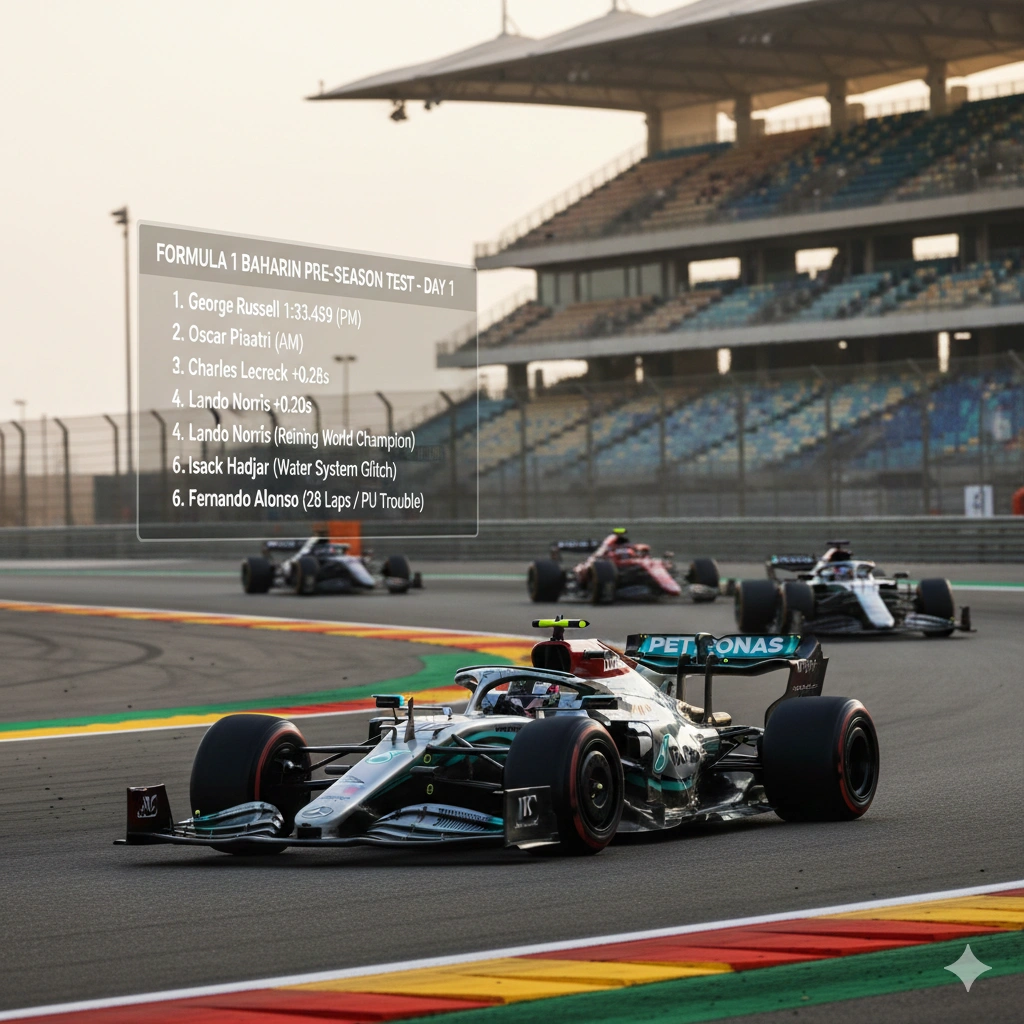
Analyzing the Top Times at Bahrain International Circuit
The timesheets reflected a fascinating battle between three of the sport’s most prominent manufacturers. Russell’s benchmark of 1:33.459 stood firm against a late charge from Oscar Piastri, who had initially set the pace during the cooler morning hours. Ferrari’s Charles Leclerc remained a constant threat, lurking just over a quarter of a second behind the lead Mercedes.
Observing the telemetry from the session reveals that Mercedes found significant gains in the technical middle sector. This area of the track demands high downforce and mechanical grip, suggesting the W17 chassis is well-balanced across various corner speeds. Consequently, the team looks much more comfortable than they did during the early shakedown tests in Barcelona.
McLaren also appeared remarkably stable, with Piastri reporting that the car felt predictable even in gusty wind conditions. The Australian driver completed a heavy program of long-run simulations, indicating that the team is prioritizing race-pace durability over pure qualifying glory. Ferrari followed a similar path, focusing on tire degradation management across multiple compounds.
F1 Bahrain Testing
The technical landscape of F1 Bahrain Testing was dominated by the implementation of the 2026 power unit regulations. These rules have shifted the balance toward increased electrical output, requiring drivers to manage energy harvesting more strategically than ever before. Every lap provided vital data on how the MGU-K and MGU-H components interact under extreme thermal stress.
Engineers spent hours analyzing the transition between internal combustion and electrical power delivery. Because the cars are now smaller and lighter, the sensitivity to weight distribution has increased exponentially, making setup tweaks more impactful. A minor change in front-wing angle now results in a much more dramatic shift in the car’s overall balance.
The cooling systems were put to a rigorous test as ambient temperatures climbed throughout the afternoon. Several teams struggled with heat soak issues, particularly during stationary periods in the pit lane. However, the front-runners seemed to have their thermal management under control, allowing them to push for extended periods without significant power derating.
Challenges Faced by Defending Champions and Rivals
While Mercedes and McLaren celebrated a productive day, the reigning world champion Lando Norris faced a more complicated outing. Despite finishing fourth, the McLaren star spent significant time in the garage while mechanics adjusted the rear suspension geometry. These teething issues are common during F1 Bahrain Testing as teams push components to their absolute limits.
Red Bull Racing experienced a surprisingly quiet day, largely due to the absence of Max Verstappen and a minor technical setback. Rookie Isack Hadjar took the wheel but was sidelined early on by a water system glitch that required a complete radiator flush. Although he recovered to finish sixth, the lost track time could prove costly for their development curve.
- Reliability concerns surfaced for Aston Martin as Fernando Alonso completed only 28 laps.
- Power unit anomalies prevented the Spanish veteran from performing any meaningful high-fuel runs.
- The team is currently investigating whether the issue stems from the battery pack or the turbocharger.
- Engineers remain optimistic that a fix will be implemented before the final day of running concludes.
Impact of New Regulations on Car Maneuverability
The 2026 regulation changes have fundamentally altered how drivers approach the tight hairpins and high-speed chicanes of Bahrain. By shrinking the wheelbase and reducing the overall width, the FIA has encouraged closer wheel-to-wheel racing potential. During F1 Bahrain Testing, we observed several instances of cars following closely through the demanding turn ten complex.
Drivers have noted that the cars feel more “snappy” and responsive to steering inputs, which rewards precision but punishes over-aggression. This characteristic was evident as several drivers explored the limits of the track, resulting in minor lock-ups and trips across the run-off areas. The learning curve for these new machines is proving to be steeper than many veterans initially anticipated.
The emphasis on electrical boosts means that overtaking maneuvers will require more tactical planning throughout a race lap. Drivers must now decide when to deploy their stored energy and when to harvest it to defend their position. This strategic layer adds a new dimension to the sport, making the data gathered during testing even more valuable for race engineers.
Reliability Trends and Power Unit Performance
A critical aspect of F1 Bahrain Testing is evaluating the longevity of the sophisticated new hybrid systems. Manufacturers like Mercedes and Ferrari appear to have a slight edge in initial reliability, completing hundreds of kilometers without major failures. This durability is essential for the long season ahead, where grid penalties for engine changes can ruin a championship campaign.
In contrast, some of the smaller teams are still grappling with the integration of the complex electrical components. Integration issues between the chassis and the power unit often lead to electronic “gremlins” that can be difficult to diagnose in a live environment. The pit lane was a hive of activity as software engineers worked frantically to patch control systems between runs.
The sound of the 2026 engines has also drawn significant attention from the fans gathered in the grandstands. With the increased reliance on electrical power, the acoustic profile is different, yet it still retains the raw aggression expected of Formula 1. This auditory feedback provides clues to the mapping strategies teams are using to manage torque delivery out of slow corners.
Strategic Observations from the Paddock
Strategic analysts spent the duration of F1 Bahrain Testing with their eyes glued to the timing screens and thermal cameras. They are looking for patterns in lap times that suggest “sandbagging” or hidden performance potential. It is a well-known secret in the paddock that top teams rarely show their true hand until the first qualifying session.
Despite the secrecy, the body language of the mechanics and team principals often tells a more accurate story. At the Mercedes garage, there was a sense of quiet confidence as Toto Wolff observed Russell’s consistent sector times. This contrasted with the more frantic atmosphere at Aston Martin, where technical directors were seen in deep conversation with engine suppliers.
- Fuel loads vary significantly during testing, making direct comparisons difficult for the casual observer.
- Soft tire compounds were utilized by Russell and Piastri to set their headline-grabbing lap times.
- Harder compounds were the focus for Ferrari, who prioritized understanding tire life over short-term speed.
- The gap between the top three teams appears smaller than it was at the conclusion of the previous season.
Looking Forward to the Australian Grand Prix
As the curtain begins to fall on F1 Bahrain Testing, the focus shifts rapidly toward the season opener in Melbourne. The data gathered over these three days will be flown back to European factories for exhaustive analysis. Every millisecond of performance found in the simulator could be the difference between a podium finish and a midfield struggle.
The transition from the hot, abrasive surface of Bahrain to the temporary street circuit of Albert Park presents a unique challenge. Teams must adapt their suspension setups to handle the bumps and lower grip levels typical of a non-permanent track. Furthermore, the cooler Australian autumn temperatures will require a different approach to tire warm-up and brake cooling.
George Russell’s performance has certainly placed a target on his back, but he remains cautious about over-optimism. He understands that F1 Bahrain Testing is merely the prologue to a much longer and more grueling narrative. The true hierarchy will only be revealed when the lights go out and the first championship points are on the line.
Evolution of Aerodynamic Philosophies in 2026
The aerodynamic design language seen during F1 Bahrain Testing has diverged into several distinct schools of thought. Some teams have opted for an aggressive “zero-pod” evolution, while others have moved toward a high-waisted sidepod entry. These choices reflect different philosophies on how to manage the wake of the front wheels and optimize airflow to the rear wing.
Mercedes appears to have found a middle ground that provides stable downforce without the “porpoising” issues that plagued their previous designs. The floor of the car is now more sophisticated, utilizing intricate vortex generators to seal the underbody airflow. This allows the car to run closer to the ground, maximizing the ground-effect performance that is central to the modern era.
Watching the cars through the high-speed sweepers of sectors two and three, it is clear that aerodynamic efficiency has improved. The cars look less nervous at high speeds, allowing drivers to carry more momentum into the corners. This stability will be crucial for tracks like Silverstone and Suzuka, where high-speed balance is the primary driver of lap time.
Final Technical Adjustments and Driver Feedback
The closing hours of F1 Bahrain Testing are traditionally reserved for “glory runs” and pit stop practice. Mechanics work under intense pressure to refine their tire change procedures, aiming for sub-two-second stops under race conditions. These repetitions are vital for building the muscle memory required to perform when the pressure is at its peak.
Driver feedback during these final stages is focused on the subtle nuances of the car’s behavior. Russell and Hamilton have both commented on the improved brake feel and steering weighting of the Mercedes. Such subjective feedback is often as important as the objective data, as it gives the driver the confidence to attack the track.
- Feedback on the new Pirelli tire compounds has been generally positive across the entire grid.
- The 2026 tires are designed to have a wider operating window to reduce overheating during close following.
- Teams have experimented with various tire pressures to find the “sweet spot” for the Bahrain asphalt.
- Long-run consistency will be the key metric used to determine the favorites for the opening race.
The Significance of Lap Counts and Durability
While the headline times capture the public’s imagination, the total lap count is often a better indicator of success. During F1 Bahrain Testing, teams that exceed 100 laps per day are typically the ones with the most robust platforms. High mileage allows for a more comprehensive understanding of component wear and fluid consumption rates.
Mercedes and Ferrari led the way in terms of total distance covered, proving that their pre-season preparation was meticulous. In contrast, the frequent interruptions for Alpine and Haas suggested that they still have significant work to do before the cars are race-ready. These reliability gaps can often take months to close, giving the front-runners a head start in the development race.
Every lap completed in the Bahrain desert is a goldmine of information for the power unit manufacturers. They monitor thousands of sensor channels in real-time, looking for any sign of impending failure or performance degradation. This proactive approach to reliability is what defines the elite level of modern Formula 1 engineering.
Weather Conditions and Track Evolution
The environmental factors during F1 Bahrain Testing played a significant role in the recorded lap times. The track surface evolved constantly as more rubber was laid down, increasing the available grip levels. This “track ramp” means that times set at the end of the day are often not comparable to those set in the morning.
Wind direction and speed also fluctuated, affecting the aerodynamic balance of the cars in different sectors. A headwind on the main straight can reduce top speed but improve braking stability into turn one. Conversely, a tailwind through the high-speed turn twelve can make the rear of the car feel unsettled and prone to sliding.
Teams use sophisticated weather stations to track these changes and adjust their expectations accordingly. They run “correction factors” on their data to normalize the lap times against the prevailing conditions. This ensures that the engineering decisions are based on the car’s inherent performance rather than luck with the wind.
Assessing the Midfield Battle and Dark Horses
Beyond the fight at the front, the midfield battle observed during F1 Bahrain Testing appears tighter than ever. Teams like Visa Cash App RB and Williams have shown flashes of impressive speed, suggesting they could challenge for points regularly. The gap between fifth and fifteenth on the grid could be separated by less than half a second.
Williams, in particular, has made a significant leap forward with their new aero package. Alex Albon was consistently near the top of the midfield times, demonstrating that the team has addressed its previous weaknesses in low-speed corners. This resurgence is a testament to the investment and leadership changes that have taken place at Grove over the last year.
- Sauber (Audi) showed steady progress as they prepare for their full manufacturer transition.
- The team focused heavily on software integration and electrical energy recovery systems.
- Haas struggled with consistency but showed decent straight-line speed on the primary straights.
- Alpine’s radical new concept will likely require more time to mature before it reaches its full potential.
Conclusion and the Road to Australia
As the sun sets on F1 Bahrain Testing, the sense of anticipation for the new season is palpable. George Russell’s top time has given Mercedes fans a reason to hope for a return to the top step of the podium. However, the true test remains the Australian Grand Prix, where the unique characteristics of Albert Park will provide a different set of challenges.
The 2026 season marks the beginning of a new era for Formula 1, defined by sustainability and technological innovation. The lessons learned in Bahrain will be the foundation upon which championships are won or lost. Every team leaves the circuit with a mixture of optimism and a long list of areas that require immediate improvement.
Formula 1 remains the pinnacle of motorsport because of this relentless pursuit of perfection. From the carbon fiber chassis to the complex hybrid engines, these machines are marvels of modern science. As we move from the testing phase to the racing phase, the drama and excitement of the sport are only just beginning to unfold.
For more details & sources visit: Hindustan Times (original; unavailable on Reuters, AP, BBC, NYT, Guardian, Al Jazeera, CNN, Bloomberg, WaPo, AFP)
Read more about Behrain news on 360 News Orbit-Behrain.