
European Powers Align With Washington as the geopolitical landscape undergoes a seismic shift. The traditional diplomatic caution of the European Union has been superseded by a hardline military alignment between France, Germany, the United Kingdom, and the United States. Following a series of drone strikes on Western assets, including French and British bases, national leaders have signaled a readiness to launch preemptive defensive strikes against Iranian military infrastructure.
This transition from sanctions-based pressure to active military coordination represents a fundamental change in how European Powers Align With Washington to protect regional stability and sovereign assets. As the crisis intensifies, the divide between the institutional calls for restraint from Brussels and the kinetic preparations in Paris, Berlin, and London has never been more pronounced.
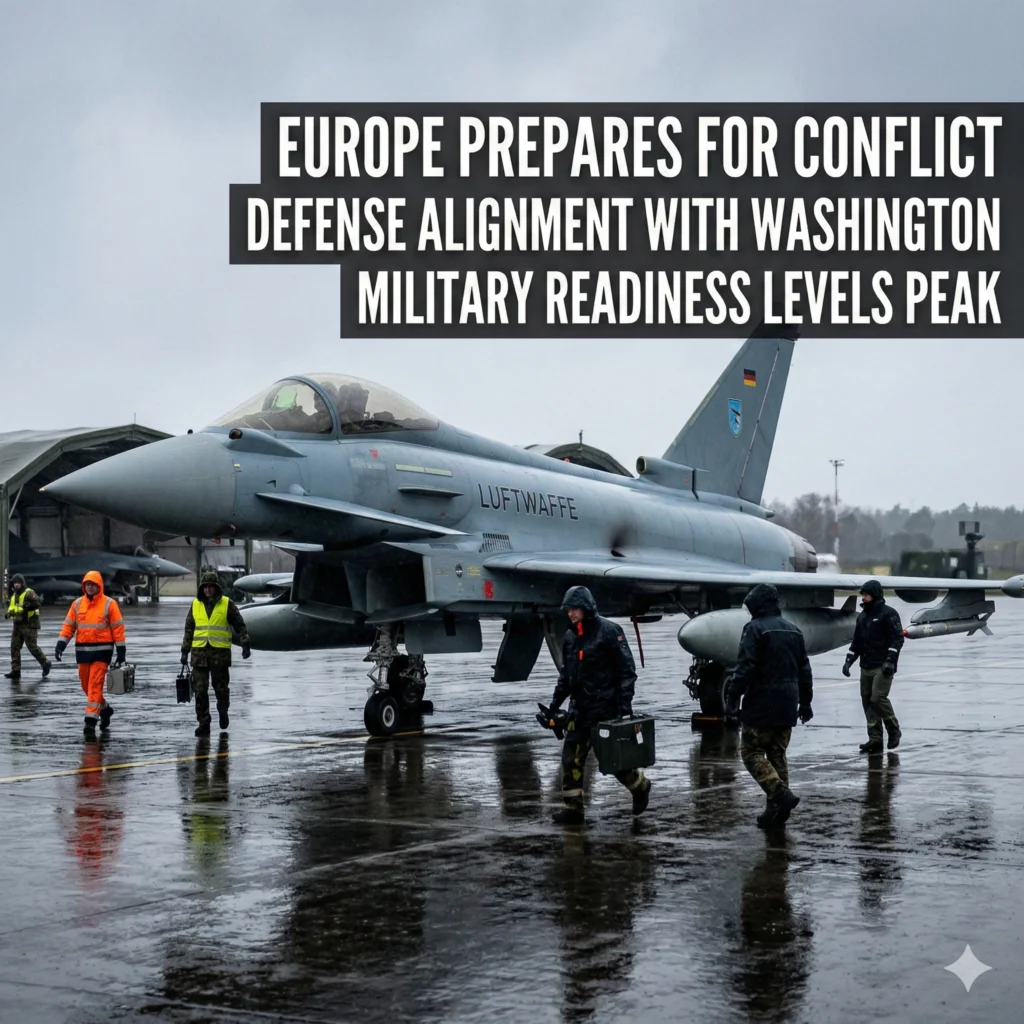
Strategic Shift as European Powers Align With Washington
The movement toward active military cooperation marks a definitive end to the era of “strategic autonomy” that previously defined European foreign policy. For years, European capitals sought to balance their relationship with Tehran through the Joint Comprehensive Plan of Action (JCPOA), but recent escalations have rendered those diplomatic frameworks obsolete. Now, European Powers Align With Washington to create a unified front capable of neutralizing long-range missile and drone capacities at their source. This alignment is not merely symbolic; it involves the integration of command structures and the sharing of high-level battlefield intelligence.
Recent statements from the “E3” nations—France, Germany, and the UK—indicate that the threshold for military intervention has been crossed. The joint declaration issued this week explicitly states that these nations are prepared to participate in strikes to destroy Iranian offensive capabilities. This decision was catalyzed by a drone strike on the British base in Cyprus and a similar attempt against a French naval installation in Abu Dhabi. When European Powers Align With Washington, it creates a formidable coalition that significantly shifts the balance of power in the Middle East and the Persian Gulf.
The role of Germany in this new coalition is particularly noteworthy under the leadership of Chancellor Friedrich Merz. Departing from previous decades of military reticence, Berlin has questioned the effectiveness of purely economic measures and is moving toward a policy of “peace through strength.” As European Powers Align With Washington, Chancellor Merz is scheduled to meet with the U.S. administration to finalize the details of German logistical and defensive support. This shift reflects a broader European realization that regional threats require a more robust and proactive military posture to ensure long-term security.
European Powers Align With Washington
The current crisis has exposed a significant structural divide within the European Union regarding the use of force. While EU foreign policy chief Kaja Kallas continues to advocate for international law and diplomatic de-escalation, the major military powers of the continent are taking a different path. These European Powers Align With Washington because they possess the actual assets and bases currently under fire in the region. The tension between the “Brussels bubble” and the sovereign decisions of Paris and London highlights the complex nature of modern European security architecture.
British Prime Minister Keir Starmer has already confirmed that UK bases, specifically those in Cyprus, will be fully available for joint operations with the United States. This logistical support is crucial for any sustained aerial campaign designed to neutralize mobile missile launchers and drone production facilities. As European Powers Align With Washington, the British base at Akrotiri has been placed on the highest security tier to repel further attacks. This proactive stance ensures that the coalition has the necessary reach to respond to threats in real-time across the entire theater of operations.
- Implementation of a unified “No-Fly Zone” over critical maritime corridors in the Persian Gulf.
- Deployment of advanced Aegis-equipped destroyers to intercept ballistic missile threats.
- Coordination of cyber-offensive operations to disable command and control networks.
- Joint training exercises between French Rafale and U.S. F-35 squadrons in the region.
The Role of National Sovereignty in Defense
The decision for European Powers Align With Washington is driven by the immediate need to protect national citizens and sovereign assets abroad. President Emmanuel Macron has emphasized that while France remains committed to global peace, it will not hesitate to defend its military personnel in Abu Dhabi. This “sovereignty-first” approach has led to a more decisive and rapid response than what could be achieved through a consensus-based EU process. By acting in concert with the United States, France can leverage superior satellite surveillance and refueling capabilities for its naval and air forces.
In Germany, the shift toward military alignment is seen as a necessary evolution of the country’s “Zeitenwende” or historical turning point. Chancellor Merz has argued that the protection of global trade routes is a vital national interest that requires a credible military deterrent. As European Powers Align With Washington, German officials are discussing the deployment of specialized air defense units to protect allied bases in the Middle East. This move marks a significant departure from Germany’s traditional role and demonstrates a new level of commitment to the transatlantic security partnership.
Furthermore, the alignment extends to the realm of electronic warfare and satellite intelligence. European Powers Align With Washington to create a “common operating picture” that allows for the instantaneous tracking of asymmetric threats. This level of technical integration is essential for modern warfare, where drone swarms and hypersonic missiles can close the distance in minutes. By pooling their technological resources, the coalition members ensure that they remain one step ahead of any potential adversary’s capabilities.
Regional Exposure and Interception Strategies
The physical proximity of European bases to the conflict zone makes the decision for European Powers Align With Washington a matter of survival. Unlike the United States, which is separated by an ocean, European nations have assets directly within the reach of regional proxies. This proximity has forced a more aggressive interception strategy, where suspicious drones are engaged long before they reach their targets. The joint coordination ensures that there are no “gaps” in the radar coverage provided by the various allied nations stationed in the Mediterranean and the Gulf.
Italian Prime Minister Giorgia Meloni has taken a pragmatic approach, focusing on the protection of Italian national interests and the safety of its citizens in the region. While Rome has been more cautious about committing to offensive strikes, it has participated in the defensive coordination efforts. As European Powers Align With Washington, Italy’s role involves securing Mediterranean shipping lanes and providing humanitarian corridors if the conflict escalates further. This multi-layered approach allows the coalition to cover all aspects of the crisis, from kinetic strikes to civil protection.
- Use of artificial intelligence to automate the identification of hostile drone signatures.
- Integration of Patriot and SAMP/T missile batteries for a unified air defense umbrella.
- Regular high-level “Situation Room” calls between the Pentagon and European defense ministries.
- Strategic positioning of carrier strike groups to provide a 360-degree deterrent.
The Diplomatic Divide and Internal EU Friction
While the major military European Powers Align With Washington, countries like Spain have remained strictly on the sidelines. Prime Minister Pedro Sánchez has prioritized de-escalation and has been vocal about the need for a UN-led solution. This internal friction within the EU makes it difficult for the bloc to speak with one voice, leading to the current situation where individual capitals are taking the lead. This trend suggests that in future high-stakes crises, the “coalition of the willing” model may become the standard for European defense.
The divergence between the institutional declarations from Brussels and the actions in Paris, Berlin, and London is a major talking point for geopolitical analysts. Some argue that this split weakens the EU’s global standing, while others see it as a natural progression toward a more realistic and tiered security system. As European Powers Align With Washington, they are effectively creating a “security core” that can act decisively without being held back by the slower diplomatic processes of the 27-member union. This evolution is likely to have long-term implications for the future of the European Project itself.
- Increased funding for the European Defense Fund to focus on high-end kinetic capabilities.
- The possible creation of a permanent “Strategic Alignment Council” outside of the formal EU structure.
- A renewed focus on NATO’s Southern Flank as a primary area of concern for European security.
- The development of a joint European-American rapid reaction force for regional crises.
Future Projections for Transatlantic Security
The long-term outlook for transatlantic relations is being reshaped as European Powers Align With Washington in this high-pressure environment. The shared experience of coordinating military responses to regional threats is forging deeper bonds between the military establishments of the E3 and the U.S. We can expect to see more permanent deployments and a more integrated defense industrial base as a result of this crisis. The “military reset” of 2026 will likely be remembered as the moment when Europe definitively chose its side in the burgeoning multipolar world.
As the situation evolves, the focus will likely shift toward post-conflict stabilization and the creation of a new regional security architecture. European Powers Align With Washington not just for the immediate strike, but for the long-term goal of preventing a wider regional conflagration. This involves complex diplomatic maneuvering with other regional players like Saudi Arabia and the UAE, who are also deeply invested in the outcome. The coalition’s success will depend on its ability to maintain unity and resolve in the face of sustained pressure and potential retaliation.
- Potential for a permanent joint naval task force in the Persian Gulf led by European and U.S. commanders.
- The expansion of the “Abraham Accords” framework to include more formal security guarantees.
- Increased cooperation on the development of next-generation laser-based defense systems.
- A shift in European energy policy to further reduce dependence on volatile regional suppliers.
Conclusion and Strategic Outlook
In conclusion, the decision for European Powers Align With Washington marks a historic turning point in global security dynamics. The alignment of France, Germany, and the UK with the United States creates a unified and powerful deterrent against regional aggression. By prioritizing sovereign defense and the protection of critical assets, these nations have shown a willingness to act decisively when their interests are threatened. The era of purely diplomatic engagement has given way to a more realistic and kinetic approach to regional stability.
The coming weeks will be critical as the coalition moves from planning to potential execution. The world is watching as European Powers Align With Washington to navigate one of the most dangerous crises of the decade. While the risks of escalation are high, the cost of inaction is seen as even greater by the leaders in Paris, Berlin, and London. This strategic alignment ensures that the West remains a potent and unified force in an increasingly uncertain world. The future of the Middle East and the transatlantic alliance hangs in the balance.
Ultimately, the crisis of 2026 has proven that the bond between Europe and America remains the bedrock of global security. As European Powers Align With Washington, they are not just responding to a threat; they are defining the new rules of international engagement for the 21st century. The move toward active military cooperation is a bold and necessary step to protect the values and interests that have defined the Western world for generations. The path forward is fraught with challenges, but the coalition stands ready to meet them with strength and unity.
For more details & sources visit: The European Conservative
For more updates about the United Kingdom, visit our UK news page.